
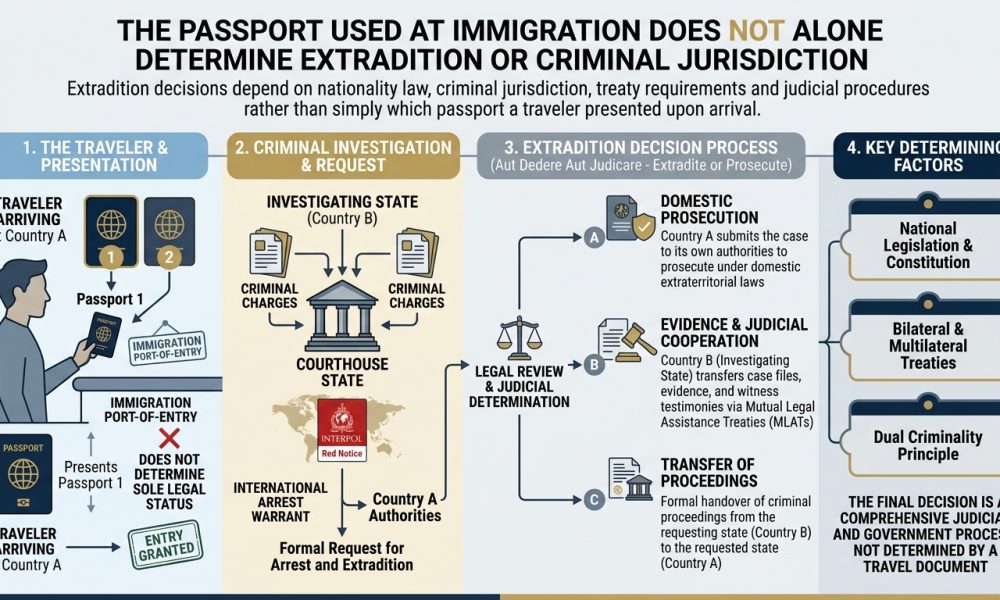
Extradition decisions depend on nationality law, criminal jurisdiction, treaty requirements, and judicial procedures, not simply which passport a traveler presents upon arrival, making accurate identity records and an understanding of international legal obligations essential for dual citizens crossing borders.
WASHINGTON, DC, November 199, 2026 — Americans holding second citizenship should understand that presenting one passport rather than another at an international immigration checkpoint does not, by itself, determine their nationality, eliminate existing criminal jurisdiction, or prevent Extradition proceedings initiated under applicable international agreements.
Although dual citizenship provides additional travel privileges, residence opportunities, and legitimate international mobility benefits, governments evaluating criminal allegations may examine citizenship records, Identification documents, treaty provisions, and judicial evidence extending far beyond the passport presented at entry.
This distinction matters more as people acquire foreign citizenship through ancestry, naturalization, marriage, or investment programs, and may face misleading assumptions about whether choosing a passport can affect their legal treatment in another jurisdiction.
International criminal proceedings involve established legal standards that passport selection alone cannot ordinarily alter, so travelers must distinguish routine border documentation procedures from the separate legal authority governing Extradition and prosecution.
Passport Presentation and Legal Nationality Are Separate Questions
A passport is an official travel and identity document issued by a government. Still, the citizenship it represents arises from nationality legislation rather than the traveler’s decision to present that document at immigration.
An American who also holds German, Mexican, Canadian, or another foreign citizenship may travel using different passports when legally appropriate. However, each nationality continues to exist under the laws that recognize it.
Consequently, presenting a Mexican passport at a foreign airport does not automatically terminate American citizenship, just as presenting an American passport does not necessarily eliminate rights or obligations associated with another legally recognized nationality.
Government authorities examining Extradition requests can therefore consider an individual’s actual nationality status regardless of which passport was used during arrival, particularly when the applicable treaty recognizes specific citizenship-based restrictions or exceptions.
Extradition Depends on Legal Authority Rather Than Immigration Records Alone
Extradition is a formal legal process through which one country requests that another surrender an individual for criminal prosecution or enforcement of a sentence, subject to applicable international agreements and domestic judicial procedures.
The U.S. Department of Justice explains in its official guidance concerning international Extradition that requests generally involve examination of relevant treaty requirements, judicial proceedings,s and an executive decision concerning whether surrender should ultimately be authorized.
The passport recorded at a traveler’s entry may help authorities establish identity and travel history. Still, it does not independently establish whether the legal requirements governing an international Extradition request have been satisfied.
Courts may instead examine the individual’s nationality, alleged criminal conduct, applicable treaty provisions, supporting evidence and potential legal objections before determining whether the person can lawfully be surrendered to another government.
Citizenship Exists Independently of the Passport Presented
Nationality ordinarily results from a legally recognized event, including birth, qualifying descent, naturalization or another acquisition procedure established by the relevant government, with passports subsequently issued as evidence of that citizenship.
For example, a person who acquires American citizenship by birth and later obtains Italian citizenship through ancestry generally retains both nationalities when permitted by applicable law, regardless of the passport selected for a particular journey.
The legal relationship continues even when one passport expires, is lost, or remains unused for several years, because the underlying nationality does not ordinarily disappear merely through changes in travel documentation.
This distinction becomes important during criminal proceedings because a court evaluating nationality protections may rely upon citizenship certificates, civil registries, naturalization records and other evidence rather than treating a passport entry stamp as conclusive.
The Country Conducting Extradition Proceedings Applies Its Own Laws
An individual with dual citizenship may face different Extradition requirements depending on where an arrest occurs, because each requested government must apply its own legislation and relevant international agreements.
A German-American dual citizen in Germany may benefit from constitutional restrictions on extraditing German nationals. In contrast, the same individual in an unrelated third country may face a different legal framework.
The third country’s courts are not automatically required to apply Germany’s domestic constitutional protections, although relevant international agreements, regional legal obligations and nationality-related provisions may still influence the proceedings.
Consequently, nationality protections cannot be treated as universally portable legal privileges, and the passport used when entering a destination does not automatically determine which country’s Extradition laws govern a subsequent request.
A Documented Extradition From Cyprus Illustrates the Distinction
The international case involving Arthur Petrov, a Russian-German dual national, shows that multiple nationalities do not necessarily prevent Extradition proceedings in a country where the individual is treated as a foreign national.
Petrov was arrested in Cyprus in August 2023 following a request from American authorities investigating alleged unlawful procurement of sensitive microelectronics, and he was subsequently extradited to the United States in August 2024.
In April 2025, The Associated Press reported on Petrov’s release during a prisoner exchange, explaining that the Russian-German national had previously been arrested in Cyprus and surrendered to American authorities despite possessing citizenship in two other countries.
The case shows that Extradition can proceed through a third country’s legal system, with the person’s citizenship and criminal allegations examined under the applicable framework rather than automatically resolved by multiple passports.
Border Entry Records Can Still Be Relevant Evidence
Although passport presentation does not determine criminal jurisdiction by itself, immigration records may help establish an individual’s location, movements, identity and dates of entry during an investigation or subsequent judicial proceeding.
Airline passenger information, border inspection records and travel documentation may therefore become relevant when prosecutors or defense attorneys examine whether a person was present in a particular country at a legally significant time.
Such records must be evaluated according to applicable evidentiary rules, and a passport stamp cannot automatically establish criminal responsibility, particularly when the underlying allegations concern conduct unrelated to the individual’s international movements.
The distinction is that immigration documentation can provide factual evidence, while the authority to prosecute or extradite arises from separate criminal laws, international agreements, and judicial determinations.
Dual Nationals May Be Recognized Differently Across Jurisdictions
Some governments permit dual nationality without substantial restrictions. In contrast, others limit recognition of additional citizenship or require individuals to use domestically issued passports when entering and departing their country of nationality.
These differences can affect immigration processing and consular assistance, but they do not necessarily establish the legal outcome of a criminal case because Extradition involves additional statutory and treaty requirements.
A person recognized as a citizen by one government may be treated as a foreign national by another, particularly when the second country has no independent nationality relationship with that individual.
For Extradition purposes, the requested country’s classification of nationality must be assessed alongside the particular legal provisions governing surrender, rather than inferred solely from the identity document accepted during routine immigration inspection.
Nationality-Based Extradition Restrictions Require Independent Verification
Certain national constitutions and Extradition laws restrict surrender of domestic citizens to foreign governments, creating potential legal protections that may be relevant when the requested person possesses multiple nationalities.
Germany provides an important example because Article 16 of its Basic Law generally restricts Extradition of German citizens while recognizing specified exceptions involving European Union member states and international courts.
Brazil establishes a different framework by distinguishing certain Extradition protections applicable to Brazilian citizens by birth from exceptions involving naturalized citizens and specified criminal allegations.
These distinctions show that nationality classification can be legally significant, although the relevant Protection depends on constitutional provisions, citizenship acquisition history, and the location of the individual facing proceedings.
Citizenship by Birth and Naturalization Can Affect Legal Analysis
Countries do not always treat citizens by birth and naturalized citizens identically when evaluating nationality-based Extradition restrictions, making the precise legal basis of citizenship relevant to some international criminal proceedings.
A citizenship certificate issued after naturalization may establish the individual’s nationality, but the acquiring government’s legislation may attach specific surrender conditions to offenses allegedly committed before naturalization.
By contrast, citizenship recognized from birth may carry a different constitutional classification, although this distinction cannot be assumed to apply uniformly across countries that permit citizenship by descent.
For individuals obtaining second passports through ancestry, the relevant question is how the issuing government legally classifies their citizenship, not simply whether the individual obtained a passport as an adult.
The Timing of Citizenship Acquisition Can Matter
An Extradition request may involve allegations concerning conduct that occurred before the requested person obtained another nationality, creating legal questions about whether the new citizenship affects applicable restrictions against surrender.
Some national laws expressly address offenses committed before naturalization, while particular Extradition treaties may contain provisions defining which citizenship status matters at a legally relevant stage of the proceedings.
Acquiring citizenship after criminal allegations arise does not automatically invalidate the new nationality. Still, it also does not necessarily provide every constitutional Protection available to citizens under the requested country’s Extradition framework.
Determining the legal consequences requires reviewing citizenship records, the date of the alleged conduct, domestic legislation, and the particular treaty governing the international surrender request.
Criminal Jurisdiction Can Exist Without Physical Presence
A government may possess criminal jurisdiction over certain conduct committed outside its territory when applicable legislation recognizes extraterritorial authority, including offenses affecting domestic interests or involving specified international criminal activities.
The United States exercises extraterritorial jurisdiction under specific statutes, while other governments recognize jurisdictional principles tied to nationality, victims, protected interests, or international treaty obligations.
Consequently, an individual entering another country using a foreign passport does not necessarily affect whether American prosecutors have jurisdiction over allegations involving conduct covered by federal criminal legislation.
Courts must still determine whether the relevant law reaches the alleged conduct and whether the prosecution satisfies procedural and constitutional requirements, making jurisdiction a substantive legal question rather than a passport-processing decision.
Territorial Jurisdiction Remains an Important Principle
Countries generally possess authority to prosecute offenses committed within their territory, subject to relevant domestic law and international legal limitations, even when the accused person holds citizenship elsewhere.
An American dual citizen accused of committing a qualifying offense in another country may therefore face prosecution under that country’s criminal legislation regardless of which passport was presented upon arrival.
Similarly, an individual who allegedly commits an offense within the United States may remain subject to American criminal jurisdiction after departing the country and acquiring additional citizenship.
Nationality may influence consular treatment or available Extradition objections, but it does not ordinarily eliminate territorial criminal jurisdiction over conduct that properly falls within a government’s legislative authority.
Extradition Requires More Than a Foreign Arrest Warrant
An arrest warrant issued by one country does not automatically compel another government to surrender the person named in it, because international Extradition generally requires additional legal review.
The requested government may examine treaty coverage, the identity of the individual sought, the nature of the alleged offense, and the supporting evidence required under its domestic legal framework.
Depending upon the applicable agreement, authorities may also consider dual criminality, nationality exceptions, political offense provisions and other restrictions that determine whether surrender is legally permissible.
The passport used during entry may help establish identity. Still, the judicial decision must be based on the applicable legal requirements rather than the assumption that immigration documentation alone establishes extraditability.
Dual Criminality Can Determine Whether Surrender Is Permitted
Many Extradition treaties require that the conduct underlying a request constitute a qualifying criminal offense under the laws of both the requesting and requested countries.
The relevant comparison generally concerns the substance of the alleged conduct rather than requiring identical statutory titles, since different legal systems often classify comparable criminal behavior under different legislative provisions.
A foreign fraud allegation may therefore satisfy dual criminality requirements even when the requested country uses different legal terminology, provided the conduct meets the conditions set out in the applicable Extradition agreement.
Conversely, meaningful differences between criminal laws may create legitimate legal objections, showing that the alleged conduct and governing treaty provisions matter more than the passport presented at border inspection.
Interpol Red Notices Do Not Establish Criminal Jurisdiction
Interpol Red Notices facilitate international cooperation by asking participating law enforcement agencies to locate individuals sought for prosecution or enforcement of criminal sentences. Still, they do not constitute universally enforceable arrest warrants.
Each country determines the legal effect of such notices under domestic legislation, so an international alert differs from a court’s independent determination that detention or Extradition is authorized.
A traveler possessing multiple passports may be identified through legitimate law enforcement information systems. Still, nationality documentation does not automatically determine whether a Red Notice satisfies local requirements for provisional arrest.
The relevant legal assessment concerns the underlying request and the authority of the jurisdiction involved, rather than an assumption that passport selection either activates or defeats international police cooperation.
Biometric Identification Can Connect Multiple Travel Documents
Modern passports incorporate identity information and, in many cases, electronic chips containing biometric data intended to improve document verification and establish a reliable connection between the passport and its authorized holder.
Where legally permitted, authorities may compare biometric information with existing records to investigate identity questions involving individuals who possess several national travel documents or have undergone lawful name changes.
These systems do not establish guilt or determine Extradition eligibility on their own. Still, they can support identity verification when courts must establish that the person detained is the person sought.
Consequently, legitimate second citizenship should be understood as an additional nationality relationship rather than a means of creating an unrelated identity disconnected from legally relevant historical records.
Lawful Name Changes Do Not Automatically Terminate Legal Proceedings
A person who changes names through marriage, court proceedings, or another authorized mechanism may receive updated passports and citizenship documentation, but the change does not ordinarily extinguish preexisting legal responsibilities.
Immigration agencies, criminal courts and other authorized institutions may examine supporting records connecting previous and current names when resolving questions involving identity, nationality and the enforcement of existing judicial decisions.
The evidentiary value of those documents depends upon applicable rules, and any identity determination must be supported by reliable information rather than assumptions based upon similarities between names or travel records.
For international citizenship applicants, maintaining accurate documentary continuity is essential because inconsistent or misleading identity information can complicate legitimate immigration procedures and criminal justice inquiries.
Provisional Arrest Can Occur Before Final Extradition Review
SomeExtraditionn agreements permit provisional arrest under specified urgent circumstances, allowing authorities to temporarily detain a requested person while the requesting government prepares the formal documentation necessary for Extradition proceedings.
Such detention must comply with applicable national laws and treaty conditions, and the requesting government may face deadlines to submit additional information required to continue the proceedings.
Provisional arrest does not establish guilt or guarantee subsequent surrender, because courts and other competent authorities must still examine the substantive and procedural requirements governing the international request.
This distinction matters for dual nationals because the legal basis for initial detention may differ from the later determination of whether Extradition is permitted.
European Citizenship Introduces Additional Regional Protections
European Union citizenship may create additional rights and procedural considerations when a member state receives an Extradition request from a non-EU country concerning a citizen of another member state.
Judicial decisions within the European legal framework have addressed the relationship between free movement, nationality discrimination and the opportunity for a citizen’s home member state to consider appropriate criminal proceedings.
These protections do not establish an automatic prohibition against Extradition to non-European jurisdictions, because surrender may remain legally possible after the relevant consultation and judicial requirements have been satisfied.
The applicable European framework must therefore be evaluated separately from national passport rules, particularly when a dual national enters a European country where the individual lacks domestic citizenship.
Consular Assistance Does Not Control Extradition Decisions
American citizens detained overseas may seek assistance from United States consular officials, including information concerning local legal representation and permitted communication with family members, subject to the receiving country’s applicable rules.
However, consular personnel ordinarily cannot compel foreign courts to dismiss Extradition proceedings or require law enforcement agencies to disregard valid judicial orders simply because the detained individual holds an American passport.
When the person also holds citizenship in the detaining country, local authorities may impose additional limitations on consular access, depending upon nationality legislation and relevant international agreements.
The availability of consular assistance should therefore be distinguished from the separate authority of courts and executive officials to determine whether an Extradition request satisfies the applicable legal requirements.
Judicial Proceedings Must Establish the Identity of the Requested Person
A fundamental issue in Extradition proceedings is whether the individual appearing before the court is actually the person identified in the requesting government’s documents, particularly when several passports or historical names are involved.
Authorities may rely upon authentic travel documents, photographs, fingerprints, citizenship records, and other admissible evidence to examine identity, subject to the safeguards established by the requested jurisdiction.
An individual’s possession of multiple legitimate passports does not automatically establish fraud or criminal conduct, because dual nationality is recognized under the laws of numerous countries and may arise through ordinary family circumstances.
Nevertheless, conflicting identity information may require further examination, showing why accurate records and independent legal representation remain important when nationality questions intersect with international criminal proceedings.
A Refusal to Extradite May Leave Criminal Charges Unresolved
When a government refuses to surrender one of its citizens, the refusal generally concerns the international transfer request rather than necessarily establishing that the foreign allegations are unfounded or permanently extinguished.
The requesting government may retain its criminal jurisdiction and outstanding charges, while the requested country may separately examine whether domestic prosecution is available under its laws and international obligations.
In some circumstances, treaties or conventions provide mechanisms to submit allegations to local prosecuting authorities when Extradition is refused on nationality grounds, although prosecution remains subject to independent legal requirements.
These distinctions reinforce that a passport presented during immigration inspection cannot settle broader questions of criminal responsibility, jurisdiction, or the ongoing validity of judicial proceedings.
Extradition and Immigration Removal Are Different Processes
Extradition involves formal international surrender for criminal proceedings, while immigration removal ordinarily concerns a government’s authority to require foreign nationals to depart under applicable immigration legislation and administrative procedures.
Although both processes can involve transportation across international borders, they arise under different legal frameworks and may provide different procedural protections, including distinct requirements concerning evidence and judicial review.
A dual citizen’s nationality may influence whether immigration removal is available in a particular jurisdiction, but that classification does not automatically establish whether Extradition is prohibited or authorized.
Governments must therefore apply the appropriate legal procedures to the circumstances involved, rather than treating ordinary immigration decisions as interchangeable with formal criminal surrender determinations.
Citizenship Planning Requires Legal Accuracy
A second passport can provide legitimate opportunities involving international residence, employment, family settlement, and expanded travel privileges. Still, those benefits should be considered independently of any ongoing criminal investigation or outstanding judicial obligation.
Amicus International Consulting examines related issues in its discussion of Interpol Red Notices and international legal procedures, emphasizing the importance of understanding international enforcement mechanisms and applicable legal requirements.
Individuals facing Extradition proceedings should seek advice from attorneys qualified in the relevant jurisdictions, because citizenship consultants cannot guarantee outcomes determined by courts, governments, and international agreements.
The appropriate objective is lawful international mobility supported by authentic documentation and realistic legal expectations, not the assumption that a particular passport can change a government’s authority to investigate criminal allegations.
The Same Individual May Face Different Outcomes in Different Countries
International Extradition laws vary among jurisdictions, meaning a person may qualify for nationality-based Protection in one country while facing a legally permissible surrender request in another where those restrictions do not apply.
This variation does not establish that individuals can determine their own criminal jurisdiction through travel-document selection, because each government applies its legislation and international obligations to the circumstances before it.
The outcome may depend upon where the individual is located, which country requests surrender, the nature of the alleged offense, and the legal classification of citizenship under the requested state’s rules.
These considerations explain why dual nationals require jurisdiction-specific legal analysis rather than simplified assurances based on visa-free travel privileges, the appearance of a passport or the country that issued it.
International Travel Requires More Than Valid Passport Documentation
Dual nationals planning international travel should understand each country’s entry and departure requirements, while also recognizing that existing criminal proceedings may create obligations beyond routine immigration processing.
Authentic passports, accurate citizenship records, and compliance with local border procedures support lawful international mobility. Still, none of these measures alone resolves outstanding warrants, establishes innocence, or prevents authorized Extradition proceedings.
When legal disputes arise, independent representation is essential to determine which judicial procedures apply, whether nationality protections are available, and how relevant treaties affect the government’s authority to seek surrender.
The broader principle is that immigration authorities examine a traveler’s admission documentation, while Extradition proceedings require additional decisions concerning identity, jurisdiction, evidence, and international legal obligations.
Conclusion: Criminal Jurisdiction Cannot Be Chosen Through Passport Presentation
The passport used at an international border can influence routine immigration processing and provide relevant evidence of travel. Still, it does not alone determine nationality, criminal jurisdiction,o r the outcome of a subsequent Extradition request.
The Arthur Petrov case illustrates how international criminal proceedings can involve individuals possessing multiple nationalities, with third-country authorities applying their own Extradition framework rather than treating citizenship documentation as an automatic barrier to surrender.
For Americans and other dual nationals, understanding the distinction between passport presentation and underlying legal status is essential to avoiding mistaken assumptions about international criminal jurisdiction and the protections available under applicable treaties.
Ultimately, second citizenship can expand lawful opportunities for international mobility, residence and family planning. Still, extradition decisions remain governed by nationality law, criminal legislation, treaty provisions and judicial procedures rather than the passport selected at immigration.




