
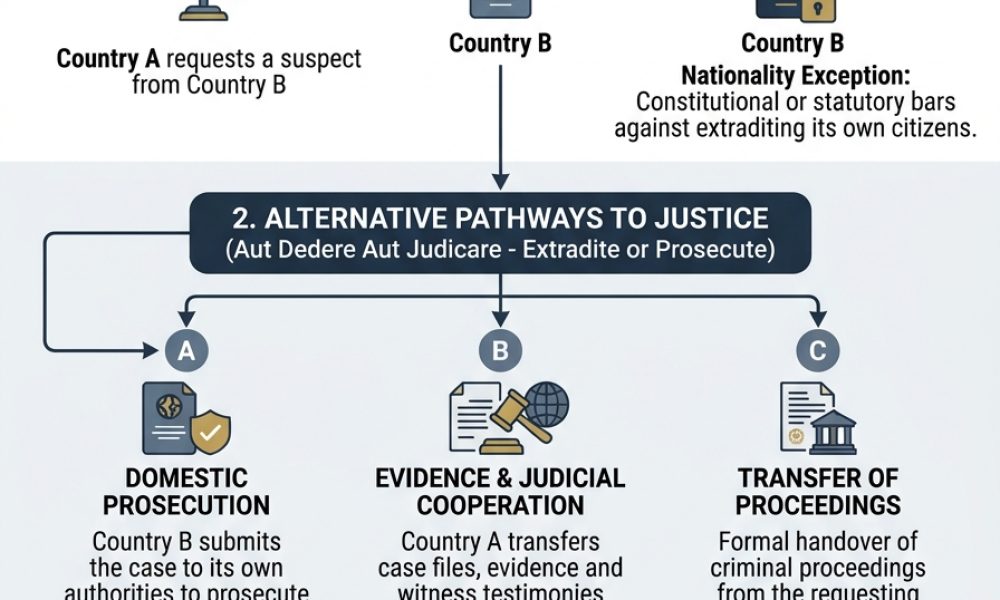
Countries that decline to surrender their own nationals may still pursue domestic prosecution or other judicial cooperation, depending on their laws and international obligations, showing that nationality-based Extradition restrictions do not necessarily eliminate criminal accountability.
WASHINGTON, DC, November 19, 2026 — Foreign governments that refuse to extradite their own citizens to the United States may nevertheless investigate the alleged criminal conduct, initiate domestic prosecutions, exchange evidence with American authorities, or pursue alternative judicial arrangements under applicable national legislation and international agreements.
Although constitutional protections against Extradition can prevent the physical surrender of individuals to foreign governments, those restrictions generally concern where criminal proceedings may occur rather than establishing immunity from investigation, prosecution or punishment for offenses allegedly committed abroad.
The distinction has become particularly important for individuals with multiple nationalities, including Americans who acquire citizenship through ancestry, marriage, naturalization, or investment programs and then face questions about the international legal responsibilities attached to their additional nationality.
International criminal justice authorities increasingly distinguish between refusing an Extradition request and refusing to pursue accountability, recognizing that domestic prosecution may provide an alternative when national constitutions, Extradition treaties, or other legal restrictions prevent surrender.
Refusing Extradition Does Not Automatically Close a Criminal Case
Extradition is the formal procedure through which one government requests that another surrender an individual for criminal prosecution or enforcement of a sentence. In contrast, domestic prosecution involves legal proceedings undertaken by the country where the individual remains.
When Extradition is refused because the requested person possesses local citizenship, prosecutors in that country may examine whether their domestic laws authorize criminal proceedings concerning conduct allegedly committed outside their national territory.
Such authority depends upon the country’s criminal jurisdiction rules, applicable international conventions, evidentiary requirements and the circumstances surrounding the alleged offense, meaning domestic prosecution cannot be presumed available simply because Extradition has been denied.
The refusal of an Extradition request therefore reflects a decision on international surrender rather than necessarily establishing that the underlying allegations are unfounded, that an arrest warrant has been canceled, or that further investigation is legally prohibited.
U.S. Authorities Recognize Domestic Prosecution as an Alternative
The United States Department of Justice acknowledges that nationality restrictions can prevent Extradition from certain jurisdictions and that American prosecutors may explore domestic prosecution by foreign authorities when surrender is unavailable under applicable law.
The department’s official guidance on international Extradition and related matters explains that prosecutors must coordinate with the Office of International Affairs when considering alternatives, including requesting that another country prosecute an individual who cannot be extradited.
This process requires careful coordination because American prosecutors cannot simply transfer a criminal case to a foreign court without examining the requested jurisdiction’s authority, available evidence, and applicable procedures for initiating domestic proceedings.
The Justice Department also recognizes that requesting foreign prosecution can involve strategic considerations concerning future Extradition cooperation, making consultation with authorized federal officials essential before American prosecutors pursue that alternative.
The Principle of Extradite or Prosecute Shapes International Cooperation
International criminal law recognizes the principle commonly expressed as aut dedere aut judicare, meaning extradite or prosecute, which appears in particular treaties and international conventions addressing offenses that governments have agreed to investigate and punish.
Under applicable agreements, a country that refuses to extradite an individual may be required to submit the matter to its competent prosecuting authorities, allowing domestic officials to determine whether criminal proceedings are legally justified.
The principle does not establish an identical universal obligation for every offense because its application depends upon specific treaty commitments, domestic implementation, jurisdictional requirements, and the conduct covered by the relevant international instrument.
Importantly, submitting a case to prosecuting authorities does not guarantee that charges will be filed or that a conviction will follow, since domestic prosecutors must still apply their own evidentiary standards and legal requirements.
International Conventions Can Require Referral for Prosecution
The United Nations Convention against Transnational Organized Crime provides an important example because Article 16 addresses circumstances in which a state refuses Extradition solely because the requested person is one of its nationals.
Under the relevant provisions, a state party receiving a qualifying request must submit the case to its competent authorities without undue delay for possible prosecution, subject to the Convention’s conditions and applicable domestic law.
Those authorities must consider the matter through appropriate national procedures. Still, the obligation to submit the case does not automatically remove prosecutorial discretion or establish that the allegations satisfy the requirements for criminal charges.
Similar extradite-or-prosecute provisions appear in other international agreements addressing designated offenses, showing that refusing to surrender a citizen may trigger additional obligations rather than ending international criminal justice cooperation.
Germany Illustrates the Difference Between Extradition and Prosecution
Germany’s constitutional framework generally prohibits extraditing German citizens to foreign countries, subject to statutory exceptions involving European Union member states and certain international courts under conditions that protect fundamental legal principles.
That constitutional restriction does not independently prohibit German prosecutors from investigating offenses committed overseas, because German criminal legislation recognizes specified circumstances in which domestic courts may exercise jurisdiction over conduct occurring outside Germany.
A German-American dual citizen facing allegations originating in the United States may therefore face separate legal questions about constitutional Extradition protections and whether German authorities have jurisdiction to investigate the alleged criminal conduct.
The answers depend on the specific offense, relevant German criminal provisions, available evidence, and applicable international agreements, rather than on the assumption that German citizenship automatically prevents all criminal proceedings connected to events abroad.
France Has Demonstrated the Domestic Prosecution Alternative
France provides another important example because its Extradition legislation generally restricts the surrender of French citizens to foreign countries. In contrast, French criminal law permits prosecution of qualifying offenses committed abroad under specified jurisdictional conditions.
In a widely discussed case involving a French citizen accused of offenses connected to Japan, French authorities argued that the individuals involved could face domestic proceedings rather than being automatically surrendered to Japanese authorities.
The case attracted international attention because it showed how nationality restrictions can influence where criminal proceedings take place while leaving open the possibility of accountability through another country’s judicial system.
However, French domestic prosecution remains subject to jurisdictional and evidentiary rules, and French citizenship does not require prosecutors to accept every foreign allegation or automatically initiate criminal proceedings.
Romania Provides an Express Legislative Mechanism
Romanian legislation concerning international legal assistance in criminal matters provides a particularly clear example of domestic prosecution following an Extradition refusal involving a Romanian citizen or qualifying political refugee.
Under specified conditions, a refusal based on nationality or protected status can require Romanian authorities, following a request from the foreign government, to submit the matter to competent judicial authorities for possible prosecution.
The statutory framework recognizes that protecting individuals against international surrender does not necessarily require abandoning allegations that might properly be examined under Romanian criminal law and established judicial procedures.
Nevertheless, domestic proceedings depend on applicable legal requirements, including jurisdiction, evidence, prosecutorial decisions, and procedural safeguards, rather than on the existence of a foreign criminal accusation alone.
Costa Rica Demonstrates How Extradition Policies Can Change
Costa Rica historically maintained restrictions against extraditing its own citizens, but constitutional changes adopted in 2025 permitted surrender in specified cases involving international drug trafficking and terrorism, substantially altering the country’s established legal framework.
On March 20, 2026, Reuters reported Costa Rica’s first Extradition of its own nationals to the United States, following the transfer of former Supreme Court justice Celso Gamboa and another individual facing international narcotics trafficking allegations.
The development demonstrated that nationality protections are not necessarily permanent, particularly when governments respond to organized crime concerns through constitutional amendments, new legislation and revised arrangements for cooperation with foreign prosecutors.
For individuals examining citizenship-based Extradition restrictions, Costa Rica illustrates why current legal verification matters more than historical descriptions of countries that previously refused to surrender their own citizens under virtually all circumstances.
Domestic Prosecution Requires Independent Criminal Jurisdiction
Before domestic authorities can prosecute conduct allegedly committed abroad, they must establish an appropriate jurisdictional basis under their own criminal legislation, which may recognize nationality, territorial connections, or particular protected interests.
The nationality principle allows some countries to prosecute their citizens for specified offenses committed outside national territory. However,h applicable conditions can include dual criminality, the seriousness of the offense, or additional statutory requirements.
Other jurisdictional principles may apply when alleged conduct affects domestic victims, national security interests, international obligations or offenses subject to recognized forms of extraterritorial criminal jurisdiction under applicable legislation.
These jurisdictional rules differ considerably among countries, so it is essential to distinguish the legal possibility of domestic prosecution from the conclusion that every foreign criminal accusation can automatically be transferred to another country’s courts.
Foreign Evidence Must Satisfy Domestic Legal Standards
When a government considers prosecuting an individual for conduct investigated abroad, domestic prosecutors may need evidence collected by foreign investigators, including documents, witness statements, financial records and forensic materials.
That evidence must be obtained, transmitted, and evaluated according to applicable legal requirements, which can differ substantially between the requesting government and the country considering domestic prosecution.
Material gathered during an American criminal investigation may therefore require additional verification, translation, authentication or procedural review before it can support charges in a foreign court operating under different evidentiary rules.
The difficulties of transferring admissible evidence explain why some Extradition refusals do not lead to successful domestic prosecutions, even when both governments express willingness to investigate the alleged conduct.
Mutual Legal Assistance Supports Cross-Border Investigations
Mutual legal assistance arrangements allow governments to request help obtaining evidence, interviewing witnesses, securing records and completing other authorized investigative measures when criminal proceedings involve several national jurisdictions.
These arrangements may operate through bilateral treaties, multilateral conventions, or domestic cooperation legislation, depending on the countries involved and the type of assistance requested.
A government that refuses to extradite its citizen may nevertheless cooperate with foreign investigators through appropriate legal channels, provided the requested assistance complies with domestic law and applicable international commitments.
For example, properly authorized requests may seek financial records or testimony relevant to an overseas fraud investigation, even when the individual under investigation remains protected against physical surrender under a nationality-based Extradition restriction.
Financial Crimes May Be Investigated Across Multiple Jurisdictions
International fraud, corruption, money laundering and related offenses frequently involve transactions, communications or assets located across several countries, making domestic prosecution a potentially important alternative when international Extradition is unavailable.
A person accused of financial misconduct in the United States may remain subject to investigation abroad if the country of residence possesses legal jurisdiction and receives sufficient admissible evidence concerning the alleged conduct.
Cross-border banking records, corporate documents, and electronic communications can assist investigators, although lawful access to such materials depends on privacy protections, judicial authorization, and applicable international cooperation procedures.
Financial relationships across multiple jurisdictions do not, by themselves, demonstrate wrongdoing, but they can create complex evidentiary questions when prosecutors investigate alleged conduct involving international transactions and foreign business entities.
Criminal Accountability and Extradition Are Separate Legal Questions
A country’s constitutional refusal to surrender its citizens restricts a particular form of international cooperation. Still, it does not necessarily determine whether those citizens may be investigated or prosecuted domestically.
This distinction matters because Extradition proceedings evaluate the legality of transferring an individual, whereas criminal trials examine allegations through the substantive criminal law and procedural safeguards of the prosecuting jurisdiction.
A person may successfully oppose Extradition on nationality grounds while remaining subject to an independent domestic investigation, provided national authorities have jurisdiction and meet the legal conditions for prosecution.
Conversely, domestic authorities may decline prosecution despite an Extradition refusal when evidence is insufficient, jurisdiction is unavailable, or other legitimate legal considerations prevent criminal proceedings from moving forward.
A Foreign Arrest Warrant May Remain Relevant
Refusing Extradition does not ordinarily require the requesting country to cancel its domestic arrest warrant, terminate pending charges, or abandon criminal proceedings. However, the continuing legal effect depends upon applicable legislation and judicial decisions.
An individual may therefore remain wanted in the requesting jurisdiction despite a separate country’s determination that surrender is prohibited under its nationality laws or relevant treaty provisions.
The requesting government may continue pursuing authorized judicial procedures while the person remains abroad, including seeking evidence, maintaining charges, or evaluating whether other lawful forms of cooperation are available.
These circumstances explain why a nationality-based Extradition refusal should not be represented as an international declaration of innocence or as a guarantee that criminal proceedings have been permanently concluded.
Interpol Notices Operate Independently From Extradition Decisions
Interpol Red Notices are international requests to locate individuals wanted for prosecution or to serve criminal sentences. Still, they are not international arrest warrants and do not independently authorize detention in every participating country.
Each jurisdiction applies its own laws when deciding whether an international notice provides grounds for provisional arrest or further judicial action, making domestic legal authority essential to determining the notice’s practical effect.
A refusal to extradite may influence how a government treats a particular international request. Still, it does not automatically eliminate the underlying notice or require other countries to reach the same conclusion.
Individuals challenging potentially improper notices must use the applicable review mechanisms and legal procedures, rather than assuming that recognition of another citizenship automatically cancels international police information circulated through authorized channels.
European Judicial Cooperation Creates Additional Possibilities
European Union member states operate specialized judicial cooperation arrangements, including the European Arrest Warrant, which can permit surrender between participating countries under conditions distinct from ordinary Extradition requests originating outside the European Union.
The European framework also includes principles intended to prevent impunity while protecting fundamental rights and respecting the limitations imposed by applicable European legislation and national constitutional arrangements.
In certain circumstances, European courts have examined whether the member state of a requested person’s nationality should receive an opportunity to pursue proceedings before another country grants Extradition to a non-European government.
These decisions show that nationality protections may interact with alternative judicial arrangements, although their application depends on European law, the person’s citizenship, and the specific circumstances surrounding the Extradition request.
A Domestic Prosecution Is Not Guaranteed Following Refusal
The existence of an international obligation to submit a prosecution case should not be confused with an automatic obligation to file criminal charges, because competent authorities must still assess the matter under applicable domestic standards.
Prosecutors may examine whether their courts have jurisdiction, whether the evidence is legally admissible, whether the alleged offense satisfies national criminal definitions, and whether any procedural barriers prevent the case from proceeding.
In some circumstances, domestic authorities may determine that the legal conditions for prosecution have not been met, even if a foreign government continues to believe the individual committed an offense.
The distinction preserves important protections associated with the presumption of innocence and independent judicial decision-making, ensuring that Extradition refusals do not automatically convert foreign accusations into domestic convictions.
Human Rights Protections Can Affect International Cooperation
Extradition requests may be refused for reasons unrelated to citizenship, including concerns involving torture, political persecution, discriminatory prosecution, or other circumstances protected under relevant national laws and international human rights obligations.
When such concerns arise, governments must evaluate whether domestic prosecution or other forms of cooperation are legally appropriate without undermining the safeguards that justified refusing surrender.
A refusal based on an identified human rights risk does not necessarily mean authorities must disregard all alleged criminal conduct. Still, it also does not authorize authorities to disregard the individual’s legal protections.
Authorities must therefore assess every alternative under the relevant jurisdiction’s laws, applicable international commitments, and the individual’s procedural rights, rather than assuming one form of international cooperation can freely replace another.
Criminal Proceedings May Continue After Citizenship Acquisition
Individuals who acquire another nationality after becoming involved in legal proceedings should recognize that naturalization does not automatically terminate existing criminal charges or prevent competent authorities from examining previously alleged conduct.
Some countries distinguish citizens by birth from naturalized citizens when applying Extradition restrictions, while others use different nationality rules that may make the timing of citizenship acquisition relevant.
The relationship between nationality and criminal jurisdiction requires separate analysis because an individual’s ability to remain within the country of citizenship does not necessarily eliminate that country’s authority to investigate conduct committed abroad.
Any claim that newly acquired citizenship automatically extinguishes criminal liability should therefore be treated cautiously, especially when prosecutors retain jurisdiction or international conventions establish obligations concerning particular offenses.
Second: Citizenship Does Not Confer Immunity From Investigation
An additional passport can confer valuable rights to reside, travel, work, and settle a family. Still, it cannot be treated as a legal instrument that automatically cancels criminal investigations or foreign judicial proceedings.
Citizenship protections against Extradition operate within particular constitutional or legislative frameworks, making them fundamentally different from diplomatic immunity, freedom from prosecution, or a judicial determination that allegations are unfounded.
Individuals should also recognize that legitimate changes of name or citizenship do not necessarily eliminate earlier identity records, which may remain legally relevant to criminal proceedings and official documentation requirements.
Responsible citizenship planning must therefore preserve accurate legal records and comply with applicable obligations, rather than relying upon unsupported claims that a new passport can create immunity from international law enforcement cooperation.
Amicus International Consulting and International Legal Awareness
The distinction between Extradition restrictions and criminal prosecution is particularly important for internationally mobile individuals who must evaluate how nationality, residence, and overseas legal proceedings interact across different jurisdictions.
Amicus International Consulting discusses related considerations in its overview of Interpol Red Notices and international legal procedures, providing context for understanding the relationship between international police information and cross-border criminal justice concerns.
For individuals considering additional nationality, a responsible advisory process should distinguish legitimate citizenship benefits from legal questions requiring direct examination by qualified criminal defense or Extradition attorneys.
Citizenship advisers can explain general mobility considerations, but they should not guarantee the cancellation of criminal allegations, immunity from international proceedings, or Protection against domestic prosecution following an Extradition refusal.
Extradition Refusal May Leave Several Questions Unresolved
When a government refuses Extradition, the requesting state may retain jurisdiction over the alleged criminal conduct. At the same time, the requested country must separately determine whether any domestic criminal proceedings are authorized or required.
This can leave unresolved questions concerning evidence transmission, prosecutorial discretion, applicable limitations periods, and whether another country may exercise jurisdiction under its own laws if the individual later travels internationally.
A refusal decision may also concern only a particular request, treaty provision,n or nationality classification, meaning its legal effect should not be generalized beyond the actual judgment and governing circumstances.
These distinctions are essential for accurate reporting because an unsuccessful Extradition request does not necessarily establish permanent immunity from prosecution, just as continued investigation does not establish guilt.
Legal Counsel Must Examine Both Countries’ Laws
Individuals facing international criminal allegations require advice from appropriately qualified lawyers familiar with the requesting country’s criminal proceedings and the requested country’s nationality, Extradition, and jurisdictional rules.
The analysis should identify whether local citizenship prevents surrender, whether domestic prosecution is legally available, and whether international agreements impose additional obligations regarding evidence sharing or referral to prosecuting authorities.
Counsel must also consider the precise criminal allegations, relevant procedural history, and any applicable human rights protections, because generalized statements about a country’s Extradition policy cannot resolve individual cases.
Obtaining accurate legal advice is especially important when authorities in different jurisdictions reach separate decisions on prosecution or surrender, creating overlapping obligations that require coordinated professional representation.
International Cooperation Can Continue Without Physical Surrender
Modern international criminal justice cooperation extends beyond Extradition because national authorities may exchange evidence, coordinate investigations, and provide judicial assistance through lawful mechanisms that do not require an accused individual to cross borders.
These procedures allow governments to pursue legitimate investigative objectives while respecting nationality restrictions and other protections that may prevent surrender, although every requested measure remains subject to applicable legal authorization. Alternative cooperation mechanisms also explain why countries maintaining constitutional protections against extraditing citizens can continue participating in international efforts against organized crime, corruption, and other serious offenses.
Nevertheless, cooperation must not be confused with an automatic obligation to prosecute, because domestic authorities remain responsible for applying their criminal laws and preserving the procedural safeguards available to individuals accused of wrongdoing.
Citizenship Planning Should Not Depend on Extradition Assumptions
Second citizenship can provide meaningful international opportunities involving residence, employment, education, family mobility and long-term financial planning. Still, those benefits should be evaluated independently of unsupported assumptions concerning Extradition and criminal liability.
Prospective applicants should distinguish a country’s historical reluctance to extradite its nationals from the current legal framework governing domestic prosecutions, mutual legal assistance and nationality-based exceptions under applicable agreements.
The examples involving Germany, France, Romania, and Costa Rica show that different legal systems approach these issues through distinct constitutional provisions, criminal jurisdiction rules, and international cooperation mechanisms.
For individuals evaluating additional nationality in 2026, the central consideration is whether the citizenship offers genuine lawful advantages, while recognizing that criminal accountability may remain possible through Extradition.
Conclusion: Refusing Extradition Does Not Guarantee Freedom From Prosecution
A foreign government’s refusal to extradite one of its citizens can prevent immediate surrender to the United States. Still, that decision does not necessarily terminate criminal proceedings or eliminate opportunities for domestic prosecution under applicable law.
International conventions, national criminal jurisdiction rules and mutual legal assistance arrangements can provide alternative avenues for investigating alleged offenses. However, those mechanisms require independent legal authority and compliance with established procedural protections.
The principle of extradite or prosecute reflects an important feature of international criminal cooperation, but its application depends on the specific agreement, offense, jurisdiction, and decisions of competent national authorities.
Ultimately, individuals acquiring second citizenship should recognize that nationality-based Extradition restrictions can influence where a criminal case proceeds without guaranteeing that prosecution will never occur, making accurate legal assessment essential to responsible international citizenship planning.




