
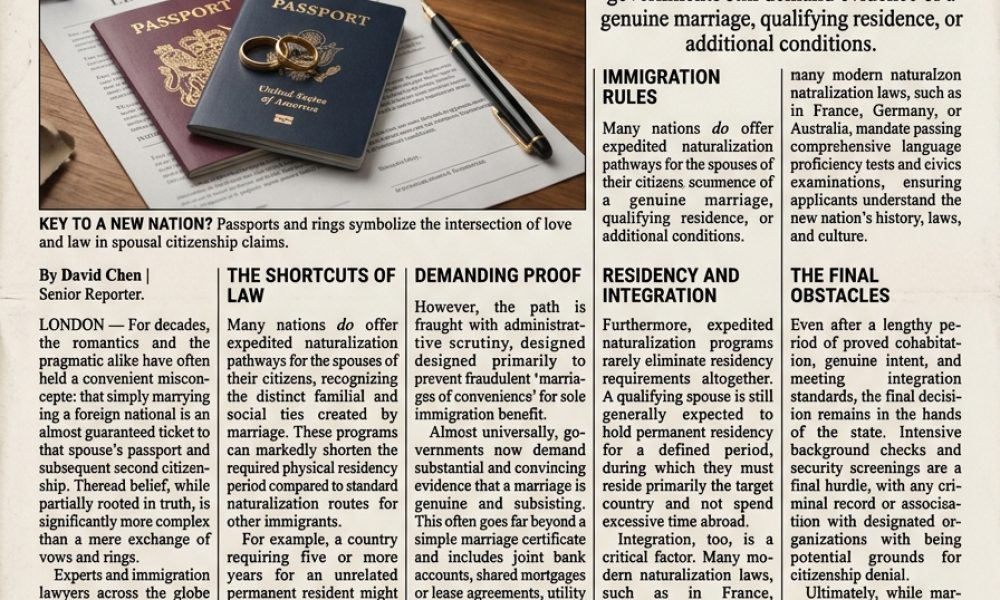
Spousal citizenship programs can shorten naturalization requirements in some countries. Still, a legal marriage alone rarely completes the process, leaving couples to navigate residence rules, relationship evidence, background checks, language requirements, and formal government decisions.
WASHINGTON, DC, November 16, 2026 — Marriage to a citizen of another country can create opportunities for immigration, residence, and eventual naturalization, but couples researching a second passport should distinguish their legal relationship from the separate citizenship procedures governments administer.
Across Europe and North America, marriage may shorten residence requirements, provide a special declaration procedure or support an initial immigration application. Yet, the applicable conditions differ considerably,y and an approved marriage certificate is rarely sufficient by itself.
For international families weighing relocation, professional opportunities and long-term security, the most consequential questions involve the citizen spouse’s legal status, recognition of the marriage, qualifying residence, evidence of a genuine relationship and the exact nationality procedure available.
Marriage Creates a Legal Connection, Not an Automatic Passport
A valid marriage can establish eligibility to request family-based immigration benefits or a shortened citizenship route. Still, marriage and nationality remain distinct legal events, with the latter generally requiring verification or a decision by competent authorities.
Government officials may examine whether spouses are legally married, whether either party had an existing marriage, where the couple actually lives, and whether statutory requirements concerning time, conduct, and residence have been satisfied before granting nationality.
This distinction matters when a couple lives outside the citizen spouse’s country, since marriage may be recognized even if the foreign partner still lacks the residence history required by a particular naturalization law.
The United States Requires Permanent Residence First
In the United States, marriage to an American citizen can support an immigration petition. Still, the foreign spouse generally must first become a lawful permanent resident and then qualify separately for naturalization.
Under the ordinary spousal naturalization provision, an applicant generally needs three years of permanent residence, three years living in marital union with the citizen spouse, and a spouse who has held American citizenship throughout that period.
The United States Citizenship and Immigration Services instructions for Form N-400 also identify evidence such as joint financial documents, housing records, insurance policies, and tax transcripts, illustrating why anillustrating why anycurate factual record must support ansupport anthentic marmarriagepplicants must also satisfy applicable physical-presence and other naturalization requirements, and the marriage-based route typically requires at least eighteen months physically inside the country during the relevant three-year period, subject to specialized statutory exceptions.
A marriage-based green card is therefore not a passport, and a couple celebrating three wedding anniversaries cannot assume eligibility unless they have fully met and documented the permanent-residence, citizenship-duration, and marital-union conditions.
A couple should also distinguish the date of marriage from the date permanent residence began, because an immigration petition, an interview appointment and an approved immigrant visa may occur well before qualifying residence is established.
Spain Recognizes a One-Year Spousal Residence Exception
Spain provides a substantially shorter nationality residence period for certain spouses under Article 22 of its Civil Code, allowing an eligible person married to a Spanish citizen for at least one year to apply after one year of qualifying residence.
The applicant must not be legally or actually separated from the Spanish spouse when applying, and the residence must be lawful, continuous, and immediately before the filing rather than accumulated from tourist visits.
Consequently, a marriage celebrated abroad does not automatically start a citizenship countdown in Spain, because the couple must separately address valid marriage recognition, immigration authorization and the statutory residence period relevant to the applicant.
Spanish authorities also assess good civic conduct and sufficient integration, so applicants should not mistake the one-year residence exception for an exemption from document review, language assessments when applicable, or final civil registration formalities.
A foreign spouse should consider whether a family-member residence process is needed before beginning the nationality calculation, since living with a Spanish citizen abroad and residing lawfully inside Spain are not interchangeable legal circumstances.
Portugal Offers a Declaration Route After More Than Three Years
Portugal’s nationality legislation provides a declaration-based route for someone married to a Portuguese national for more than three years, with a comparable possibility for a qualifying de facto partnership that has received the necessary judicial recognition.
Unlike systems built primarily around a specified period of local residence, the Portuguese marriage provision can apply to couples living abroad. However, effective community ties, statutory exclusions, and the relationship’s specific facts remain important.
Portuguese official guidance updated in 2026 explains that certain longer marriages, or marriages involving shared Portuguese children, can receive favorable treatment on proof of community ties, without making every three-year marriage an automatic citizenship grant.
The country’s 2026 nationality reforms also changed other naturalization provisions, reinforcing why families must distinguish the marriage-specific article from ordinary residence naturalization rules and verify which legislation governs their particular application date and circumstances.
Those seeking Portuguese nationality from abroad should also prepare for possible civil-registration requirements involving the foreign marriage, particularly when a wedding took place under another country’s legal system and has not yet been recorded in Portugal.
British Citizenship Requires Settlement and Residence
The United Kingdom allows eligible spouses or civil partners of British citizens to apply for naturalization after three years of qualifying residence. Still, applicants ordinarily must already hold indefinite leave to remain, settled status or another recognized status free from immigration time restrictions.
Marriage to a British citizen removes the usual additional twelve-month wait after obtaining settlement for the five-year naturalization route. Yet, it does not automatically remove the immigration process needed to acquire settlement in the first place.
Applicants must also meet rules on lawful residence, absences, good character, language ability, and the Life in the UK test, while being physically present in Britain at the start of the relevant three-year qualifying period.
A couple who married three years earlier but spent those years living elsewhere should therefore avoid assuming immediate British naturalization eligibility, because the residence and settled-status conditions are independent of the wedding date.
For many spouses using the ordinary British partner immigration route, permanent settlement itself can require a substantially longer period of eligible residence, leaving the three-year citizenship provision unavailable until that separate immigration milestone has been reached.
France Recognizes Marriage but Requires Language and Community Life
France permits qualifying foreign spouses of French citizens to seek nationality by declaration, generally after four years of marriage. However, the period can extend to five years when particular residence or overseas consular-registration conditions are not satisfied.
The couple must demonstrate that their shared marital Life has continued and that the French spouse retained French citizenship. At the same time, authorities also examine the formal recognition of marriages celebrated outside France and applicable statutory restrictions.
Importantly, France increased the language proficiency standard for marriage-based nationality declarations to level B2 in 2026, making documented written and spoken French ability a material consideration even where the couple has lived together for many years.
Some spouses may qualify while living abroad when the applicable conditions are met. Still, such flexibility does not eliminate the obligation to substantiate the marriage, satisfy language rules and complete the nationality declaration process.
Couples who rely on foreign residence should carefully preserve evidence of their ongoing community life and their spouse’s life circumstances because those circumstances can affect which marriage-duration threshold applies to a declaration.
German Law Requires Both Marriage Duration and Residence
German federal guidance states that marriage to a German national does not itself confer citizenship. However, eligible spouses may qualify for naturalization after at least three years of lawful residence in Germany and two years of marriage.
The shortened route operates alongside other substantive conditions, including integration and the requirements of German nationality law, so applicants should examine their immigration status and personal circumstances rather than treat the wedding certificate as decisive.
A family residing overseas may maintain a genuine marriage to a German citizen without building the domestic residence required for this route, demonstrating again why citizenship opportunities differ from family relationships recognized for other legal purposes.
Canada Has No Special Citizenship Shortcut for Spouses
Canada offers a particularly useful contrast because marrying a Canadian citizen does not create a separate accelerated naturalization procedure, even though an eligible citizen or permanent resident may sponsor a spouse for permanent residence through family immigration rules.
Once permanent residence is obtained, the foreign spouse generally faces the same citizenship standards as other adult applicants, including at least 1,095 days of qualifying physical presence during the five years immediately preceding the application.
Language, knowledge, tax-filing, and other applicable requirements still matter, making Canadian spousal sponsorship an immigration pathway rather than a promise that a marriage certificate automatically produces a Canadian passport or faster citizenship approval.
An applicant should also distinguish time physically present as a permanent resident from any eligible pre-permanent-residence presence, because Canadian citizenship calculations contain their own rules and limits that cannot be replaced by simply counting married years.
Officials Examine Genuine Relationships, Not Just Ceremonies
Across jurisdictions, government reviewers may consider the history of a couple’s relationship, living arrangements, joint responsibilities, and consistency of personal record. However,h the evidence requested should reflect the relevant statutory rules rather than an invented universal checklist.
A marriage celebrated with appropriate legal formalities can still invite scrutiny if the relationship was entered solely to obtain immigration benefits. At the same time, genuine couples living temporarily apart may need to explain their legitimate circumstances with reliable documents.
Shared leases, correspondence, joint financial arrangements and records concerning children may support an authentic relationship when applicable. Still, no individual document should be presented as a compulsory substitute for the evidence a government actually requests.
A 2026 U.S. Prosecution Illustrates the Fraud Risk
In August 2026, Associated Press reported federal charges against eleven defendants in an alleged marriage-fraud operation, describing prosecutors’ claims that participants arranged more than one thousand purportedly sham weddings to support applications for immigration status.
Authorities alleged that some American participants received payments. At the same time, organizers collected substantial fees from foreign nationals. Still, the allegations remained criminal charges rather than judicial findings of guilt against every accused person at the time of the report.
The case underscores why prospective applicants should reject offers to purchase a marriage or manufacture relationship evidence, while also recognizing that the existence of enforcement cases does not justify treating ordinary genuine international marriages as inherently suspicious.
Foreign Marriage Certificates May Require Recognition
Couples married abroad may need certified civil records, legalizations, translations, or registration with the citizen spouse’s home authorities before an immigration or nationality office can rely on the relationship for a particular procedure.
The correct steps depend on where the marriage occurred and where the citizenship application will be filed, including whether the destination country recognizes the form of marriage and any previous divorce or annulment.
Parents, guardians, and spouses with different surnames should also keep consistent legal identity documents, especially when a foreign marriage certificate uses naming conventions that differ from those on birth certificates, residence cards, or passports.
Separation, Divorce and Death Can Change Eligibility
Many spouse-based nationality routes depend on the marriage remaining legally valid, and some also require an ongoing marital union, meaning that separation or divorce before a key filing or decision may alter the applicable citizenship pathway.
United States guidance generally requires an applicant using the three-year spousal provision to remain married to the American citizen until the naturalization oath. At the same time, Spain explicitly excludes legally or actually separated applicants from its ordinary one-year marriage exception.
Special rules may protect applicants facing domestic abuse or other exceptional circumstances, so anyone confronting a breakdown of the relationship should seek individualized legal assistance rather than assume citizenship rights always disappear or continue unchanged.
Children Do Not Automatically Receive Matching Passports
A spouse’s successful naturalization does not necessarily grant the same nationality to children, because citizenship by descent, birth, adoption or later parental naturalization may each involve separate conditions and formal procedures under domestic law.
Parents should review whether their children already have the relevant citizenship or need a separate registration, certificate, or passport application, particularly if the children were born abroad before one parent became a citizen.
Children born after a parent’s naturalization may have different citizenship rights from siblings born earlier, depending on birthplace, parental residence and the receiving country’s transmission rules, so the family should assess each child’s position separately.
Family travel plans should also address parental consent and the required passport for each nationality, rather than assuming the principal applicant’s new citizenship eliminates documentation, border-control requirements, and custody safeguards for other countries.
Dual Citizenship and Financial Duties Need Separate Analysis
A foreign spouse who eventually naturalizes may be permitted to retain an existing nationality. Still, acceptance of multiple citizenships depends on the laws of the countries concerned and should be reviewed before undertaking any declaration or renunciation.
Tax residence, reporting duties and property obligations likewise do not automatically disappear after marriage or naturalization, especially for people maintaining employment, investments or household connections across several countries at the same time over many years.
Amicus International Consulting has examined related financial considerations in its discussion of second passports and continuing American tax obligations, highlighting the distinction between acquiring an additional citizenship and satisfying existing obligations under applicable tax law.
Responsible Advisers Should Explain the Real Procedure
Anyone evaluating a marriage-related citizenship option should request a written assessment that identifies the relevant nationality law, immigration status, relationship-duration test, documents, anticipated government fees, and circumstances that could affect eligibility before formal approval.
Amicus International Consulting describes broader second-passport and international mobility advisory services. Still, neither a consultant nor a private intermediary can independently confer citizenship, waive mandatory residence rules, or promise a foreign government’s final decision.
Applicants should avoid representatives who propose fictitious cohabitation records, false declarations, or undisclosed marriages of convenience, because lawful citizenship planning depends on genuine relationships and truthful evidence rather than paperwork designed to mislead officials.
The Strongest Strategy Begins With Status, Not a Passport Promise
A reliable plan starts by confirming the marriage’s legal validity and the citizen spouse’s nationality, then determining whether the foreign partner needs immigration permission, qualifying residence, language evidence, or a formal nationality declaration.
Couples should also track travel history, residence approvals, renewal dates, and required periods of shared life, so they can file a nationality application when the legal conditions are genuinely met rather than when a promotional timetable expires.
Marriage can provide a meaningful path toward a second citizenship in certain countries; the lasting opportunity comes from completing the relevant legal process, not from assuming that a wedding ceremony automatically changes nationality or produces another passport.




