
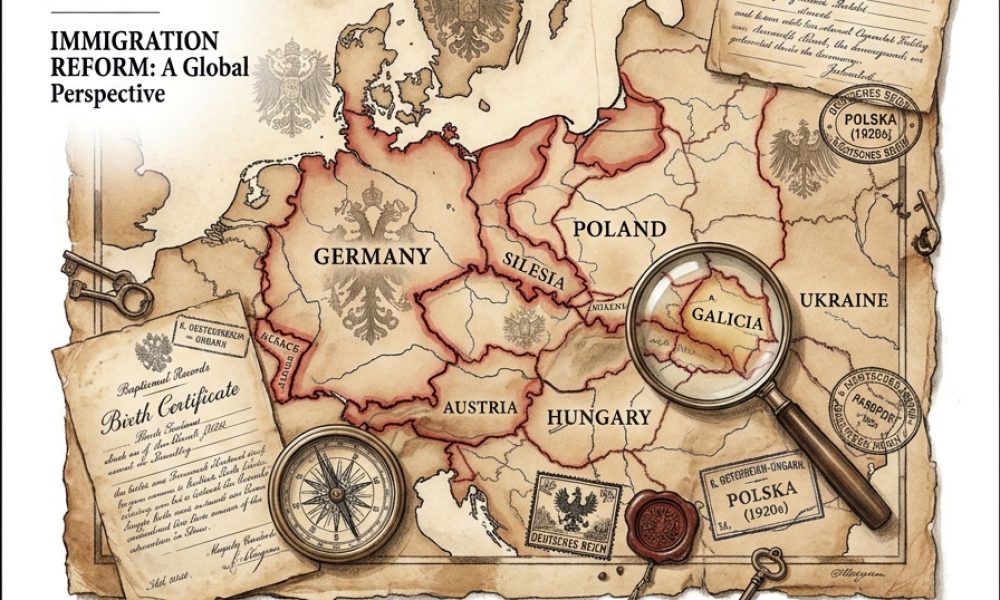
Families whose ancestors lived under former empires or changing national boundaries may face complex questions about historical nationality, citizenship transmission, and documentary evidence.
WASHINGTON, DC, November 16, 2026 — Families investigating European citizenship through parents, grandparents or more distant ancestors are discovering that historical border changes can complicate otherwise promising claims, particularly when an ancestor’s birthplace belonged to a different country at the time of birth.
Across Central and Eastern Europe, the collapse of empires, two world wars, territorial transfers and changing nationality legislation created overlapping citizenship histories that cannot always be resolved by examining a modern map or identifying an ancestral village.
For applicants seeking a second European passport, the central legal question is not simply where an ancestor was born, but whether that person held a qualifying nationality and could legally transmit it through successive generations.
The Country on Today’s Map May Not Be the Relevant Country
A family researching a grandparent born in Lviv, now part of Ukraine, may find records identifying the birthplace as Lwów in interwar Poland or Lemberg under earlier Austro-Hungarian administration, depending on the document’s date.
Similar complications arise around Vilnius, now Lithuania’s capital, and cities across present-day Slovakia, Romania, Croatia and Serbia, where earlier political arrangements placed communities within states whose borders no longer match their historical territories.
A birth certificate identifying the Austro-Hungarian Empire establishes an important historical location. Still, it does not automatically prove that the person later acquired Austrian, Hungarian, Polish, or another successor state’s nationality.
The decisive analysis must connect the relevant territory, the ancestor’s actual legal status,, and the nationality legislation in force on specific historical dates, while recognizing that governments sometimes allocated citizenship through residence, municipal affiliation,, or treaty arrangements.
The Collapse of Austria-Hungary Created Competing Nationality Histories
When Austria-Hungary disintegrated after World War I, successor states inherited territories with diverse populations, leaving families with archival documents issued under one government and later identity papers from another political system.
A person born before 1918 in territory now belonging to Slovakia might have held Hungarian nationality and later become associated with Czechoslovakia. Still, the precise result depended on the applicable succession rules and personal circumstances.
The same complexity affects people whose relatives came from Transylvania, parts of today’s Croatia, or other former imperial regions, because historical ethnicity, language, and citizenship did not always correspond.
A German-speaking ancestor from an imperial city was not necessarily a German citizen, just as an ethnically Hungarian family living outside present-day Hungary cannot establish modern citizenship solely through a surname or ancestral language.
Polish Citizenship Claims Require Historical Reconstruction
Poland’s restoration of independence after World War I introduced nationality legislation in 1920, making the timing of an ancestor’s departure and the person’s legal relationship with the newly established Polish state especially consequential.
Families whose ancestors emigrated before Poland regained independence may face different evidentiary challenges from those whose relatives departed as documented Polish citizens during the interwar years, even when both families trace their origins to the same community.
Polish authorities examine whether citizenship was acquired and later lost under the legislation in force at the relevant time, including historical rules on foreign naturalization, foreign military service, and public office in another country.
Consequently, a birth certificate showing that a grandfather was born in territory later incorporated into Poland may be valuable genealogically. Still, it does not independently establish the uninterrupted nationality chain required to confirm citizenship.
Poland’s official confirmation procedure is handled by its provincial authorities, with consulates facilitating some applications from abroad, and the documentary inquiry may involve both an ancestor’s original nationality and any later legally recognized loss of that status.
A family that discovers an interwar residence register or an old Polish identity card should preserve its provenance and seek historical interpretation, because contemporary administrative confirmation depends on more than an isolated document’s appearance or title.
Wartime Displacement Can Make Records Harder to Interpret
War, forced migration and border settlement agreements displaced communities across Europe during the twentieth century, sometimes leaving the same person recorded by several states, in several languages, and under changing administrative classifications within a single lifetime.
Refugee files, displaced-person registrations, and postwar resettlement papers can bridge prewar civil registers and later migration documents. However,h the descriptive nationality entered by an agency may not conclusively establish citizenship under domestic law.
An ancestor described as Polish in a refugee camp might have been classified by ethnicity, language, or former residence. At the same time, another document could identify the legal nationality held under the successor state’s prevailing rules at that time.
The evidentiary challenge is therefore to assemble a coherent sequence of official decisions and circumstances, not to select whichever wartime description most closely matches the modern passport an applicant hopes eventually to obtain.
Historic persecution can also activate special restitution provisions in some countries. However, these procedures still require their own statutory conditions and cannot automatically extend to every family displaced during the same war.
Hungarian Descent Can Involve Two Distinct Legal Processes
Hungarian consular guidance distinguishes between verifying citizenship that may have passed through generations and simplified naturalization for eligible descendants, and the distinction matters when an ancestor’s historical citizenship was interrupted or never transmitted.
Verification can require reconstructing the nationality of successive parents. At the same time, simplified naturalization generally requires evidence of Hungarian ancestry or a qualifying Hungarian ancestor, adequate language proficiency, and compliance with conduct and security conditions.
Hungarian officials also identify historical rules affecting citizenship transmission through mothers before October 1957 and potential loss through prolonged absence under earlier legislation, showing why the precise recorded birth and departure dates matter.
An applicant whose ancestor lived in a territory transferred after World War I should therefore investigate the ancestor’s actual nationality status and the route available today, rather than assume that historical Hungarian place names guarantee a passport.
Austria’s Persecution Route Has Specific Territorial Conditions
Austria provides a special citizenship pathway for certain victims of Nazi persecution and their direct descendants under Section 58. Still, eligibility relies on defined historical circumstances and cannot be inferred solely from ancestry within the former empire.
Official Austrian guidance explains that the qualifying ancestor’s principal residence within the relevant Austrian federal territory is crucial, even when that ancestor held citizenship of a successor state of Austria-Hungary or was stateless.
A relative persecuted in territory now belonging to another successor state does not automatically satisfy the Austrian procedure merely because the family once lived under Habsburg rule. However, separate nationality pathways may merit investigation.
These distinctions make it particularly important to separate historical sympathy and culturally meaningful heritage from the precise statutory evidence of persecution, residence and family relationship that Austrian authorities need before making a decision.
German Restitution Law Addresses a Different Historical Injustice
German nationality law provides restoration and restitution measures for descendants of people deprived of citizenship or prevented from acquiring it because of Nazi persecution, including routes under Article 116 of the Basic Law and Section 15 of the Nationality Act.
The two procedures address different legal circumstances, so a family whose ancestor lost nationality through a specific deprivation measure may need a different evidentiary analysis from someone whose relative was excluded from naturalization.
Archives documenting persecution, prior citizenship and the timing of emigration may be decisive. At the same time, a family name, language, or former residence in a German-speaking community cannot, on its own, establish eligibility under the restitution provisions.
The comparison reinforces a wider principle across Europe: a descendant may qualify because of a specific historical injustice recognized by legislation, not because all people from the surrounding territory received identical nationality rights.
Italy’s 2025 Reform Makes Older Family Assumptions Risky
Italian citizenship by descent traditionally encouraged extensive research into ancestors who emigrated generations ago, but legislation enacted in 2025 restricted automatic recognition for many foreign-born descendants holding another citizenship, with exceptions and transitional protections.
A Reuters report on Italy’s March 2025 citizenship restrictions captured the Italian government’s publicly stated concern about increasingly distant ancestral claims and the significance of ancestry-based citizenship for descendants living across the Americas.
Italy’s foreign ministry now explains that applications must satisfy the amended nationality framework, while continuing to examine whether citizenship was held and transmitted through the relevant family line under the law governing each generation.
Families whose records point toward Trieste, South Tyrol, or other historically contested border regions face a further preliminary question about the ancestor’s legal nationality, because geographic ties to modern Italy alone are not sufficient.
Czechoslovakia’s Dissolution Adds Another Layer
The former Czechoslovak state and its dissolution into the Czech Republic and Slovakia in 1993 demonstrate how a family’s older passport or birth certificate may refer to a country that no longer exists.
Czech consular guidance describes declaration procedures for certain former citizens and their descendants, including qualifying people with a Czech parent or grandparent. Still, eligibility depends on nationality histories and statutory conditions rather than general Czechoslovak ancestry.
The distinction between Czech and Slovak citizenship can be particularly important when an ancestor lived in one part of the former federation, registered documents elsewhere, or acquired another nationality before the states separated.
An applicant should therefore establish which predecessor-state citizenship was actually held and how the legal succession affected the family, instead of treating a Czechoslovak label as interchangeable with citizenship in either current republic.
Naturalization Abroad Can Break the Transmission Chain
A common obstacle is the ancestor’s later naturalization in the United States, Canada, Argentina, or another destination, because European states historically differed on when acquiring foreign nationality terminated the original citizenship.
Polish guidance identifies past loss rules involving foreign naturalization and certain other conduct. In contrast, Italian guidance requires evidence that the relevant ancestor retained Italian citizenship until the next generation’s birth under the applicable transmission rules.
For this reason, a descendant may need the ancestor’s naturalization petition, oath date, or evidence that no naturalization occurred, rather than relying only on a passenger list showing arrival in a new country.
Even a difference of several months can matter when an ancestor became a foreign citizen shortly before or after a child’s birth, because the date may determine whether nationality passed to that child.
Women and Children Were Sometimes Treated Differently
Historical nationality systems often imposed unequal rules on women, married couples and children, producing complex inheritance questions that contemporary applicants cannot resolve by simply applying current equality principles retroactively to every earlier birth.
Hungarian consular guidance identifies historical limitations affecting citizenship transmission through women before October 1957, while Italian historical maternal-line questions can require separate examination of births before January 1, 1948, and the available legal procedures.
Changes in marriage status, adoption, legitimacy, and formal recognition of parentage may also affect the documentary chain of citizenship, especially where the family moved across jurisdictions with different civil registration rules over multiple generations.
A careful application file must therefore identify each generation’s birth date, parentage, and nationality status, rather than assuming that a female ancestor’s citizenship was always transmitted under the same rules that apply today.
Archives and Historic Place Names Need Careful Research
Church registers, civil certificates, military records, census entries, and residential registers can help reconstruct an ancestor’s legal identity, but each document must be interpreted in light of the authority that created it.
One person’s given name may appear in Polish, German, Hungarian, or another language across successive documents. At the same time,e a town’s spelling may change even when the family never physically moved from the same house.
Researchers should carefully record original spellings, historical administrative districts and relevant dates before requesting archives, because modern search terms may fail to locate historic files filed under another language, parish or predecessor jurisdiction.
Certified extracts and authorized translations may eventually be needed for a formal application. Still, families should first check genealogical findings against the country’s actual nationality rules before incurring substantial additional document-retrieval costs.
A Second Citizenship Is Not Automatically a Passport
Some countries offer procedures to confirm citizenship a person may already possess. In contrast, others provide naturalization or restitution that takes legal effect only after a decision or required declaration, making those pathways fundamentally different.
The United States Department of State’s explanation of dual nationality notes that citizenship laws vary by country and that multiple citizenships can coexist with continuing obligations, an important consideration for American descendants reviewing European family histories.
Approval or confirmation may still require registration of civil records and a separate passport application, so a legal entitlement should not be confused with permission to travel immediately under another country’s documents.
The second-passport advisory services described by Amicus International Consulting may provide an initial commercial point of contact. Still, only the relevant foreign authorities can determine nationality status under the laws governing a family’s claim.
Document Authenticity Remains a Separate Safeguard
Historical documents can be incomplete or contain clerical inconsistencies. Still, applicants should pursue certified corrections or legally recognized explanations rather than creating replacement family records intended to establish citizenship where the evidence does not support it.
Amicus International Consulting also discusses how modern passport security helps distinguish genuine travel documents from counterfeits. However, electronic passport protections cannot authenticate an ancestor’s citizenship or substitute for historical evidence examined by government officials.
Applicants should confirm the provenance of records obtained through private researchers, compare conflicting civil documents, and avoid intermediaries promising guaranteed citizenship based on an old photograph, an ethnic surname, or an unverified digital certificate.
Families Should Build the Timeline Before Filing
A responsible ancestry inquiry starts with a dated timeline identifying ancestral births, marriages, border changes, emigration, naturalization, and the births of later generations, followed by legal analysis of which nationality legislation applied at each stage.
That method helps distinguish a missing archival record from a substantive nationality interruption. It may reveal that a different country’s procedure, or a separate restitution route, deserves consideration before a family submits a formal claim.
The broader opportunity remains meaningful for people whose family histories cross Europe’s changing borders, but establishing nationality requires more than identifying a birthplace on an old map or gathering certificates bearing familiar national symbols.
Ultimately, successful claims depend on accurate historical reconstruction, uninterrupted legal transmission where required, and careful use of authentic documents, ensuring that the eventual decision rests on nationality law rather than an appealing but incomplete ancestral story.




