
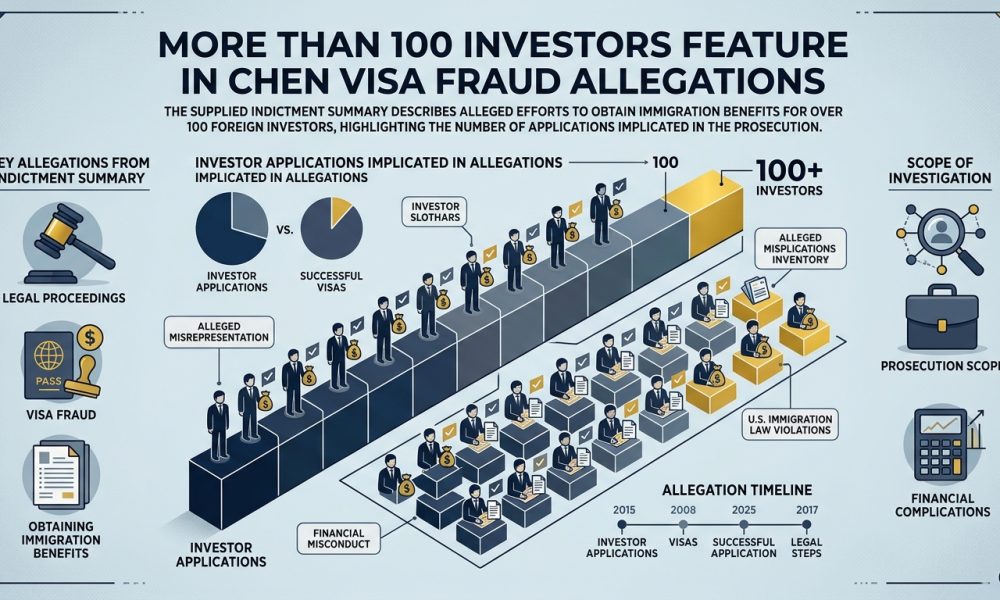
Federal prosecutors alleged that immigration attorney Danhong “Jean” Chen and her business partner pursued immigration benefits for more than 100 foreign investors through fraudulent EB-5 documentation, raising questions about investor Protection, professional accountability, and the integrity of investment-based immigration applications.
WASHINGTON, DC, November 11, 2026 — A federal immigration fraud investigation involving more than 100 foreign investors and approximately $52 million in investment capital has become a significant example of the risks that arise when immigration lawyers, commercial investment promoters, and regional center operators participate in overlapping financial arrangements.
The prosecution of California attorney Danhong “Jean” Chen and her former spouse and business partner, Jianyun “Tony” Ye, illustrates how allegedly falsified documents, concealed corporate ownership, and misleading investment representations can affect substantial numbers of immigration applications involving foreign families seeking lawful permanent residence in the United States.
Although the original 2019 indictment described an extensive alleged scheme involving more than 100 investors, subsequent criminal proceedings established specific offenses committed by Chen and Ye without demonstrating that every investor knowingly participated in wrongdoing or that every immigration application contained fraudulent information.
The case acquired additional significance when Chen was extradited from the Kyrgyz Republic in March 2025, pleaded guilty to federal offenses in November 2025, and received a thirty-month prison sentence in January 2026, completing an unusually prolonged international prosecution.
Federal Indictment Identifies More Than 100 Foreign Investors
On March 26, 2019, the United States Attorney’s Office for the Northern District of California announced a fourteen-count federal indictment alleging that Chen and Ye participated in a large-scale immigration visa fraud scheme involving more than 100 foreign investors.
The Justice Department’s original indictment announcement described alleged efforts to secure immigration benefits through the federal Employment-Based Fifth Preference program, commonly known as EB-5, using documents that prosecutors said contained false signatures and materially inaccurate information.
According to the indictment, Chen operated the Law Offices of Jean D. Chen in San Jose, California. At the same time, Ye served as the office manager, with the practice presenting itself as a professional legal service specializing in immigration matters.
Federal prosecutors stated that clients represented through the law office invested approximately $52 million in EB-5 projects, underscoring the scale of the underlying transactions and the need to document the investments accurately.
The figure of more than 100 investors describes the scope of the alleged immigration scheme, not a finding that every participating investor committed a crime, knowingly submitted false information, or received immigration benefits improperly.
Understanding the Scale of the Alleged Immigration Scheme
The number of investors involved matters because immigration applications often include extensive personal, corporate, and financial records, so alleged misconduct affecting a large client population can raise complex questions about individual eligibility and government reliance on professional submissions.
An investor may have contributed legitimate funds, supplied accurate Identification records, and reasonably relied on an attorney. At the same time, separate misconduct by a professional representative may have affected the ownership disclosures or supporting documentation submitted on the investor’s behalf.
Conversely, an investigation may identify applicants who knowingly made inaccurate declarations, making individual examination essential rather than assuming that everyone associated with the same legal practice held the same legal position.
The reported $52 million in investments likewise should not be interpreted as a judicial finding that the entire amount represented stolen money, personal profits, or financial losses suffered by the investors involved.
Instead, the amount illustrates the financial exposure associated with the clients represented by Chen’s practice and the potential consequences when professional misconduct intersects with government decisions concerning substantial foreign investments.
How the EB-5 Immigrant Investor Program Operates
The American EB-5 immigrant investor program was established to encourage qualifying foreign investment in United States commercial enterprises while supporting job creation and providing eligible investors and certain family members with a potential pathway to lawful permanent residence.
Applicants must meet the investment thresholds and other statutory conditions applicable to their filings, while supplying evidence concerning the qualifying commercial enterprise, the lawful origin of investment capital, and the required creation of American jobs.
During the period prosecutors examined, the program generally required qualifying investments of $500,000 in designated areas meeting particular economic criteria or $1 million in other locations. However, those historical thresholds should not be confused with requirements governing newer applications.
Modern EB-5 applications are governed by later-revised legislation and regulations, so prospective investors should distinguish historical allegations about transactions conducted years earlier from the requirements federal immigration authorities currently administer.
Investment immigration also differs from direct citizenship acquisition because successful participation can establish an immigration pathway toward permanent residence, rather than automatically granting United States citizenship or an American passport upon investment.
Regional Center Ownership Becomes a Central Issue
One principal allegation concerned Golden State Regional Center, an entity tied to EB-5 investment activity that prosecutors said Chen and Ye acquired in 2014 before transferring nominal ownership to another individual.
According to the indictment, the individual identified as the new owner was allegedly unaware that ownership records named her in that capacity, raising questions about whether government filings accurately reflected the regional center’s actual control.
Prosecutors alleged that subsequent documents submitted to United States Citizenship and Immigration Services contained signatures falsely attributed to the purported owner, including paperwork requesting continued recognition of the regional center’s eligibility to promote investments.
These allegations mattered because immigration officials rely on accurate information about regional center management, corporate ownership, and investment arrangements when evaluating whether applications and business activities meet federal requirements.
A regional center’s formal recognition does not eliminate investors’ and their representatives’ responsibility to provide truthful information, nor does it guarantee that every project promoted through the entity will succeed financially.
False Documents Raise Questions About Investor Eligibility
The indictment further alleged that Chen and Ye submitted EB-5 immigration applications containing misleading descriptions of how applicants qualified for the program, including inaccurate statements concerning investment arrangements and the intended use of investor funds.
Such representations can be material because immigration authorities must determine whether the capital was invested in a qualifying enterprise and whether the documented arrangements satisfy statutory requirements, not merely appear compliant on submitted forms.
Prosecutors also alleged that some filings misrepresented the relationship between Chen’s law office, individual investors, and Golden State Regional Center, creating concerns about undisclosed professional conflicts and the accuracy of supporting explanations.
Nevertheless, an allegation involving a particular category of documentation does not establish that every application prepared by the law office contained the same defect or produced an improperly granted immigration benefit.
A responsible assessment requires Identification of the documents affected, the applicant’s knowledge, the applicable legal requirements, and the evidence available to immigration authorities when each application was reviewed.
Foreign Investors Face Different Legal and Financial Risks
Foreign nationals participating in investment immigration programs may depend on professional advisers to explain unfamiliar American legal procedures, translate technical requirements, coordinate investment documentation, and manage communications with government agencies reviewing their applications.
This reliance creates substantial vulnerability when legal representatives have undisclosed financial interests in recommended investment projects or fail to explain how their professional relationships could influence the advice they give clients.
The Chen investigation demonstrates why applicants should receive clear information about who controls an investment vehicle, how professional advisers are compensated, and whether a recommended investment has been independently examined for legal and commercial risks.
A client’s financial commitment may be substantial even where the investment ultimately fails to provide immigration benefits, since unsuccessful applications do not necessarily create an automatic right to recover capital contributed to a qualifying enterprise.
Investors therefore need to distinguish immigration eligibility, financial risk, professional liability, and possible legal remedies, recognizing that each question depends on different evidence, contractual arrangements, and applicable legal standards.
An Immigration Lawyer’s Responsibilities Extend Beyond Filing Forms
Immigration attorneys occupy positions of considerable trust because their clients often depend on their professional judgment when making life-changing financial and relocation decisions involving family members, commercial assets, and long-term residence arrangements.
A competent professional should explain eligibility requirements, verify material information, disclose relevant conflicts, preserve client records, and ensure that government submissions accurately reflect the facts supplied and independently confirmed during representation.
When legal advice intersects with investment promotion, attorneys must also consider whether commercial relationships interfere with independent professional judgment or create obligations that cannot be reconciled with individual clients.
The Chen indictment alleged that representations concerning the law office’s relationship with Golden State Regional Center were inaccurate, highlighting why undisclosed overlaps matter when attorneys examine immigration documentation.
The broader concern is not that attorneys are prohibited from understanding investment structures, but that professional representation must remain truthful, appropriately independent, and consistent with the ethical obligations governing the particular engagement.
The SEC Investigation Adds a Financial Enforcement Dimension
The Securities and Exchange Commission initiated civil enforcement proceedings in October 2018 against Chen, Ye, and additional parties, alleging improper investment solicitation and other violations tied to their immigration-related businesses.
Those proceedings preceded the federal criminal indictment and created a separate regulatory context for examining whether the defendants’ investment arrangements complied with securities requirements and whether investors received adequate information about relevant financial relationships.
Federal prosecutors later alleged that Chen and Ye interfered with government investigations by encouraging inaccurate statements and deleting relevant electronic communications, adding obstruction allegations to the underlying immigration fraud accusations.
These matters show how immigration investment misconduct can attract scrutiny from multiple federal institutions, including immigration authorities, securities regulators, criminal investigators, and professional disciplinary bodies that examine licensed attorneys.
The involvement of several agencies also creates opportunities to compare documentary evidence from different sources. However, investigators must still assess information obtained during an investigation under the legal standards governing each proceeding.
The Case Develops Into an International Extradition Matter
After the SEC civil proceedings began in October 2018, Chen left the United States and remained abroad while federal authorities continued investigating and pursuing the criminal charges later filed against her.
In March 2025, American officials announced that Chen had been extradited from the Kyrgyz Republic, marking what the Justice Department described as the first Extradition from that country to the United States on federal criminal charges.
The return required cooperation between American and Kyrgyz authorities, demonstrating how international law enforcement coordination can become necessary when a defendant remains outside the jurisdiction handling an underlying financial or immigration prosecution.
Extradition itself does not establish criminal guilt, since the legal transfer of a defendant and the determination of criminal responsibility represent separate stages governed by the procedures of the countries and courts involved.
In Chen’s case, the Extradition ultimately allowed federal proceedings to advance toward a guilty plea and sentencing, resolving criminal charges that had remained outstanding for several years after the original indictment.
The Guilty Plea Establishes Specific Criminal Responsibility
In November 2025, Chen pleaded guilty to one count of visa fraud and two obstruction-related counts, according to an investigative summary subsequently published by the Securities and Exchange Commission’s Office of Inspector General.
On January 27, 2026, Chen received a sentence of 30 months in federal prison, along with 2 years of supervised release and a $20,000 fine, after resolving those federal criminal charges.
Her former spouse and business partner, Jianyun “Tony” Ye, had previously pleaded guilty to visa fraud and obstruction in 2021 and received a twelve-month federal prison sentence, which he subsequently served.
These outcomes show that the prosecution established criminal responsibility, while making it unnecessary to treat every allegation in the fourteen-count indictment as an individually proven offense.
The distinction matters when discussing the more than 100 foreign investors, because the defendants’ convictions do not automatically establish that all the investors committed misconduct, received improper benefits, or knowingly provided inaccurate information.
International Passport Reporting Adds Another Dimension
Chen’s circumstances also drew international attention because journalists examined her reported acquisition of Dominican citizenship and her use of the name Maria Sofia Taylor. At the same time, United States authorities investigated her activities.
An October 2023 Le Monde investigation into Dominica’s citizenship-by-investment program examined Chen’s case alongside broader concerns about screening applicants who subsequently became associated with criminal allegations, financial investigations, or international law enforcement attention.
Possession of a second passport is not inherently evidence of unlawful conduct, because individuals can legitimately acquire additional citizenship through naturalization, ancestry, marriage, or investment programs established by sovereign governments.
However, authorities reviewing a person’s legal history may need to reconcile previous names, nationality records, travel documents, and immigration filings to determine whether relevant declarations accurately identify the individual.
The key distinction concerns the lawful issuance and authenticity of identity documents, the accuracy of information supplied during applications, and any material misrepresentations that applicable authorities are entitled to examine.
Modern Passport Security Cannot validate every investment record.
Contemporary passports incorporate sophisticated protective features intended to help authorities detect counterfeit documents, unauthorized alterations, and certain forms of identity manipulation, including machine-readable information and electronic security mechanisms where implemented.
Those safeguards can support verification that the relevant authority issued a particular travel document. Still, they cannot independently prove the accuracy of corporate ownership records or financial representations submitted during an immigration application.
Amicus International Consulting explains these distinctions in its analysis of modern passport security and identity Protection, examining how security features support document authentication without replacing the broader background verification required for reliable identity assessments.
The Chen case illustrates why authentic identity credentials and truthful immigration submissions represent separate compliance questions, especially when legal proceedings involve corporate arrangements, investment eligibility, and representations made through professional intermediaries.
Effective screening therefore requires examining supporting records beyond the passport itself, including previous names, corporate registrations, relevant legal proceedings, financial documents, and independently verifiable information from appropriate sources.
What the More Than 100 Investors Can Learn From the Case
The most important lesson for investors is that professional misconduct can affect an immigration application even when a client contributes legitimate funds, acts in good faith, and reasonably relies on a licensed adviser.
Prospective applicants should keep complete copies of financial records, review immigration filings before submission, and independently verify material representations about investment vehicles, project ownership, and the authority of people signing official documents.
When an investor discovers that a former representative has been implicated in fraudulent activity, the appropriate response is to obtain an individualized legal assessment rather than automatically assuming that every application associated with the professional is invalid.
Such an assessment can identify whether a particular filing contains inaccurate information, whether corrective action is legally available, and whether any relevant issue requires disclosure to immigration authorities under applicable procedural rules.
Individuals considering broader international mobility strategies should likewise distinguish lawful residence planning from citizenship acquisition, recognizing that government approval depends on accurate documentation and compliance with the legislation governing each program.
Amicus International Consulting’s overview of second passport services provides related information about international mobility planning. At the same time, government authorities retain responsibility for determining eligibility, evaluating applications, and issuing citizenship or travel documents under their laws.
Government Oversight and Investor Protection Remain Essential
The Chen prosecution demonstrates the importance of coordinating immigration adjudication with financial regulatory oversight, particularly when investment capital, legal representation, and regional center operations involve multiple entities with potentially overlapping commercial interests.
Governments administering investment migration programs benefit from reliable ownership disclosures, meaningful document verification, professional accountability, and investigative cooperation that can identify material inconsistencies before immigration benefits are approved.
Regulatory improvements can also help legitimate investors by clarifying disclosure requirements and strengthening professional oversight, reducing the possibility that applicants will unknowingly rely on misleading business records or improperly prepared immigration submissions.
Nevertheless, enforcement measures must preserve distinctions between deliberate fraud, professional negligence, administrative mistakes, and innocent reliance on advisers, because those categories involve different legal responsibilities and may require different remedies.
Conclusion: Investor Numbers Do Not Establish Collective Wrongdoing
The allegation that Chen’s practice pursued immigration benefits for more than 100 foreign investors reveals the considerable scale of the federal investigation. In contrast, the approximately $52 million invested through the practice underscores the financial stakes.
Chen’s November 2025 guilty plea and January 2026 sentencing established criminal responsibility for specific visa fraud and obstruction offenses, completing an international prosecution that began with allegations concerning immigration documents and investment-related business arrangements.
Those findings do not establish that every client knowingly engaged in fraudulent activity, so journalists, regulators, and immigration professionals must distinguish the documented convictions from the broader allegations originally presented.
Ultimately, the case illustrates why effective investment immigration systems require truthful documentation, transparent professional relationships, reliable financial evidence, and government oversight that protects lawful applicants while holding responsible individuals accountable for proven criminal misconduct.




