
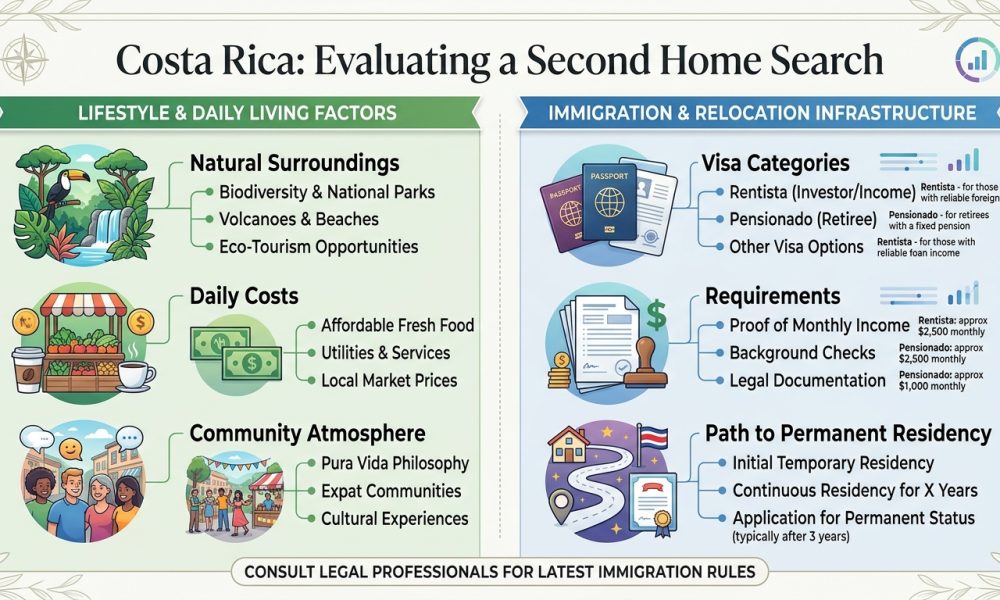
Its presence in overseas lifestyle discussions highlights interest in the surroundings and daily life, while prospective residents must independently determine which immigration options fit their circumstances.
WASHINGTON, DC, October 30, 2026. Costa Rica is attracting attention from Americans exploring the possibility of establishing a second home abroad, as interest in tropical living, accessible healthcare, residential privacy and long-term international mobility encourages families to examine alternatives to traditional retirement and relocation destinations.
From the residential communities surrounding San José to the Pacific beaches of Guanacaste and the mountain towns of the Central Valley, Costa Rica offers a variety of environments that appeal to retirees, entrepreneurs, and affluent families seeking a different pace of life.
The country’s appeal extends beyond its beautiful surroundings because prospective residents increasingly consider the practical benefits of maintaining a legally recognized residence outside the United States, especially when family security, financial flexibility, and long-term lifestyle planning influence their decisions.
However, the attractiveness of owning property or spending extended periods in Costa Rica should not be confused with eligibility for permanent residence or eventual citizenship, since these are separate legal arrangements governed by specific immigration and nationality requirements.
According to AMICUS INTERNATIONAL CONSULTING, which advises internationally mobile clients on lawful overseas relocation and second citizenship planning, Americans considering Costa Rica should begin by determining whether their primary objective involves seasonal living, permanent relocation, or eventually acquiring an additional nationality.
The distinction matters because a residential property, tourist admission, or a temporary immigration permit may support a comfortable overseas lifestyle without automatically granting permanent residence or a Costa Rican passport.
For Americans considering their international future in 2026, Costa Rica shows how lifestyle opportunities and immigration eligibility must be evaluated together before making major financial or personal commitments.
Why Costa Rica Appeals to Americans Considering Life Abroad
Costa Rica occupies a distinctive position in the international relocation conversation because it combines tropical surroundings, established expatriate communities, and relative geographic accessibility for Americans who want to maintain connections with the United States.
Direct commercial flights connect Costa Rican airports with major American cities, making it easier for residents to maintain family relationships, manage professional responsibilities,, and travel between their verseas homes and the United States.
The country’s landscapes range from Pacific and Caribbean coastlines to mountain communities and tropical forests, offering different residential environments for individuals whose preferences extend beyond conventional urban living.
For retirees, the chance to spend more time outdoors and adopt a less demanding daily routine can be particularly appealing, especially when combined with access to private healthcare and established residential communities.
Families with children may prioritize international education, outdoor recreation and the availability of residential neighborhoods where other internationally mobile households have already established long-term connections.
The broader discussion is reflected in Google News coverage of Americans relocating to Costa Rica and exploring overseas retirement, where housing costs, lifestyle considerations and immigration arrangements frequently feature in conversations about international living.
Nevertheless, an attractive destination does not automatically represent the appropriate legal solution for every prospective resident, particularly when the individual expects to remain overseas for years rather than months.
The Central Valley Offers an Established Residential Environment
Costa Rica’s Central Valley attracts Americans who want to balance a comfortable residential lifestyle with access to hospitals, professional services, international schools, and the country’s main commercial infrastructure.
Communities around Escazú, Santa Ana, Atenas and Grecia offer different combinations of residential developments, mountain scenery, local amenities and proximity to the greater San José metropolitan area.
Escazú and Santa Ana may appeal to business owners and families seeking established private healthcare facilities, international schools and modern residential properties within reasonable reach of the capital.
Atenas and Grecia offer alternatives for individuals who prefer smaller communities, cooler elevations and a less urban environment while maintaining access to important services.
However, prospective residents should investigate actual travel times, transportation conditions, and access to medical facilities rather than relying exclusively on geographical distance when comparing neighborhoods.
A property that looks conveniently located on a map may involve difficult roads, seasonal weather challenges, or long travel times during congestion, especially when the household depends on frequent medical or professional appointments.
For families establishing a second home, these practical considerations can become more important than the initial appeal of a property overlooking the surrounding mountains.
Guanacaste Attracts Americans Seeking Coastal Living
Costa Rica’s Guanacaste province has become familiar to international travelers for its Pacific coastline, tourism infrastructure, and residential communities that cater to people interested in beach-oriented living.
Locations such as Tamarindo, Playas del Coco and the Papagayo Peninsula offer different combinations of recreational opportunities, residential properties, hospitality services and access to international travel connections.
For affluent Americans, coastal Costa Rica may represent an opportunity to maintain a second residence that combines privacy, outdoor activities and access to amenities associated with established tourism destinations.
However, housing prices in desirable coastal communities can be substantial, particularly for properties with ocean views, modern construction, extensive security, or proximity to high-end hospitality developments.
Seasonal climate conditions also deserve attention because temperatures, rainfall, humidity, and water availability can affect the practicality of maintaining a home year-round.
Prospective buyers should review property maintenance, insurance, access roads, and utilities before assuming a short vacation experience reflects the realities of permanent or seasonal residence.
The financial comparison becomes especially important when Americans plan to maintain a household in the United States while covering the ongoing expenses of an overseas property.
Costa Rica’s Pacific Coast Offers Different Lifestyle Choices
Beyond Guanacaste, Costa Rica’s Pacific coastline includes residential communities that appeal to Americans seeking access to beaches, natural surroundings,, and smaller population ceters.
Manuel Antonio and the surrounding Quepos area offer an environment shaped by tourism, wildlife, and coastal recreation, while communities farther south may appeal to individuals seeking quieter surroundings.
Dominical and Uvita attract visitors interested in ocean views, natural landscapes, and a more relaxed pace of life, although residential infrastructure and access to services differ from major urban centers.
These locations can offer considerable lifestyle appeal, but families should carefully examine emergency medical access, transportation conditions, internet reliability, and the availability of essential household services.
For retirees or individuals with ongoing medical needs, proximity to a major hospital may matter when evaluating whether a coastal property can serve as a dependable long-term home.
The best location is therefore not necessarily the one with the most impressive scenery, but the community that can support the household’s daily needs year-round.
Tourist Admission Is Not the Same as Legal Residence
One of the most important distinctions for Americans considering Costa Rica involves the difference between entering the country as a visitor and obtaining immigration permission intended for long-term residence.
American passport holders may be admitted without obtaining a tourist visa in advance, and Costa Rican immigration authorities may authorize stays of up to 180 days depending on the circumstances.
However, the maximum potential admission period is not guaranteed, and visitors must comply with the departure date and conditions immigration officials set when they enter the country.
Purchasing an apartment or renting a house does not automatically grant additional immigration privileges simply because you maintain a residential address in Costa Rica.
The U.S. Department of State’s Costa Rica travel and residency guidance warns Americans against using tourist status improperly as a substitute for lawful long-term residence. It identifies important entry, safety, and property considerations.
For individuals considering a permanent relocation, the appropriate approach involves identifying a qualifying immigration category and following the application procedures administered by Costa Rican authorities.
Relying indefinitely on repeated tourist admissions can create uncertainty because entry decisions remain subject to immigration law and the discretion of authorized border officials.
Costa Rica Offers Several Residence Categories
Costa Rica offers different immigration arrangements for foreign nationals whose circumstances support long-term residence, including categories tied to retirement income, independent financial resources, and qualifying investment.
The country’s residence framework distinguishes between temporary and permanent residence, with eligibility determined by relevant legislation and the documentation submitted during the application process.
Applicants should understand that obtaining temporary residence may require demonstrating a specific source of income or investment, maintaining supporting records, and meeting ongoing immigration requirements.
Different categories may also impose different restrictions concerning employment, renewal, and the activities foreign residents are authorized to conduct while living in Costa Rica.
The appropriate category depends on the applicant’s actual circumstances, not the amount of money available for an overseas property purchase or the attractiveness of a particular residential community.
Pensionado Residence for Qualifying Retirees
The Pensionado category is intended for qualifying foreign nationals who can demonstrate the required pension income, making it particularly relevant to Americans receiving eligible retirement benefits.
The commonly established financial threshold involves a permanent monthly pension of at least $1,000, although applicants should confirm current documentary requirements and program conditions before proceeding.
Supporting evidence generally needs to establish the pension’s qualifying nature and continuity, rather than simply demonstrating that the applicant maintains sufficient savings to cover living expenses.
For eligible retirees, this category may provide a practical immigration foundation for establishing a long-term residence, subject to approval and compliance with the conditions governing the status.
However, Pensionado residence does not immediately confer Costa Rican citizenship, and eventual naturalization requires satisfying separate nationality legislation and documentary requirements.
Rentista Residence for Financially Independent Applicants
The Rentista category may apply to Americans with substantial independent financial resources who do not receive the type of pension income required for the retirement residence category.
Applicants generally must demonstrate qualifying financial means under the applicable rules, including the commonly referenced requirement of at least $2,500 in monthly income for a prescribed period.
The evidence and financial arrangements immigration authorities accept may differ from standard bank statements showing an applicant’s investment portfolio, making advance verification important.
For entrepreneurs taking an extended career break or financially independent individuals considering overseas residence, Rentista status may be worth exploring when the applicant’s circumstances fit the program.
However, financial eligibility alone does not confer permanent residence or nationality, and the applicant must remain compliant with all applicable immigration requirements.
Inversionista Residence for Qualifying Investors
Costa Rica also offers an investor residence category for foreign nationals who make qualifying investments that satisfy the financial and documentary requirements established under immigration legislation.
A commonly referenced minimum qualifying investment is $150,000, although applicants must verify the applicable investment categories, ownership documentation, and current administrative conditions.
Potentially eligible investments may involve specified forms of property or business activity, depending on the rules governing the investor residence framework.
An important consideration is that investment residence should not be mistaken for citizenship by investment, since making an approved financial commitment does not automatically result in Costa Rican nationality.
Applicants must also assess whether the underlying investment is commercially sensible and legally secure, rather than treating it solely as a way to obtain immigration permission.
Digital Nomad Permission Offers a Different Arrangement
Costa Rica’s digital nomad program offers another option for qualifying remote workers who want to spend an extended period in the country while continuing to provide services to clients or employers abroad.
The program generally requires applicants to demonstrate at least $3,000 in monthly income originating outside Costa Rica, increasing to $4,000 when qualifying dependents are included in the application.
Successful applicants can obtain permission to stay for up to one year, with the possibility of renewal for an additional year when the relevant conditions are met.
Medical insurance and supporting financial documentation are required, making this arrangement substantially different from simply entering Costa Rica as a tourist.
However, digital nomad permission is a special stay category, not an automatic pathway to permanent residence or citizenship, and applicants should not assume it establishes ordinary residence for naturalization purposes.
For Americans who wish to experience Costa Rica before deciding whether to establish a permanent home, the program may offer an appropriate temporary arrangement when their work and financial circumstances qualify.
Permanent Residence Requires a Separate Legal Assessment
Permanent residence can offer greater long-term stability than temporary immigration permission, but acquiring that status generally involves conditions distinct from those associated with initial residence approval.
Some temporary residents may become eligible to apply for permanent residence after maintaining qualifying status for the required period, while others may qualify through recognized family relationships.
Applicants should review the specific requirements for their immigration category, including the required length of qualifying temporary residence and any ongoing conditions that affect eligibility.
Permanent residence generally provides a more durable right to live in Costa Rica, but individuals must still comply with the legal rules governing immigration status and associated responsibilities.
For wealthy Americans seeking a dependable second home, permanent residence may offer enough flexibility without requiring the acquisition of another nationality.
The appropriate objective depends on whether the individual wants a comfortable overseas residence or the broader nationality rights associated with citizenship.
Costa Rican Citizenship Is a Longer-Term Consideration
Costa Rica’s nationality laws establish separate routes through which qualifying foreign nationals may pursue naturalization, including procedures involving lawful residence and satisfaction of additional legal conditions.
For Americans who do not qualify for a shorter statutory period, ordinary naturalization generally requires seven years of qualifying residence, along with requirements concerning conduct, financial means, and other prescribed conditions.
A residence permit does not automatically establish that an individual has completed the qualifying period for citizenship, especially when actual residence and documentary records require review.
Applicants may also face language and civic knowledge requirements, making preparation and genuine familiarity with the country important components of the naturalization process.
For someone who intends to visit Costa Rica only during the winter months, these requirements may make citizenship a less immediate objective than obtaining and maintaining appropriate residence status.
AMICUS INTERNATIONAL CONSULTING advises that Americans exploring lawful second passport and citizenship planning should assess nationality eligibility separately from property ownership and residence arrangements before committing to a long-term international strategy.
Costa Rican citizenship can provide meaningful rights when lawfully acquired, but applicants must satisfy the country’s nationality requirements rather than assuming that residential investment or extended visits automatically establish entitlement.
Healthcare Is Central to the Second Home Decision
Access to healthcare is among the most important considerations for Americans examining Costa Rica, particularly retirees and families whose members require continuing medical care or specialized treatment.
The country offers public and private healthcare options, with private hospitals and specialist services concentrated in developed urban areas, particularly around San José and the Central Valley.
Private healthcare may appeal to individuals seeking specific medical professionals or shorter appointment times, but treatment costs and insurance arrangements must be evaluated based on the patient’s circumstances.
Foreign residents may also face obligations related to participation in Costa Rica’s public social security and healthcare system, depending on their immigration status and applicable requirements.
Families should therefore account for healthcare contributions, private insurance, prescription expenses, and access to emergency medical services when preparing a realistic annual household budget.
The availability of an attractive residential property should not outweigh the importance of reliable healthcare, especially when the household includes elderly relatives or individuals requiring ongoing specialist treatment.
The Cost of Living Depends on the Lifestyle Chosen
Costa Rica is sometimes presented as an inexpensive alternative to living in the United States, but actual household expenses vary considerably by location, housing standards, and individual preferences.
A family buying a premium coastal residence may face substantial property expenses, while households relying on imported consumer goods or international schools may find their budgets exceed initial expectations.
Private healthcare, automobile ownership, insurance, and frequent international travel can also add high costs when families maintain financial and residential commitments in both countries.
Some local services and everyday expenses may be more affordable than comparable arrangements in expensive American metropolitan areas, but those differences should be verified using realistic household assumptions.
Currency movements and inflation can also affect long-term budgets, so it’s important to consider how purchasing power may change during an extended period overseas.
For Americans with substantial financial resources, the objective may be less about minimizing expenses and more about maintaining a preferred lifestyle while keeping financial obligations predictable.
Property Purchases Require Careful Legal Review
Americans considering real estate in Costa Rica should review ownership records, property boundaries, and any location-specific restrictions before agreeing to purchase, as coastal properties require particular attention because Costa Rica maintains a maritime zone legal framework that can restrict ownership and development near the shoreline.
The first 50 meters measured from the ordinary high-tide line are generally public zone. In comparison, the next 150 meters may be subject to concession arrangements and restrictions rather than ordinary private ownership.
These conditions can make coastal property transactions materially different from purchases involving fully titled inland property, particularly when foreign ownership limitations apply.
Buyers should also review property taxes, construction permits, utility access, insurance availability, and the legal status of any existing structures or improvements.
A reputable independent Costa Rican attorney and appropriate property due diligence are essential, especially when a transaction involves substantial funds or a property marketed as a secure long-term investment.
Safety and Security Require Location-Specific Planning
Costa Rica offers many appealing residential environments, but prospective residents should not assume that an attractive tourism destination is free from crime or other personal security concerns.
The U.S. government maintained a Level 2 advisory for Costa Rica during 2026, recommending increased caution because of crime, including theft and more serious incidents affecting travelers.
For Americans establishing a permanent or seasonal home, residential security may involve choosing appropriate neighborhoods, evaluating building access controls, and understanding local emergency response capabilities.
Families should also examine road conditions, nighttime transportation arrangements, and the practical availability of security services when selecting a property outside major urban centers.
Coastal residents must consider additional risks, including dangerous rip currents, severe seasonal weather, and the potential challenges of obtaining emergency assistance in remote locations.
Privacy can also influence household arrangements, but a secure residential environment does not eliminate legal requirements for identity verification, property registration, or banking compliance.
American Tax Obligations Continue After Relocation
Establishing residence in Costa Rica does not automatically remove federal tax responsibilities tied to United States citizenship, so qualified cross-border financial advice matters before a household relocates.
American citizens generally remain subject to federal income tax rules concerning worldwide income, although exclusions, foreign tax credits, and other provisions may affect individual circumstances.
Foreign financial accounts and certain overseas investments may create additional reporting obligations, depending on ownership, account values, and the applicable financial disclosure requirements.
Prospective residents should also determine whether their activities and length of stay create tax obligations in Costa Rica, particularly when they maintain business operations or receive income from different jurisdictions.
Consider the financial consequences of owning property, maintaining foreign accounts, and supporting two households together rather than treating overseas residence as an automatic financial advantage.
For affluent families, proper tax coordination can be as important as selecting the right immigration category because poorly planned arrangements may create unnecessary administrative and financial complications.
Five Questions Americans Should Answer Before Moving
Americans evaluating Costa Rica can improve their decision-making by separating the destination’s emotional appeal from the legal and practical requirements of long-term residence.
1. Is Costa Rica Intended as a Seasonal Home or Permanent Residence?
Applicants should determine whether they expect to spend several months each year in Costa Rica or establish their principal household there, since the intended duration influences immigration eligibility and practical planning.
2. Which Immigration Category Matches the Applicant’s Circumstances?
Retirement income, independent financial resources, qualifying investments, and remote employment may support different immigration categories, each involving distinct documentary requirements and ongoing conditions.
3. Does the Selected Community Provide Essential Services?
Assess healthcare, education, transportation, communications, and access to professional assistance before selecting a property, especially if the intended residence is outside a major population center.
4. What Are the Complete Financial Commitments?
A realistic annual financial plan should include housing, insurance, healthcare, immigration expenses, property maintenance, and travel between Costa Rica and the United States.
5. Is Citizenship Actually Part of the Long-Term Objective?
Applicants should determine whether they want immigration permission to support a preferred lifestyle or intend to satisfy the separate residence and nationality requirements necessary for eventual naturalization.
A Trial Residence Can Reveal What Vacations Cannot.
For many Americans, spending an extended period in Costa Rica before making a permanent commitment can provide valuable insight into ordinary living conditions and local services.
A community that feels ideal during a short vacation may present different challenges when residents must manage household maintenance, medical appointments, transportation, and administrative responsibilities year-round.
Seasonal weather can also influence residential satisfaction, particularly in coastal and tropical regions where rainfall, humidity, and accessibility vary considerably between different periods.
Renting a property for an extended stay may help prospective residents evaluate neighborhoods and household expenses before committing substantial resources to a real estate purchase.
However, any extended trial stay must comply with Costa Rican immigration rules, and visitors should not assume that repeated tourist entries provide an unrestricted substitute for proper residence status.
Costa Rica’s Appeal Extends Beyond Retirement
Although retirement remains an important consideration, Costa Rica can also appeal to entrepreneurs, internationally mobile professionals, and families whose business or personal circumstances allow them to spend substantial time abroad.
A business owner may want a second residence while continuing to manage existing operations, while an executive approaching retirement may explore the country as part of a gradual international transition.
Families may prioritize education and outdoor living, while individuals seeking greater personal privacy may prefer residential environments where they can maintain a lower public profile.
These motivations demonstrate why overseas planning increasingly involves lifestyle, family needs, and financial considerations rather than a narrow focus on acquiring another passport.
However, the legal foundation must match the activity being conducted, especially when employment, commercial operations, or continued residence require specific government authorization.
A Second Home Can Be Valuable Without a Second Passport
One of the most important conclusions for Americans considering Costa Rica is that acquiring another nationality may not be necessary to achieve the practical benefits of overseas living.
Someone who obtains appropriate residence status may be able to establish a comfortable household, access services, and build meaningful connections in the country while retaining American citizenship.
For others, eventual naturalization may provide additional rights that justify the longer-term commitments required to meet Costa Rica’s nationality requirements.
The decision should depend on personal objectives rather than the assumption that every successful overseas residence arrangement must ultimately produce another passport.
Families who distinguish between residence and citizenship are better positioned to evaluate whether Costa Rica offers the legal flexibility and lifestyle benefits they actually require.
The Future of Overseas Planning Is About Having Real Options
Costa Rica’s continued presence in American relocation discussions reflects the appeal of establishing another place to live, particularly when families consider how international mobility might support retirement, personal security, and long-term flexibility.
The country offers attractive residential environments and several immigration categories, but prospective residents must determine which arrangements fit their financial resources, personal circumstances, and intended duration of stay.
For some Americans, a qualifying temporary residence category may provide an appropriate foundation for establishing a second home, while others may eventually pursue permanent residence or naturalization when legally eligible.
Property ownership, lifestyle preferences, and financial capacity can support an overseas strategy, but none independently substitutes for the immigration and nationality requirements established by Costa Rican authorities.
The most effective approach is to choose Costa Rica because it supports the life a family wants to build, then establish the lawful immigration status that makes that life sustainable.
For Americans considering a second home in 2026, the real opportunity is not simply owning property in a beautiful destination, but creating a dependable international residential option supported by legitimate documentation, realistic expectations, and careful long-term planning.




