
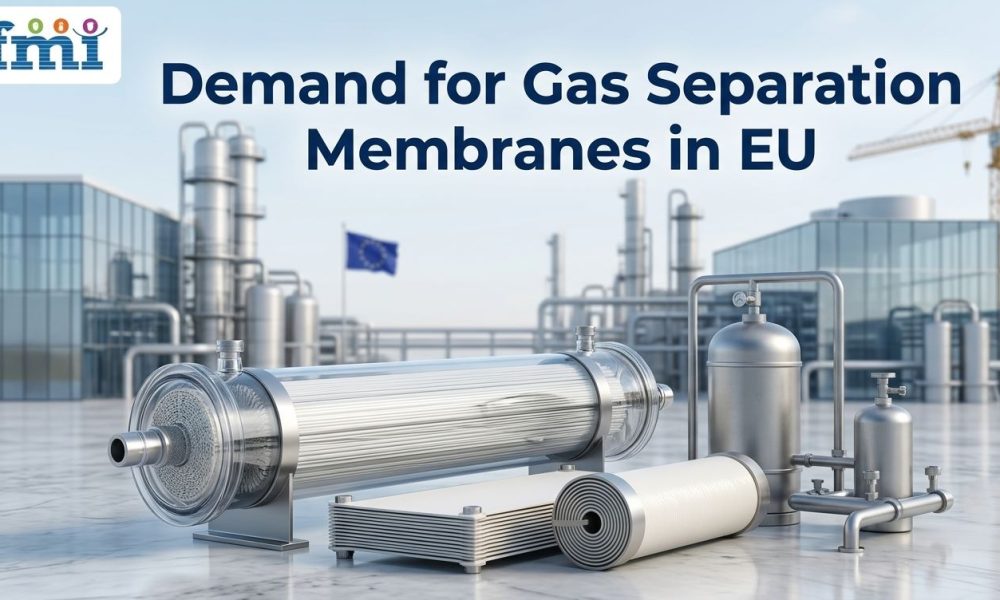
According to the latest market intelligence report published by Future Market Insights (FMI), demand for gas separation membranes in the EU is estimated at USD 699.30 million in 2026, rising from USD 656.00 million in 2025.
The market is projected to reach USD 1,325.05 million by 2036, expanding at a compound annual growth rate (CAGR) of 6.60% from 2026 to 2036. Growth is supported by expanding carbon capture, utilization and storage (CCUS) projects, hydrogen purification requirements, and increasing demand for biogas upgrading to meet grid injection standards across European markets.
Get detailed market forecasts, competitive benchmarking, and pricing trends: https://www.futuremarketinsights.com/reports/sample/rep-gb-27214
Market Size & Growth Forecasts
- 2025 Market Value: USD 656.00 million
- 2026 Estimated Market Size: USD 699.30 million
- 2036 Projected Market Value: USD 1,325.05 million
- Growth Rate:60% CAGR (2026–2036)
- Incremental Revenue Opportunity: Approximately USD 625.75 million over the forecast period
- Market Expansion Multiple: Approximately 1.9x
Key Market Segments
By Product Type
- Polyimide (Polymeric): Accounts for 36.0% of EU gas separation membrane sales in 2026. Its thermal stability, chemical resistance, and mechanical strength support applications involving CO₂ capture, hydrogen purification, and high-pressure industrial gas separation. Its share is projected to increase to 37.0% by 2036.
- Polysulfone (Polymeric): Serves industrial gas separation applications requiring polymeric membrane systems for selective gas transport and process efficiency.
- Other Polymeric Materials: Support specialized separation requirements across industrial and energy applications.
- Inorganic and Metallic Membranes: Ceramic, zeolite, and palladium-based systems serve applications requiring specialized separation performance and material properties.
By Application
- CO₂ Separation: Accounts for 27.5% of market demand in 2026, projected to reach 29.0% by 2036, driven by carbon capture, biogas upgrading, and natural gas sweetening.
- Hydrogen Separation: Supports hydrogen purification and recovery from industrial processes and low-carbon hydrogen production.
- Nitrogen Separation: Serves industrial nitrogen generation across manufacturing and process industries.
- Oxygen Separation: Supports oxygen enrichment and specialized industrial gas applications.
- Other Applications: Includes acid gas, methane, and olefin-paraffin separation across energy and chemical industries.
By Distribution Channel
- Direct to EPC/OEM: Accounts for 62.0% of market sales in 2026, increasing to 65.0% by 2036. Direct procurement supports technical collaboration, application engineering, project-specific customization, and supply reliability for CCUS and hydrogen infrastructure projects.
- Distributors: Serve customers requiring regional supply access and support for membrane systems and associated applications.
- Online/Indirect Channels: Support additional procurement routes for membrane products and related solutions.
By Membrane Construction Type
- Hollow Fiber: Supports compact module configurations and industrial gas separation applications requiring high membrane surface area.
- Spiral Wound: Provides an alternative module configuration for selected gas separation requirements.
- Plate and Frame: Serves applications requiring specialized membrane arrangements and system configurations.
By Country
- Spain: 6.8% CAGR, driven by CCUS, industrial decarbonization, and biogas upgrading.
- France:6% CAGR, supported by hydrogen infrastructure and industrial decarbonization.
- Germany: 5% CAGR, driven by industrial demand, hydrogen investment, and carbon capture.
- Italy:4% CAGR, supported by biogas production and carbon capture projects.
- Rest of Europe: 6.4% CAGR, driven by industrial gas demand and decarbonization.
- Netherlands: 6.3% CAGR, supported by chemical industries, hydrogen infrastructure, and CCUS.
Access the Complete Report in PDF Format: https://www.futuremarketinsights.com/reports/brochure/rep-gb-27214
Major Market Trends & Drivers
- Expansion of Carbon Capture Projects: European decarbonization initiatives are driving membrane demand for CO₂ separation in cement, steel, and refining industries.
- Hydrogen Infrastructure and Purification: Hydrogen production and recovery projects are increasing demand for membranes offering high selectivity, permeability, and operational stability.
- Biogas Upgrading and Renewable Natural Gas: Biomethane production for pipeline injection and fuel applications is creating opportunities for single-stage and multistage membrane systems.
- Technical Performance and Fouling Challenges: Membrane fouling, contaminants, and performance degradation can affect operating life and system economics, making reliability essential.
Competitive Landscape
The EU gas separation membranes market features specialized membrane manufacturers, chemical companies, and industrial gas providers. Competition centers on CO₂ selectivity, hydrogen recovery, module design, reliability, and application engineering. Partnerships with EPC contractors, OEMs, and CCUS developers support technology qualification and project adoption.
Key Companies Profiled Include: Evonik Industries AG, Air Liquide Advanced Separations, Fujifilm Manufacturing Europe B.V., regional membrane manufacturers, and industrial gas companies with membrane technologies.
Analyst Perspective / Insight:
“The EU gas separation membrane market is entering an infrastructure-scale deployment phase where carbon capture project development converts membrane technology from niche industrial gas applications to primary decarbonization infrastructure. Membrane manufacturers who cannot deliver modules rated for sour gas and high-CO₂ concentration service conditions face exclusion from the carbon capture project segment that represents the highest growth trajectory. The critical technology risk centers on membrane fouling under real industrial flue gas conditions, as long-term performance degradation in particulate-laden and SOx-contaminated gas streams limits membrane operating life below the economic thresholds carbon capture project developers require.”
About Future Market Insights
Future Market Insights (FMI) is a market intelligence and consulting organization providing research, market forecasts, competitive analysis, and strategic insights across industries. Its coverage spans chemicals, healthcare, food and beverage, technology, packaging, consumer goods, and industrial markets, supporting business planning and investment decisions.
Media Contact:
Corporate Communications Team
Future Market Insights
Email: [email protected]
Phone: +1-347-918-3531
Official Report Page: https://www.futuremarketinsights.com/reports/demand-for-gas-separation-membranes-in-eu



