
Summary: The UK gluten-free bakery market is expanding as medically necessary gluten avoidance sustains demand for everyday bakery staples, while verified gluten controls, improved texture, and affordable pack sizes influence repeat purchasing.
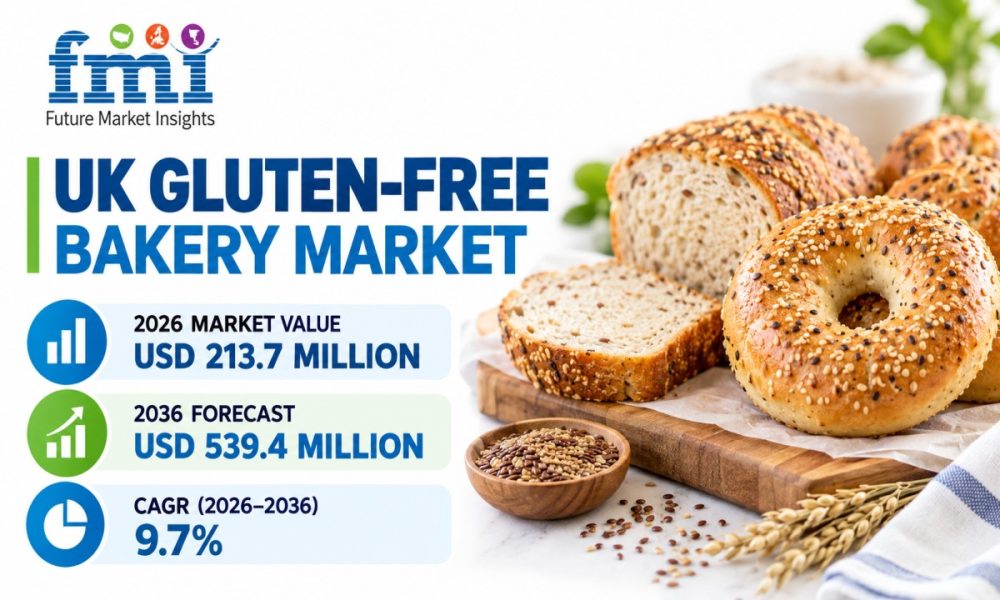
The UK gluten-free bakery market is projected to grow from USD 213.7 million in 2026 to USD 539.4 million by 2036, registering a CAGR of 9.7% during the forecast period, according to Future Market Insights (FMI). Demand is supported by lifelong dietary requirements among people with coeliac disease and wider consumer access to free-from products. However, price premiums and uneven access to gluten-free prescriptions continue to shape household purchasing decisions.
UK Gluten-Free Bakery Market Snapshot
- 2026 market value: USD 213.7 million
- 2036 forecast: USD 539.4 million
- CAGR (2026–2036):7%
- Leading claim nature: Conventional, with a 54.0% share in 2026
- Leading grade: Standard vital gluten, with a 43.0% share in 2026
- Leading format: Fresh, with a 36.0% share in 2026
- Leading sales channel: Supermarkets and hypermarkets, projected to hold 29.0% in 2026
Request a sample report: https://www.futuremarketinsights.com/reports/sample/rep-gb-34771
Why Is the UK Gluten-Free Bakery Market Growing?
Medical Need Supports Recurring Bakery Demand
People with coeliac disease must avoid gluten throughout their lives, creating consistent demand for bread and related bakery substitutes. Coeliac UK reported in May 2025 that 36% of people with coeliac disease in the UK had received a medical diagnosis, while approximately 500,000 people remained undiagnosed. This unmet diagnostic need represents a potential source of future demand as awareness and diagnosis improve.
Hull University Teaching Hospitals NHS Trust stated in January 2025 that a strict lifelong gluten-free diet is the only treatment for coeliac disease. Consequently, dependable availability and consistent product quality remain important to households purchasing gluten-free bakery staples.
Price Premiums Limit Repeat Purchasing
Higher prices remain a major barrier to market growth. Coeliac UK reported in February 2025 that gluten-free bread loaves cost 4.5 times more gram for gram than conventional equivalents. Specialist ingredients, controlled production processes, and waste exposure can increase costs for both manufacturers and retailers.
These economics make pack sizes, product freshness, and shelf availability important considerations. Manufacturers that balance verified gluten controls with acceptable taste, texture, and affordability may be better positioned to encourage repeat purchases.
Prescription Access Shapes Retail Demand
Access to gluten-free prescriptions varies across the UK’s devolved health systems. Coeliac UK reported in February 2026 that 43% of England’s 42 Integrated Care Boards had fully withdrawn gluten-free prescriptions, while Scotland and Wales retained broader national support arrangements in the same review.
As prescription access becomes less consistent, more purchasing may shift toward supermarkets and packaged bakery products. Retail demand therefore depends on price, pack size, reliable availability, and consumers’ ability to identify suitable products.
Key Segment Trends in the UK Gluten-Free Bakery Market
Conventional Products Lead Claim Nature
Conventional products are expected to account for 54.0% of the claim-nature category in 2026. Mainstream formulations provide manufacturers with flexibility to balance ingredient costs, texture, and familiar bakery characteristics across different price points.
At the same time, gluten-free claims require appropriate finished-product controls. Dr. Schär introduced its Quality Commitment in May 2025, setting optimal nutrition criteria for at least 95% of its new gluten-free products. This reflects the growing importance of combining safety and nutritional considerations with product quality.
Standard Vital Gluten Leads the Grade Category
Standard vital gluten is projected to represent 43.0% of the grade category in 2026, supported by broader commercial availability and more consistent sourcing than organic or high water-absorption grades.
Manufacturers must distinguish ingredient specifications from finished-product claim validation. The Food Standards Agency’s 2024/25 retail surveillance programme tested 60 free-from products and identified nine allergen-labelling issues, including four products using non-prescribed “free from gluten” wording. Clear labelling and disciplined product-release processes remain important for consumer confidence.
Supermarkets and Hypermarkets Lead Sales Channels
Supermarkets and hypermarkets are projected to account for 29.0% of the market in 2026. National retail networks support routine household shopping, product comparisons, and broader access to packaged gluten-free bakery goods.
Digital product-verification tools also support purchasing decisions. Coeliac UK reported in July 2025 that more than 185,000 products had been checked and restored to its Live Well Gluten Free app, helping consumers verify product information before buying.
Opportunities and Challenges
Key driver: Lifelong gluten avoidance creates recurring demand for bread and related bakery substitutes across everyday meals.
Key restraint: Price premiums reduce household purchasing flexibility and increase the commercial risks associated with slow-moving inventory and product waste.
Key opportunity: Accredited foodservice venues create additional demand for portioned bakery formats that maintain gluten controls during storage, handling, and final preparation. Coeliac UK reported in January 2026 that more than 3,000 UK food venues held its Gluten Free Accreditation.
Competitive Landscape
The UK gluten-free bakery market includes specialist brands and retailers offering controlled own-brand products. Dedicated bakery brands compete through range breadth, dependable texture, and documented gluten controls, while retail platforms benefit from national store networks and established customer access.
Key companies include Warburtons, Genius Foods, Dr. Schär, Juvela, Promise Gluten Free, BFree Foods, Tesco, and Marks & Spencer.
Recent Industry Developments
- February 2026: Marks & Spencer launched Gluten Free Colin the Caterpillar after Park Cakes invested £1.5 million in a segregated production line. The product reached more than 400 M&S stores and sold over 10,000 units within five days.
- September 2025: Genius Foods moved pharmacy bread production onto newly installed bakery equipment, linking the investment to improvements in texture, reliability, and production continuity.
- February 2025: Tesco introduced Finest Free From Chocolate Orange Hot Cross Buns for Easter, extending its seasonal gluten-free bakery offering through its national grocery network.
What Should Industry Participants Prioritize?
Manufacturers should prioritize verified gluten controls, consistent product texture, and pricing that supports repeat household purchases. Retailers can strengthen category performance through dependable availability, appropriate pack sizes, and clear product information. Foodservice suppliers have opportunities to expand through ready-to-finish bakery products and accredited venues, provided handling and preparation processes maintain the necessary controls.
For detailed market forecasts, segment analysis, competitive insights, and industry trends, access the full report from Future Market Insights:
https://www.futuremarketinsights.com/reports/united-kingdom-gluten-free-bakery-market
Related Reports
- Gluten-Free Food Market
- Gluten-Free Bread Market
- Gluten-Free Bakery Products Market
- Specialty Bakery Market
- Frozen Bakery Products Market
About Future Market Insights (FMI)
Future Market Insights, Inc. is an ESOMAR-certified, ISO 9001:2015 market research and consulting organization trusted by Fortune 500 companies. With a global presence across the U.S., UK, India, and Dubai, FMI delivers data-driven insights across 30+ industries and 1,200 markets worldwide.



