
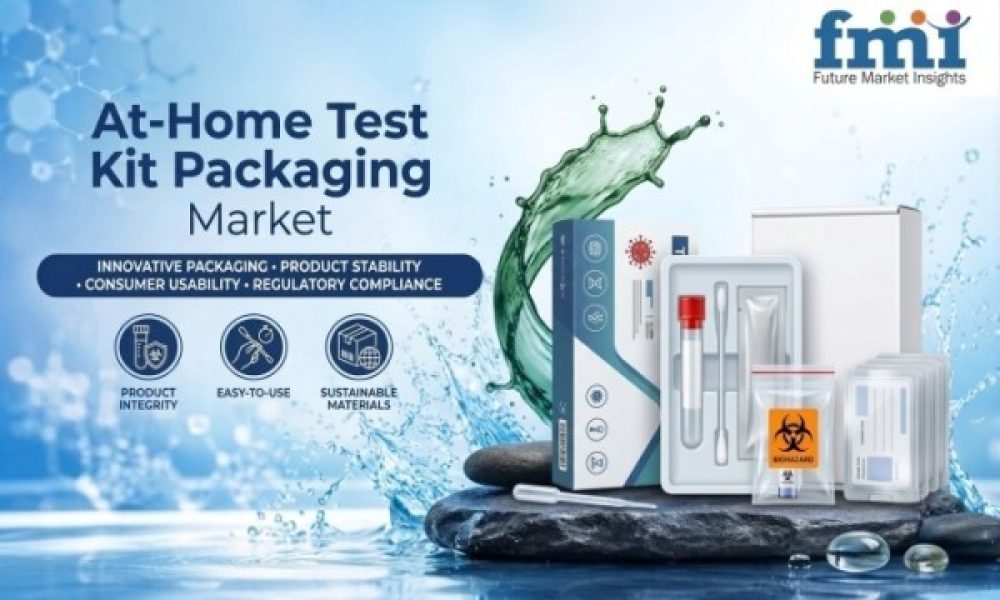
The global at-home test kit packaging market is projected to grow from USD 646.9 million in 2026 to USD 1,074.0 million by 2036, registering a compound annual growth rate (CAGR) of 5.2%, according to Future Market Insights (FMI). Demand is linked to the expanding range of diagnostic tests designed for home use, where packaging must organize components, protect sensitive materials and help consumers follow testing instructions correctly.
As diagnostic manufacturers introduce additional over-the-counter (OTC) test formats, packaging decisions increasingly extend beyond material selection and unit cost. Component placement, label control, barrier performance and protection during parcel distribution all influence whether a package can support repeat commercial production.
Get detailed market forecasts, competitive benchmarking, and pricing trends:
https://www.futuremarketinsights.com/reports/sample/rep-gb-35084
Home Diagnostic Formats Are Changing Packaging Requirements
Recent regulatory authorizations illustrate the range of consumer test formats entering the market. In October 2025, the US Food and Drug Administration (FDA) granted ACON Laboratories traditional authorization for an OTC four-analyte test covering respiratory syncytial virus (RSV), influenza A/B and COVID-19. In January 2025, the FDA also granted traditional authorization for Wondfo USA’s Welllife COVID-19 / Influenza A&B Home Test.
These multi-analyte formats place greater emphasis on packaging layouts that keep collection materials, test components and instructions distinguishable. A design must preserve the intended sequence from opening the kit through sample collection and result interpretation.
FMI estimates that swab and vial kits will account for 30.0% of the market in 2026. These kits require secure component retention because collection and transfer steps depend on users handling the correct items in the intended order.
Polymer Systems Lead the Material Outlook
Polymer systems are projected to represent 36.0% of the market by material in 2026. Thermoformed trays and molded structures can position components while limiting the weight of the package, an important consideration for products shipped directly to households.
However, polymer packaging is not suitable for every test configuration. Reagent compatibility, moisture and oxygen barriers, and shelf-life requirements determine whether a polymer-only structure is appropriate. Glass, aluminium and foil, and fiber-based materials continue to serve applications with different containment, protection and presentation requirements.
Child-resistant packaging is expected to account for 29.0% of the market by compliance feature in 2026. Its relevance depends on the risk presented by the specific kit, including whether small liquid containers require additional access controls. Child resistance, tamper evidence and serialization address different requirements and should not be treated as interchangeable features.
Qualification Costs Create a Barrier to Package Switching
A lower-priced package does not automatically provide a lower-cost solution for diagnostic manufacturers. Changes to trays, barrier materials, printed labels or instructions can trigger compatibility reviews, production-line trials and quality-system assessments.
Packaging suppliers that support controlled artwork revisions while retaining qualified component geometry may help customers reduce avoidable requalification work. This is particularly relevant when one test family requires different labels, languages or instructions across markets.
Regional technical support is another consideration. In March 2026, Nelipak opened an Asia-Pacific Technical Development Center in Singapore for package design and validation. In August 2025, Amcor opened a healthcare warehouse and distribution facility in Costa Rica. These developments illustrate two different aspects of the supply chain: technical assistance during package development and regional availability of healthcare packaging formats.
For suppliers, the opportunity lies in structures that accommodate product variants without compromising fit, protection, instructions or validation requirements.
Germany Leads the Profiled Country Growth Forecast
FMI’s country outlook places Germany at a projected CAGR of 6.8% between 2026 and 2036, followed by the United States at 6.5% and South Korea at 6.2%. The United Kingdom is forecast to grow at 5.9%, France at 5.6%, and Japan at 5.3%.
These forecasts point to differing national growth trajectories. Packaging suppliers serving multiple countries must account for language requirements, labeling revisions, local compliance processes and distribution conditions. Reusable structural designs can help manage product variation, but each application still requires appropriate qualification and documentation.
Competitive Landscape and Report Coverage
Companies profiled in the report include Nelipak, Amcor, Oliver Healthcare Packaging, TekniPlex Healthcare, DuPont, SGD Pharma, Gerresheimer and Sonoco ThermoSafe. Their relevance varies by packaging format, from formed and flexible healthcare structures to primary containers, barrier materials and temperature-qualified transport systems.
The FMI report examines the market by product type, material, compliance feature, end use, sales channel and region. Product categories include swab and vial kits, lateral-flow kit trays, return mailer kits and serialized kit cartons. End-use segments cover hospital and clinical settings, retail pharmacies, clinical trials, and OTC and direct-to-consumer health applications.
The geographic assessment covers North America, Latin America, Europe, East Asia, South Asia and Pacific, and the Middle East and Africa. FMI’s research approach combines primary and secondary research with market triangulation and validation of market estimates.
Analyst Perspective
“At-home test kit packaging earns repeat business once one qualified structure can absorb new analytes, labels and country instructions without changing component geometry. The commercial advantage is lower requalification work with lay-user sequencing, barrier performance and parcel protection preserved.”
Nandini Roy Choudhury, Principal Consultant, Future Market Insights
About the Report
The At-Home Test Kit Packaging Market report provides market sizing and forecasts for 2026–2036, with analysis of product and material segments, compliance features, end uses, sales channels, regional trends and key companies.
Read the full report: https://www.futuremarketinsights.com/reports/at-home-test-kit-packaging-market
FMI Custom Research: Strategic Intelligence for Confident Decision-Making
In today’s rapidly evolving business environment, leadership teams need more than market data—they need clear, actionable intelligence tailored to their strategic objectives. FMI’s Custom Research solutions are designed around the specific business questions organizations need answered, enabling executives to evaluate growth opportunities, validate investments, assess competitive dynamics, and reduce uncertainty before making critical decisions. By combining deep industry expertise, primary research, and proprietary market intelligence, FMI delivers insights that help organizations move from assumptions to evidence-based strategies with greater speed and confidence.
Business Impact
FMI helps organizations transform market complexity into strategic clarity, enabling leadership teams to identify growth opportunities faster, optimize resource allocation, strengthen competitive positioning, and make high-stakes business decisions with confidence.
To explore how FMI Custom Research can support your strategic priorities, please connect with our team at – [email protected]
About Future Market Insights (FMI)
Future Market Insights, Inc. (FMI) is an ESOMAR-certified, ISO 9001:2015 market research and consulting organization, trusted by Fortune 500 clients and global enterprises. With operations in the U.S., UK, India, and Dubai, FMI provides data-backed insights and strategic intelligence across 30+ industries and 1200 markets worldwide.



