
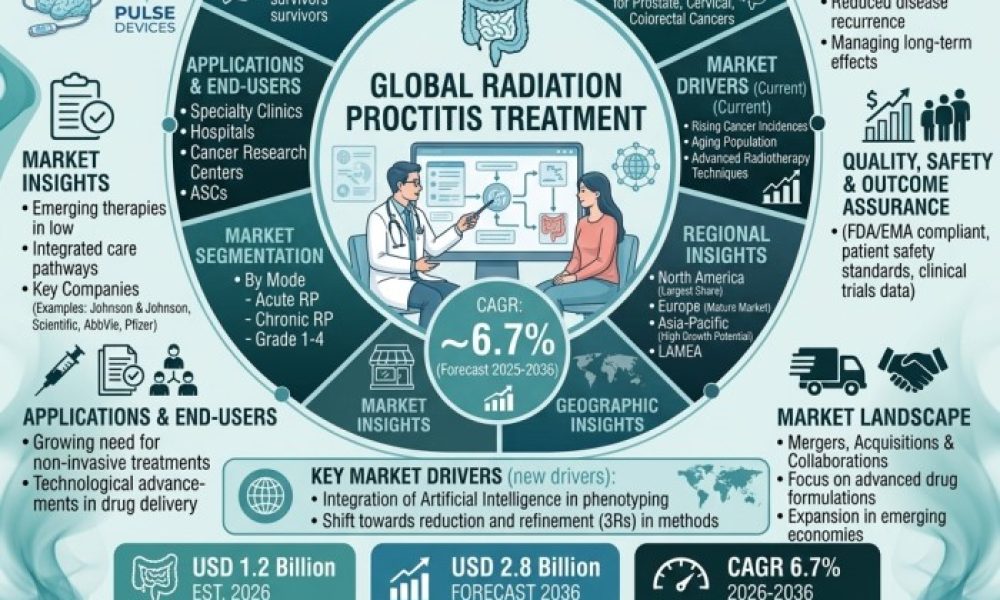
Rising pelvic-cancer radiotherapy volumes and wider adoption of argon plasma coagulation are reshaping demand for stepped radiation-proctitis care, according to Fact.MR.
NEWARK, Del., October 8, 2026. — The global radiation proctitis treatment market is estimated at USD 0.6 billion in 2026 and is projected to reach USD 1.3 billion by 2036, expanding at a CAGR of 8.0% during the forecast period, according to Fact.MR. The market is expected to create an absolute dollar opportunity of USD 0.7 billion between 2026 and 2036. Pharmacological Therapies lead the product segment with a 44.6% share in 2026, while Post Radiation Cancer Care accounts for 68.3% of the application segment.
Get detailed market forecasts, competitive benchmarking, and pricing trends:
Radiotherapy volumes are expanding the treatment pool
The strongest demand trigger is the rising volume of pelvic-cancer radiotherapy for prostate, cervical, uterine, and rectal cancers. Fact.MR identifies the resulting increase in chronic radiation proctitis cases as a central growth driver. At the same time, argon plasma coagulation is being adopted as a first-line endoscopic strategy for hemorrhagic cases, while topical rectal therapies such as sucralfate enemas and oral support agents broaden conservative treatment pathways.
The market is developing around a stepped-care model rather than a single treatment approach. Pharmacological therapies form the broad entry point, while endoscopic intervention and hyperbaric oxygen therapy address hemorrhagic or refractory cases. Limited access to hyperbaric oxygen facilities, however, keeps some advanced treatment concentrated in specialized centers.
Where growth is fastest
- China — 9.5% CAGR: The country has the highest CAGR in the report’s country table. Expanding cancer-treatment capacity and rising pelvic-cancer radiotherapy volumes are widening demand for argon plasma coagulation and pharmacological therapies. Centralized procurement is also steering hospital purchasing toward cost-competitive products.
- India — 8.8% CAGR: Expanding private oncology networks and rising radiotherapy volumes are increasing demand, particularly in metropolitan cancer centers. Cost considerations favor pharmacological and topical rectal therapies, while argon plasma coagulation access remains concentrated in tertiary centers.
- Germany — 8.1% CAGR: Structured oncology networks, EU medical-device requirements and the GKV reimbursement framework shape procurement and treatment availability. Fact.MR identifies documentation requirements and reimbursement as important considerations for endoscopic and hyperbaric pathways.
- Brazil — 7.4% CAGR: Brazil is the fourth-fastest market in the published country CAGR table.
- United States — 6.7% CAGR: Established oncology and gastroenterology networks support demand, with reimbursement and specialty-center access influencing adoption.
- United Kingdom — 6.0% CAGR: The UK is included among the major country markets covered in Fact.MR’s forecast, with a 6.0% CAGR in the country table.
- Japan — 5.3% CAGR: Japan records the lowest CAGR in the published country table, with advanced endoscopic practice and domestic device manufacturing supporting demand.
What leads the market
- Pharmacological Therapies — 44.6%: This is the leading product category in 2026, supported by conservative medical management, including sucralfate-based and oral support therapies.
- Post Radiation Cancer Care — 68.3%: This is the dominant application segment in 2026, reflecting the concentration of demand among patients requiring care following pelvic-cancer radiotherapy.
Endoscopic treatment technology is also a major part of the treatment pathway, particularly where argon plasma coagulation is used for hemorrhagic cases. Hyperbaric oxygen therapy represents a more specialized option for refractory disease.
The hurdle
The principal constraint is the absence of standardized, guideline-endorsed treatment regimens combined with limited high-powered trial evidence. Fact.MR also identifies the risk of post-procedure rectal ulcers following argon plasma coagulation and limited access to hyperbaric oxygen facilities as factors affecting adoption. These conditions make treatment selection and access dependent on clinical setting, available infrastructure and patient-specific circumstances.
Recent developments
Fact.MR identifies several recent areas of clinical and research activity:
- April 23, 2025: A ScienceDaily report by Manning, Karlsson, Hammarström and Laurell discussed long-term relief associated with hyperbaric oxygen treatment for radiation-induced injuries. The Fact.MR bibliography cites the report as a reference supporting its discussion of hyperbaric oxygen therapy.
- 2025: Comparative studies of argon plasma coagulation power and parameter settings continued to examine treatment approaches for chronic radiation proctitis. Fact.MR says this research activity reinforces argon plasma coagulation as the preferred endoscopic modality for rectal bleeding control.
- 2026: The report cites a StatPearls update, Hyperbaric treatment of radiation proctitis, by Cooper and Thacker, published in 2026. Fact.MR also notes that clinical research published through 2025 continued evaluating optimal argon plasma coagulation treatment parameters.
The companies profiled include Erbe Elektromedizin GmbH, Olympus Corporation, Boston Scientific Corporation, Medtronic plc, FUJIFILM Holdings Corporation, Pentax Medical (HOYA Group), CONMED Corporation, Sanofi, Allergan (AbbVie Inc.), and Smith & Nephew plc.
Analyst perspective
“Radiation proctitis treatment is a stepped-care market tied directly to pelvic-cancer radiotherapy volumes. There is no single guideline-endorsed regimen, so demand layers across conservative pharmacological therapy, argon plasma coagulation for hemorrhagic cases, and hyperbaric oxygen for refractory disease. Pharmacological options lead by share, but endoscopic technology anchors the active-intervention pathway. China and India are scaling fastest as cancer-care capacity expands and radiotherapy caseloads rise. The suppliers best positioned pair validated endoscopic platforms with supporting topical therapies and cancer-center relationships, since access to argon plasma coagulation and hyperbaric facilities largely determines which patients reach definitive treatment.”
— Shambhu Nath Jha, Principal Consultant, Fact.MR
What this means for healthcare procurement and industry decision-makers
- Plan portfolios around stepped care.
Procurement teams should distinguish between broad-demand pharmacological therapies and more specialized endoscopic or hyperbaric interventions. The 44.6% share held by Pharmacological Therapies indicates the scale of the conservative-treatment opportunity, while endoscopic technology addresses a distinct intervention pathway. - Assess infrastructure before expanding advanced treatment capacity.
MR identifies limited access to hyperbaric oxygen facilities as a market constraint. Investment decisions should therefore consider whether the target cancer-center network has the infrastructure and patient volume needed to support specialized treatment pathways. - Prioritize high-growth markets while accounting for procurement conditions.
China and India have the fastest published country growth rates at 9.5% and 8.8%, respectively. In China, centralized procurement influences purchasing decisions, while India’s demand is concentrated in metropolitan cancer centers and expanding private oncology networks.
Report coverage
The Fact.MR report covers the global radiation proctitis treatment market across product, application, end use, technology, formulation and distribution channel, with forecasts from 2026 to 2036.
Explore More Related Studies Published by Fact.MR Research
Non-Invasive Diagnostic Tests Market
Elastomeric Pump Cartridges Market
About Fact.MR
Fact.MR is a market research and consulting firm providing syndicated research, customized research, investment research, and market intelligence across a broad range of industries. Its research coverage includes food and beverage, healthcare, pharmaceuticals, biotechnology, consumer products, chemicals and materials, technology, industrial goods, and packaging.
Fact.MR provides market intelligence designed to help organizations understand market dynamics, emerging opportunities, competitive developments, and changing industry requirements.
Media Contact
Fact.MR
Email: [email protected]
Phone: +1 (628) 251-1583
Website: www.factmr.com



