
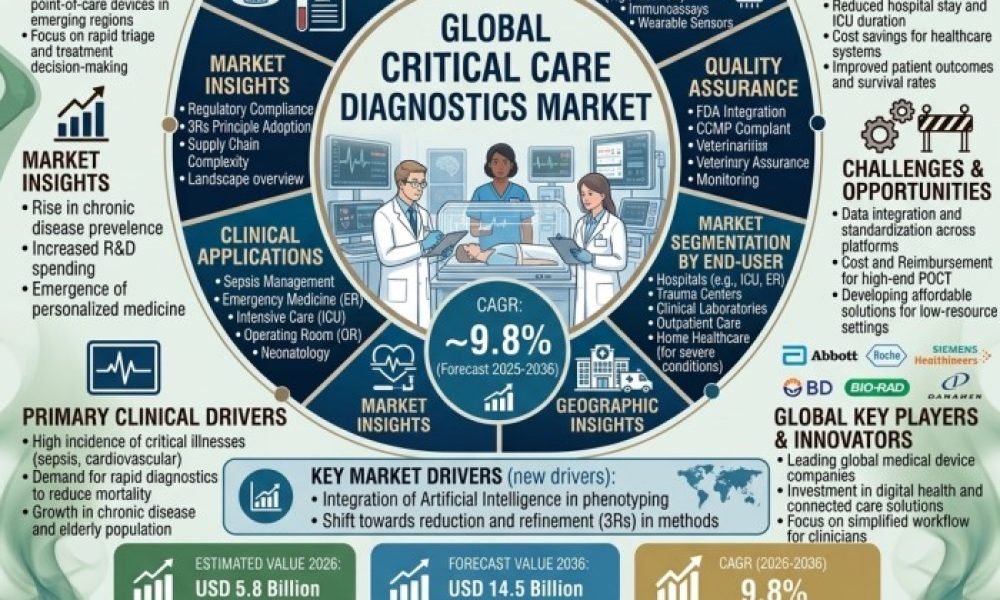
Migration of critical testing to bedside platforms, rapid molecular assays and AI-enabled decision support are reshaping procurement priorities, according to Fact.MR.
NEWARK, Del., October 8, 2026. — The global critical care diagnostics market is projected to grow from USD 1.5 billion in 2026 to USD 2.6 billion by 2036, expanding at a 5.5% CAGR, according to Fact.MR. The market is expected to create an incremental opportunity of USD 1.1 billion over the forecast period.
The shift toward rapid testing at the bedside is becoming a central source of demand. Point-of-care platforms are extending cardiac, coagulation and infectious-disease testing beyond central laboratories, while rapid molecular assays are adding new testing applications in intensive-care and emergency settings. At the same time, AI-enabled decision-support integration is increasing the value of connected diagnostic systems.
Get detailed market forecasts, competitive benchmarking, and pricing trends:
Where growth is fastest
- China: The market is projected to expand at a 7.4% CAGR through 2036. Hospital expansion and intensive-care capacity build-out across provincial centers are widening demand for point-of-care diagnostic systems and cardiac biomarker testing. Centralized procurement is also directing purchasing toward competitively priced rapid diagnostic kits.
- India: Growth is forecast at a 6.9% CAGR. Expanding private critical-care networks and rising cardiac and sepsis caseloads are supporting point-of-care adoption, while cost considerations favor rapid diagnostic kits and reagent-based systems in emerging centers.
- Germany: The market is expected to advance at a 6.3% CAGR. EU IVDR compliance is increasing documentation and validation requirements for critical-care diagnostic platforms, while GKV reimbursement and lifecycle-cost priorities favor instrument-integrated systems with established service networks.
- Brazil: The market is projected to grow at a 5.8% CAGR through 2036.
- U.S.: Growth is expected at a 5.2% CAGR, with mature installed capacity shifting demand toward point-of-care expansion and platform upgrades.
- UK: The market is forecast to rise at a 4.7% CAGR.
- Japan: Growth is projected at a 4.1% CAGR, supported by preference for validated diagnostic platforms and demand associated with cardiac and critical-care testing.
What leads the market
- Point of Care Diagnostic Systems account for 46.8% of the product segment in 2026, making them the leading product category. Their position reflects the migration of critical testing from central laboratories to bedside settings and the expansion of rapid molecular and immunoassay platforms.
- Intensive Care Unit Diagnostics represent 71.2% of the application segment in 2026. The segment remains the dominant use setting because acute cardiac, sepsis and respiratory testing is concentrated in intensive-care units, generating recurring demand for diagnostic reagents and systems.
The hurdle
Infrastructure remains a constraint, particularly where molecular cartridge deployment depends on reliable cold-chain and supporting infrastructure. The report also identifies multiyear reagent-rental agreements as a barrier to competitive switching because hospitals can become tied to established platforms. Staffing shortages in some regions may further restrict adoption of more complex critical-care assays.
These factors make service capability, installed base and platform connectivity important considerations alongside instrument pricing.
Recent developments
Industry activity is reinforcing the move toward rapid point-of-care testing.
In December 2025, F. Hoffmann-La Roche Ltd received FDA 510(k) clearance and a CLIA waiver for its cobas Liat Bordetella assay. According to the report, the molecular point-of-care assay delivers results in roughly 15 minutes and expands rapid on-site testing in U.S. critical and acute settings.
In April 2025, Baebies received FDA Breakthrough Device designation for a point-of-care heparin monitoring test designed to deliver results in under 15 minutes. The report links the development to faster anticoagulation management in critical-care and surgical settings.
Key companies profiled in the report include Abbott Laboratories, F. Hoffmann-La Roche Ltd, Siemens Healthineers AG, Danaher Corporation, Becton, Dickinson and Company, bioMerieux SA, Werfen, Nova Biomedical, QuidelOrtho Corporation and Sysmex Corporation.
The report describes the competitive environment as moderately concentrated. Abbott, Roche, Siemens Healthineers and Danaher have broad positions across point-of-care and central critical-care platforms, while Becton Dickinson, bioMerieux, Werfen and Nova Biomedical compete in areas including cardiac, coagulation and infectious-disease testing.
Analyst perspective
“Critical-care testing is migrating to the bedside, and that migration favors suppliers with connected platforms rather than the broadest catalog alone. New rapid molecular point-of-care assays, some returning results in about 15 minutes, change clinical management in intensive care and emergency settings. Multiyear reagent agreements lock in revenue and slow switching, so installed base matters more than list price.
China and India are expanding fastest as hospital and ICU capacity grows. The advantage goes to firms that combine rapid results with decision-support integration and dependable service, since hospitals are standardizing on data-connected systems, not standalone analyzers.”
— Shambhu Nath Jha, Principal Consultant, Fact.MR
What this means for hospital procurement and diagnostic decision-makers
- Evaluate platforms beyond instrument price.
Procurement teams should consider reagent commitments, service networks, connectivity and lifecycle costs when comparing critical-care diagnostic platforms. The report indicates that multiyear reagent agreements and installed bases can materially affect supplier switching. - Prioritize testing workflows that benefit from speed and connectivity.
The expansion of rapid molecular point-of-care assays and AI-enabled decision-support creates opportunities to integrate diagnostic results more closely with critical-care workflows. Buyers should assess whether new systems can connect testing with existing data environments. - Track emerging-market infrastructure and procurement models.
China and India are forecast to grow faster than the other countries listed in the report. Hospital expansion, ICU capacity development and cost-sensitive procurement are shaping demand in these markets, creating different requirements from mature markets such as the U.S. and Japan.
The Critical Care Diagnostics Market report covers global and regional forecasts from 2026 to 2036 across product, application, end use, technology, formulation and distribution channel.
Explore More Related Studies Published by Fact.MR Research
Non-Invasive Diagnostic Tests Market
CPAP Humidifier Chambers Market
About Fact.MR
Fact.MR is a market research and consulting firm providing syndicated research, customized research, investment research, and market intelligence across a broad range of industries. Its research coverage includes food and beverage, healthcare, pharmaceuticals, biotechnology, consumer products, chemicals and materials, technology, industrial goods, and packaging.
Fact.MR provides market intelligence designed to help organizations understand market dynamics, emerging opportunities, competitive developments, and changing industry requirements.
Media Contact
Fact.MR
Email: [email protected]
Phone: +1 (628) 251-1583
Website: www.factmr.com



