
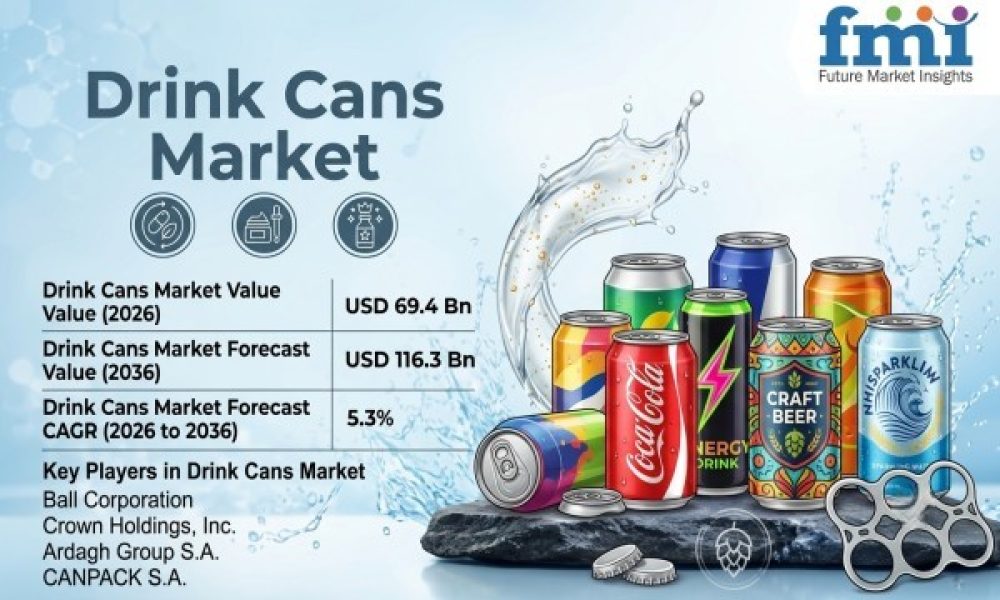
The global drink cans market is projected to grow from USD 69.4 billion in 2026 to USD 116.3 billion by 2036, expanding at a 5.3% CAGR over the forecast period, according to Future Market Insights (FMI). The market was valued at USD 65.9 billion in 2025.
Demand is being shaped by rising consumption of canned beverages, sustainability-led packaging decisions, and the expansion of beverage categories that increasingly use metal cans. Aluminum beverage cans account for 75.0% of product share, making them the leading product segment in the market.
Carbonated soft drinks remain the largest application category, accounting for 35.0% of application share in 2026. At the same time, alcoholic beverages, energy drinks, sports drinks, functional beverages, canned water, and ready-to-drink products are broadening the role of cans across the beverage industry.
Get detailed market forecasts, competitive benchmarking, and pricing trends:
https://www.futuremarketinsights.com/reports/sample/rep-gb-14114
Sustainability and Beverage Consumption Support Can Demand
The shift toward recyclable packaging is a key factor supporting demand for aluminum beverage cans. Aluminum offers lightweight construction, barrier properties, efficient chilling, and established recycling infrastructure. The report notes that aluminum can recycling rates exceed 70% in many established collection markets.
Brand owners are increasingly incorporating packaging sustainability into product and portfolio decisions. This is supporting the movement toward cans in applications that have traditionally relied on bottles or other packaging formats.
Growth in canned craft beer, hard seltzers, ready-to-drink cocktails, energy drinks, sports drinks, functional beverages, and canned water is creating additional production requirements for can manufacturers.
Nandini Roy Choudhury, Principal Consultant at FMI, says, “Can manufacturers that can deliver lightweight designs with improved sustainability credentials while maintaining production cost competitiveness are likely to capture growing brand owner demand over the forecast period.”
Aluminum Cans Remain the Dominant Product Format
Aluminum beverage cans hold a 75.0% share of the product segment. Two-piece drawn-and-wall-ironed cans remain the standard high-volume production format, with common sizes including 330 ml and 355 ml formats.
Lightweighting is also influencing can manufacturing. Producers are working to reduce aluminum content while maintaining structural performance. For beverage companies, this creates a balance between material efficiency, packaging performance, sustainability requirements, and manufacturing economics.
Carbonated soft drinks account for 35.0% of application share. Major soft drink brands continue to support large-scale can consumption through single-serve, convenience, vending, and multipack channels.
United States Leads Country-Level Growth
The United States is projected to register a 7.9% CAGR through 2036, the fastest country-level growth among the markets highlighted in the study.
South Korea follows with a 7.8% CAGR, supported by convenience store beverage sales and expanding canned alcoholic and functional beverage categories. The European Union is projected to grow at 7.6% CAGR, while the United Kingdom and Japan are expected to register 7.4% and 7.3% CAGR, respectively.
Regional growth is being influenced by established beverage consumption patterns, recycling infrastructure, packaging regulations, convenience retail, and the expansion of canned beverage categories.
Cost Volatility Remains a Key Industry Consideration
While demand fundamentals remain favorable, can manufacturers face exposure to aluminum raw material and energy price volatility. Changes in primary aluminum prices, energy tariffs, and alloy premiums can affect manufacturing economics and contract pricing.
Competition from other beverage packaging formats also remains relevant. Producers therefore need to balance material efficiency, production costs, customer requirements, and sustainability expectations.
Capacity expansion is another important area to monitor. Major producers are investing in additional manufacturing capabilities to address capacity constraints and serve beverage customers across North America, Europe, and Asia-Pacific.
Competitive Landscape
The global competitive environment includes major producers with established manufacturing networks and beverage customer relationships. Key companies profiled in the report include Ball Corporation, Crown Holdings, Inc., Ardagh Group S.A., CANPACK S.A., Toyo Seikan Group Holdings, Silgan Holdings Inc., and Envases Group.
Additional companies covered include Hindustan Tin Works Ltd., CPMC Holdings Ltd., and Ball Beverage Packaging South America. Emerging players identified in the study include Baosteel Packaging, Massilly Group, Orora Packaging, and Bharat Containers.
Report Scope
The FMI study covers the drink cans market by product, application, end use, capacity, and region. Product categories include aluminum beverage cans, steel beverage cans, and hybrid and specialty cans. Applications include carbonated soft drinks, alcoholic beverages, energy and sports drinks, juices and functional drinks, and water and sparkling water.
The research covers 2026 to 2036 forecasts, with historical analysis and market assessment across more than 30 countries.
Dive Deeper into the Data—View the Full Report Here!
https://www.futuremarketinsights.com/reports/drink-cans-market
FMI Custom Research: Strategic Intelligence for Confident Decision-Making
In today’s rapidly evolving business environment, leadership teams need more than market data—they need clear, actionable intelligence tailored to their strategic objectives. FMI’s Custom Research solutions are designed around the specific business questions organizations need answered, enabling executives to evaluate growth opportunities, validate investments, assess competitive dynamics, and reduce uncertainty before making critical decisions. By combining deep industry expertise, primary research, and proprietary market intelligence, FMI delivers insights that help organizations move from assumptions to evidence-based strategies with greater speed and confidence.
Business Impact
FMI helps organizations transform market complexity into strategic clarity, enabling leadership teams to identify growth opportunities faster, optimize resource allocation, strengthen competitive positioning, and make high-stakes business decisions with confidence.
To explore how FMI Custom Research can support your strategic priorities, please connect with our team at – [email protected]
About Future Market Insights (FMI)
Future Market Insights, Inc. (FMI) is an ESOMAR-certified, ISO 9001:2015 market research and consulting organization, trusted by Fortune 500 clients and global enterprises. With operations in the U.S., UK, India, and Dubai, FMI provides data-backed insights and strategic intelligence across 30+ industries and 1200 markets worldwide.



