
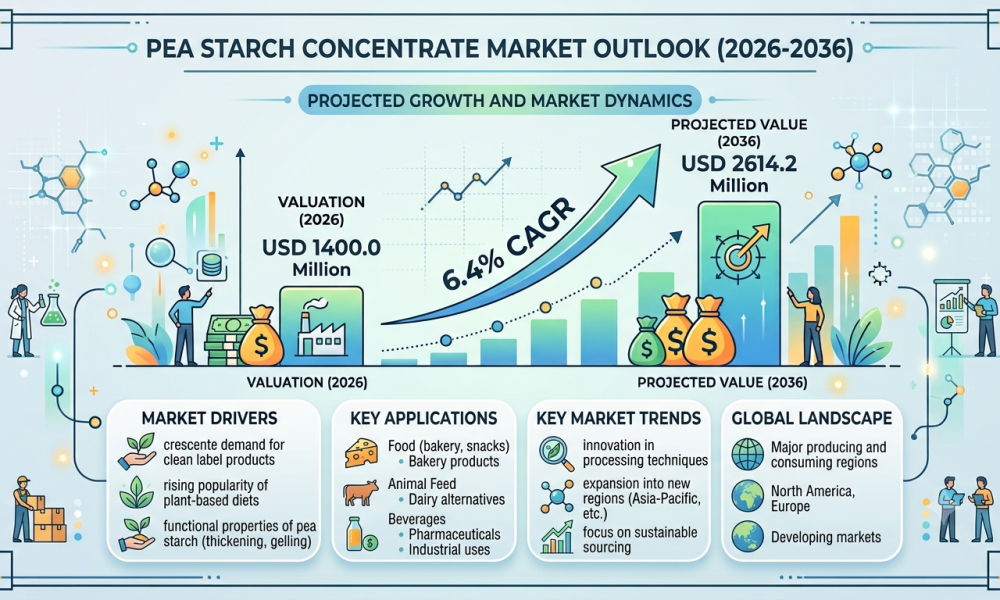
The global pea starch concentrate market is projected to grow from USD 1,400.0 million in 2026 to USD 2,614.2 million by 2036, registering a 6.4% CAGR during the forecast period. Growth is supported by rising demand for clean-label starches, plant-based formulations, gluten-free foods, and functional ingredients that provide binding, thickening, and firm-gel properties. Pea starch concentrate is gaining attention among food manufacturers seeking pulse-based alternatives to conventional corn and potato starches.
Demand is particularly strong in bakery applications, where pea starch can support texture and binding in gluten-free formulations. The ingredient is also finding opportunities in meat analogues, noodles, snacks, beverages, soups, sauces, pet food, and other applications. Growing investment in soluble, pregelatinized, and ready-to-eat grades is creating opportunities for suppliers to move beyond conventional native starch and address more specialized formulation requirements.
Get detailed market forecasts, competitive benchmarking, and pricing trends: https://www.futuremarketinsights.com/reports/sample/rep-gb-12546
Global Segment Leaders
- Product Type – Yellow Peas: 62.2% in 2026. Yellow peas lead the product type segment as major wet-fractionation facilities commonly use yellow peas, while their starch properties support applications requiring firm gels and binding.
- Nature – Conventional: 93.8% in 2026. Conventional pea starch concentrate dominates because organic supply requires additional segregation and handling costs, while conventional grades meet the clean-label and non-GMO requirements of many food manufacturers.
- End Use – Bakery: 30.4% in 2026. Bakery represents the leading end-use segment, supported by demand for starches that provide binding, moisture management, and texture in bread, cakes, cookies, and gluten-free formulations.
- Grade – Food Grade: 75.1% in 2026. Food-grade pea starch accounts for the largest share as food manufacturers require defined specifications and certifications for ingredients used in commercial formulations.
Country-Level Performance
New Zealand is projected to grow at the fastest pace, with a 7.6% CAGR through 2036. Growth is supported by demand from specialty food and snack manufacturers and the use of imported specialty grades.
Canada is expected to record a 7.2% CAGR, supported by its strong dry-pea production base and the availability of domestic pea supplies for starch processing and export-oriented applications.
The United Kingdom is forecast to grow at a 6.7% CAGR, with bakery and snack manufacturers contributing to demand. Traceability, supply availability, and landed costs are expected to influence supplier selection.
The United States is projected to expand at a 6.3% CAGR, supported by established food-processing applications, domestic pea production, and recurring demand for documented food-grade starch products.
Mexico is expected to grow at a 5.7% CAGR, supported by regional food ingredient suppliers and growing use of pea starch in food formulations.
Australia is forecast to record a 5.3% CAGR, supported by its pulse production base and demand for functional starch ingredients.
Russia is projected to grow at a 4.3% CAGR, while Brazil is expected to record the slowest growth among the profiled countries at 2.9%.
Regional Context
New Zealand and Canada represent the faster-growing markets, with CAGRs of 7.6% and 7.2%, respectively. Their growth is supported by pulse availability, food processing demand, and opportunities for specialty pea starch grades. The United Kingdom and United States also show strong expansion at 6.7% and 6.3%, reflecting continued adoption across bakery, snacks, and other processed-food applications.
Mexico and Australia are projected to grow at moderate rates of 5.7% and 5.3%, respectively. Russia and Brazil record comparatively slower growth, at 4.3% and 2.9%, reflecting stronger competition from established starch sources and differences in local supply economics.
The full report covers North America, Latin America, Western Europe, Eastern Europe, East Asia, South Asia and Pacific, and the Middle East and Africa, with 27 countries and country groups covered in the study.
Access full Report in PDF Format@ https://www.futuremarketinsights.com/reports/brochure/rep-gb-12546
Competitive Landscape
The competitive landscape includes Roquette Freres, Cosucra Groupe Warcoing SA, Emsland Group, AGT Food and Ingredients Inc., Ingredion Incorporated, Puris Foods, Vestkorn Milling AS, Yantai Shuangta Food Co., Ltd., and Nutri-Pea Limited. Competition is shaped by product-grade breadth, processing capabilities, technical support, certification, and the development of specialized pea starch formats.
Recent developments include Roquette’s introduction of AMYSTA L 123 in October 2025, a thermally soluble pea starch designed for beverages, soups, and sauces. PURIS has also expanded its pea starch portfolio across native, pregelatinized, and ready-to-eat formats, reflecting growing demand for process-ready ingredients.
Analyst Perspective
“Pea starch concentrate will find less obvious demand in glass noodles and vermicelli, as the high amylose in pea starch gives the firm, translucent strands normally made from costlier mung bean starch. I also see new openings in pet food kibble binding, edible films and biodegradable packaging, as gel strength and clean-label status are drawing buyers from outside the core bakery and snack space.”
— Nandini Roy Choudhury, Principal Consultant, Future Market Insights
About Future Market Insights (FMI)
Future Market Insights, Inc. (ESOMAR certified, recipient of the Stevie Award, and a member of the Greater New York Chamber of Commerce) offers profound insights into the driving factors that are boosting demand in the market. FMI stands as the leading global provider of market intelligence, advisory services, consulting, and events for the Packaging, Food and Beverage, Consumer Technology, Healthcare, Industrial, and Chemicals markets. With a vast team of over 400 analysts worldwide, FMI provides global, regional, and local expertise on diverse domains and industry trends across more than 110 countries.



