
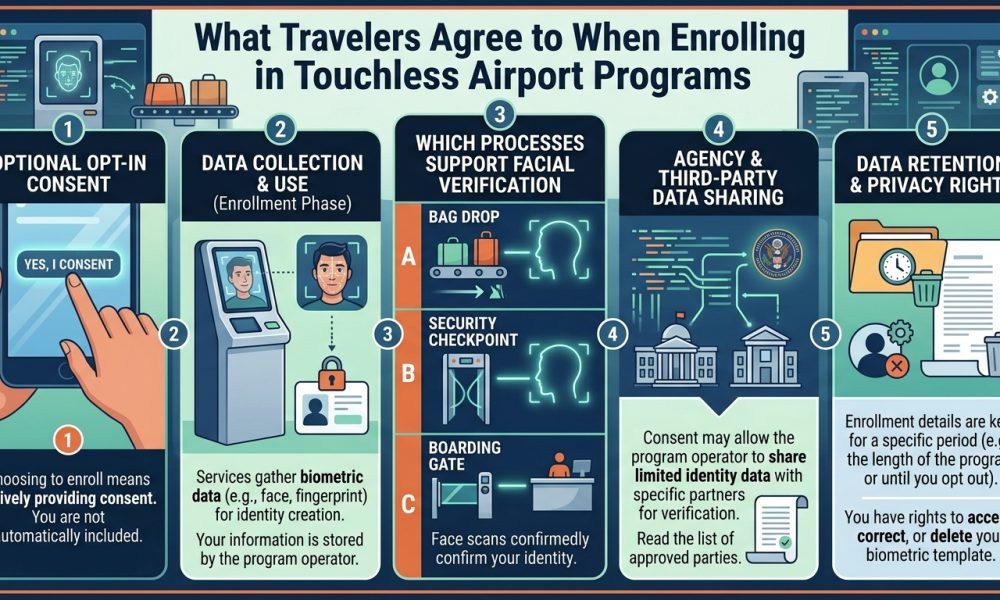
Consent terms explain how participating services use identity information and which airport processes support facial verification.
WASHINGTON, DC, October 7, 2026 — Travelers enrolling in touchless airport identity programs are agreeing to more than simply standing in front of a Camera, because participation can authorize airlines and government systems to use specified identity information, travel records, and facial comparison technology during particular stages of an eligible airport journey.
As facial recognition becomes increasingly common at security checkpoints, baggage counters and other passenger-processing locations, understanding precisely what enrollment means has become an important privacy issue for travelers who may otherwise assume that selecting a digital identity option replaces the moment when an employee manually examines a passport or driver’s license.
The underlying agreement can establish which information a participating airline may use to determine eligibility, when government identity systems may perform facial verification, what airport processes enrollment covers, how travelers can withdraw participation, and what conventional Identification alternatives remain available when passengers choose not to use the service.
Enrollment Begins Before the Traveler Reaches the Camera
For many passengers, the most important biometric decision happens well before they arrive at the airport, because participating touchless programs generally depend on information already linked to an airline account, trusted traveler membership, and a qualifying government identity document before a facial comparison can occur.
Under the current TSA PreCheck Touchless ID program, eligible passengers generally participate through supporting airlines after meeting program requirements, allowing travelers to use facial comparison at designated airport locations instead of routinely presenting a physical Identification document during participating identity-verification processes.
That enrollment structure distinguishes touchless identity from a Camera that appears unexpectedly at a checkpoint, because the passenger has generally established an account relationship, supplied qualifying information, and affirmatively elected to participate before the biometric service becomes available during an eligible itinerary.
The consent decision therefore connects several elements that travelers may otherwise view separately, including their airline profile, TSA PreCheck status, passport information, reservation information, and willingness to have facial recognition used as an automated identity-verification method during specified airport transactions.
Travelers Are Agreeing to an Identity Verification Method
The central purpose of touchless enrollment is not to eliminate identity verification, because airlines and transportation security authorities still need confidence that the person arriving at an airport matches the traveler associated with a reservation and the identity credentials required for the process.
Instead, participating passengers agree that facial matching may perform an identity-verification function that would otherwise involve presenting a physical Identification document, allowing an authorized system to compare the traveler appearing before a Camera with an appropriate government reference photograph associated with the participating identity record.
That distinction matters because enrolling does not ordinarily mean airport authorities stop checking identity; rather, travelers permit a different technical mechanism to answer substantially the same operational question before baggage acceptance, transportation security screening, or another supported airport procedure can continue.
Passengers should therefore read enrollment language as authorization for a defined verification process rather than as general permission for unlimited facial recognition, while also recognizing that the precise terms, participating organizations and supported airport locations can differ among airlines and program implementations.
Passport Information Can Help Establish Eligibility
Touchless airport programs can require passport information even for domestic travel, which sometimes confuses travelers who associate passports primarily with international border crossings rather than flights entirely within the United States.
The reason is identity assurance rather than destination requirements: passport records provide authoritative identity information and a government-held reference photograph that participating biometric systems can use to determine whether the person standing before the airport Camera matches the enrolled traveler.
Providing passport information for enrollment does not turn a domestic journey into an international border process, nor does it mean passengers suddenly need passports for every domestic flight, because the document can serve as an enrollment credential supporting the optional biometric identity service.
Travelers considering participation should still recognize that providing passport details is a meaningful disclosure of personal identity information, so it’s important to understand which organization receives those details, why the information is required, and how the service describes its subsequent handling.
TSA PreCheck Membership Is Another Important Component
Current Touchless ID participation also relies upon TSA PreCheck eligibility, meaning the service operates within an existing trusted traveler environment rather than functioning as a universally available replacement for conventional airport Identification procedures used by every passenger entering a transportation security checkpoint.
The program therefore combines established traveler information with a newer biometric verification mechanism, allowing qualifying passengers to use their faces as identity credentials at participating locations while retaining the broader security screening framework associated with their TSA PreCheck participation.
This layered structure demonstrates why the phrase “facial recognition program” can oversimplify what actually occurs, because the Camera represents only one visible element within an identity ecosystem involving enrollment records, airline information, government credentials, passenger reservations, and transportation security procedures.
A traveler who does not meet the underlying eligibility requirements cannot necessarily obtain touchless processing merely by consenting to a photograph, because authorization depends on the program’s ability to associate the passenger with the qualifying records required for participation.
Airline Enrollment Creates an Ongoing Preference
Some participating airlines let qualifying customers set Touchless ID as an account-level preference rather than requiring a new biometric enrollment decision before every flight. However, travelers may still encounter itinerary-specific requirements before the service becomes available at a participating airport.
For example, Delta explains that eligible customers using its TSA PreCheck Touchless ID service can opt into the feature through their profile, after which participating journeys may display the appropriate Touchless ID eligibility indicators once the required conditions are met.
This account-based approach makes touchless processing more convenient for frequent travelers. Still, it also makes understanding ongoing consent particularly important because a passenger may have enrolled months earlier and then encounter biometric processing as an established preference on another qualifying journey.
Travelers should therefore periodically review airline privacy settings and digital identity preferences rather than assuming every airport Camera presents a completely new enrollment agreement at the time of travel, especially when their original choice remains linked to a loyalty or passenger profile.
Consent Can Cover More Than the Security Checkpoint
Touchless identity technology can support multiple airport processes, meaning passengers should pay attention to whether enrollment applies exclusively at transportation security or also extends to airline-operated functions such as baggage acceptance at participating airports.
A traveler might first encounter the service while checking luggage, where facial comparison can help airline systems confirm identity without requiring the passenger to repeatedly retrieve a physical document, then encounter another biometric verification process when reaching a designated security lane.
Although both interactions can feel like parts of one continuous touchless journey, different organizations can have different responsibilities at each stage, so it matters to distinguish an airline’s operational role from the government’s identity-verification role when examining consent and privacy policies.
Enrollment materials should consequently be understood in terms of specific airport touchpoints, because agreeing to participate in a named digital identity program can potentially authorize biometric verification at more than one supported location while leaving unrelated processes outside the scope of that participation.
The Airline Does Not Necessarily Perform the Facial Match
Seeing biometric functionality inside an airline Application can create the impression that the airline itself operates the entire recognition system. However, modern touchless programs can involve cooperation among airlines, the Transportation Security Administration, and other government technical infrastructure that supports identity verification.
Delta’s current explanation of its program states that an airport Image can be encrypted, separated from biographical information, and transmitted through a secure channel to U.S. Customs and Border Protection’s facial biometric matching service, which performs the identity comparison and returns an appropriate verification response.
That architecture illustrates why travelers need to understand every major participant identified by a program’s privacy disclosures, because enrollment through a commercial airline does not necessarily mean that biometric processing occurs exclusively within the airline’s own information systems.
Conversely, government participation in the matching process does not mean the airline receives unrestricted access to government identity databases, because systems can be designed to return a verification result without exposing the complete underlying government record to the commercial partner.
Consent Is Not the Same as Unlimited Surveillance Permission
One of the most important distinctions in touchless travel concerns purpose limitation, because voluntarily using facial recognition to automate a required airport identity check is materially different from granting unrestricted permission for organizations to identify a passenger anywhere cameras happen to be operating.
Touchless enrollment generally relates to defined travel transactions involving an identified passenger, an eligible itinerary, and a location where identity would ordinarily need to be verified through conventional documentation before the traveler could proceed.
This approach differs conceptually from open-ended facial recognition that attempts to identify unknown individuals throughout public spaces, because touchless airport systems are designed around a traveler with an established relationship to the participating program who is expected at a particular processing location.
Travelers should nevertheless examine the actual consent language rather than relying exclusively on broad descriptions such as convenient, secure, or touchless, because privacy disclosures and program conditions contain legally and operationally meaningful details.
Captured Images and Stored Passport Records Are Different Things
Biometric privacy discussions can become confusing when references to deletion do not clearly distinguish the live photograph captured during an airport transaction from the passport Image and identity information that already exist within government or airline records.
When a program states that a checkpoint photograph is deleted after identity verification, that statement generally addresses the newly captured biometric Image rather than suggesting that authorities have deleted the passport photograph or underlying identity record from which the reference information originated.
The distinction matters because a traveler can reasonably want to know how long a particular airport photograph survives while also recognizing that an existing passport record continues to exist under separate laws and retention requirements governing issuance of that government credential.
Travelers reviewing privacy commitments should ask which Image a deletion promise covers, which organization holds it, whether another participating entity temporarily processes a copy, and whether the underlying government identity record remains unaffected by the transaction.
Commercial and Government Retention Policies Should Be Read Separately
Another common misunderstanding arises when passengers encounter a statement from an airline saying it does not retain biometric information and assume that statement applies to every organization involved in the verification process.
An airline can truthfully describe its own retention practices. At the same time, a government agency follows separately established information-management requirements, so you must identify whose data policy you’re discussing before concluding what happens after the traveler leaves the checkpoint.
The same principle works in reverse because a government agency’s deletion commitment does not automatically establish what an airline does with ordinary reservation information, loyalty account details, or passport data that the passenger previously supplied for purposes unrelated to the temporary live facial Image.
Privacy analysis therefore requires separating several categories of information rather than treating everything associated with a biometric journey as one indistinguishable record, particularly when identity data, reservation information, reference photographs and temporary Camera images follow different technical and legal pathways.
Travelers Can Still Be Asked for Physical Identification
Enrollment in a touchless program should never be interpreted as permission to travel without the physical documents that a passenger may otherwise need, because technical problems, unsuccessful comparisons, eligibility issues, or operational decisions can require employees to return immediately to conventional Identification procedures.
Participating airlines specifically caution travelers that even customers using Touchless ID may still be asked to present a valid government-issued Identification document or passport, showing that facial verification serves as an alternative processing method rather than permanently replacing authoritative physical credentials.
That fallback mechanism also strengthens security because biometric automation should not force airport personnel to accept an uncertain result when identity cannot be established confidently, allowing trained personnel to review Identification manually whenever automated processing cannot complete the expected comparison.
For passengers, the practical rule remains simple even in increasingly digital airports: enrolling in touchless identity can reduce how often documents leave a wallet or travel bag, but travelers should still carry every Identification and travel document required for their journey.
Facial Verification Is Only One Part of Airport Security
Successful facial comparison does not determine whether a passenger or their belongings have satisfied aviation security requirements, because identity verification remains distinct from the physical screening procedures designed to identify prohibited items, security concerns and other conditions affecting access to secure airport areas.
The biometric transaction answers the narrower question of whether the individual at the checkpoint matches the expected enrolled identity. At the same time, subsequent security systems and personnel continue performing the screening functions applicable to the passenger and their property.
This distinction helps explain why Touchless ID should not be described as a universal security clearance, because successful enrollment and facial verification cannot independently establish that a passenger has completed every other airport, airline, or government process required before boarding.
Touchless identity instead automates one important administrative checkpoint within a much larger aviation security system, potentially making travel faster without eliminating the independent controls that continue operating before passengers reach their aircraft.
A Match Does Not Create Absolute Identity Certainty
Facial recognition systems operate through mathematical comparison rather than human intuition, analyzing characteristics extracted from a newly captured Image and determining whether those characteristics correspond sufficiently with a trusted reference photograph under the system’s established matching criteria.
A successful result therefore represents a system determination that the presented face matches the expected identity strongly enough to proceed, rather than a philosophical declaration that technology has established a person’s identity with absolute and universal certainty.
Likewise, a failed comparison does not automatically establish impersonation or document fraud, because lighting, Image quality, physical appearance, Camera positioning, and technical conditions can affect automated processing and may simply require the passenger to complete a conventional manual identity check.
Responsible airport systems therefore need fallback procedures that let legitimate travelers continue after proper verification, rather than treating every failed facial comparison as evidence of misconduct or automatically preventing passengers from proceeding.
Passport Security Still Supports Touchless Identity
Even though travelers rarely remove their passports during an airport visit, trusted government identity documents remain important to the digital ecosystem because authoritative passport records provide the biographical information and high-quality reference photographs needed to establish a reliable enrolled identity.
Electronic passports themselves contain multiple physical and digital safeguards, including specialized materials, security printing, and electronically protected chip information, which collectively support the broader confidence government authorities place in passport-based identity records.
Amicus International Consulting has previously examined these safeguards in its guide to modern passport security and identity Protection, which explains why secure document issuance remains important even as facial recognition increasingly moves passenger verification away from repeated physical inspection of passport booklets.
Touchless travel therefore represents an evolution in how authoritative identity information is presented and compared, not the disappearance of secure identity documentation, because the reliability of the digital process still depends heavily on the reliability of the records supporting it.
Opting Out Should Not Be Confused With Avoiding Identity Checks
Voluntary participation means eligible travelers can choose not to use the touchless method. Still, declining biometric convenience does not eliminate the standard identity requirements that airport authorities and airlines are entitled or required to perform before allowing passengers to continue.
A passenger who chooses conventional processing can instead present the appropriate physical Identification document through established procedures, allowing the required identity check to occur without relying on the voluntary touchless service selected by other qualifying travelers.
This difference between declining a technology and declining an underlying security requirement is central to understanding consent, because travelers retain a choice about the biometric method without necessarily possessing a corresponding right to bypass identity verification altogether.
Clear program notices should make that distinction easy to understand so passengers can make informed decisions without incorrectly believing that refusing facial recognition will either prevent them from traveling or exempt them from the Identification process entirely.
Consent Should Remain Understandable as Programs Expand
As biometric travel systems spread across more airports and airlines, meaningful consent will increasingly depend on whether passengers can understand which organization operates each service, which records make them eligible, which airport transactions are covered, and how they can stop participating.
Long privacy policies remain important for legal detail. Still, travelers also benefit from concise operational explanations describing what happens when they approach a Camera, where the captured Image travels, what reference Image supports the comparison, and what happens to the transaction photograph afterward.
Airlines and government authorities also face an ongoing responsibility to distinguish touchless identity from other biometric programs, particularly because similar cameras can support international border processing, domestic security verification, airline baggage handling, and other functions with substantially different legal foundations.
Without those distinctions, passengers can easily assume every facial recognition Camera operates under one universal consent agreement, even though responsibilities, retention policies, eligibility rules, and underlying purposes can vary considerably between airport programs.
Informed Enrollment Requires Looking Beyond Convenience
The appeal of touchless travel is easy to understand because passengers routinely manage passports, driver’s licenses, boarding passes, luggage and electronic devices while navigating busy airport environments where eliminating even one repetitive document exchange can make the journey noticeably easier.
However, convenience should be paired with an understanding that enrollment establishes a digital relationship among the traveler, participating airline, and government identity systems, with biometric verification working only because those organizations can link a passenger’s journey to previously established identity information.
Travelers deciding whether to participate should therefore consider what information enrollment requires, how long the preference remains active, which airport processes can use it, whether withdrawal is available, and how the organizations involved describe their respective responsibilities for biometric and non-biometric data.
Those questions do not imply that touchless airport programs are inherently unsafe or unusually intrusive. Still, they do recognize that meaningful consent requires more than clicking an enrollment button without understanding what the resulting digital identity service actually does.
The Camera Is the Final Step in a Much Longer Agreement
When an enrolled passenger reaches an airport Camera and completes a facial comparison within seconds, the visible interaction can seem remarkably simple. Still, that brief transaction depends on identity information, eligibility checks, consent decisions, and technical relationships established before the traveler entered the terminal.
Understanding those earlier steps allows passengers to evaluate touchless travel more intelligently, because they can distinguish temporary biometric capture from persistent account information, airline responsibilities from government responsibilities, and optional facial verification from the underlying identity requirements that remain part of aviation security.
As touchless identity becomes a more familiar feature of airport travel, the most important privacy question may therefore move beyond whether an airport uses facial recognition and toward a more precise question concerning what the traveler actually authorized when choosing to participate.
For passengers who understand those terms, touchless processing can be evaluated as a specific identity-verification service with defined purposes and alternatives rather than as an indistinct biometric system whose cameras, databases, and consent rules remain hidden behind the promise of a faster airport journey.




