
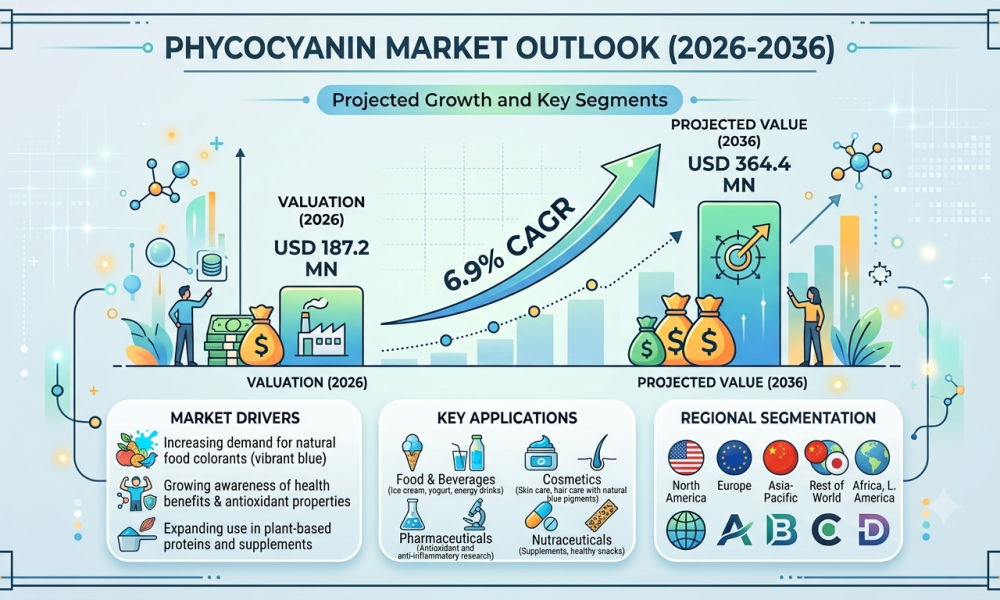
The global phycocyanin market is projected to grow from USD 187.2 million in 2026 to USD 364.4 million by 2036, registering a 6.9% CAGR during the forecast period. Demand is supported by the shift away from synthetic blue colorants, growing clean-label requirements, natural ingredient adoption, and increasing use of phycocyanin across food, beverages, nutraceuticals, cosmetics, and personal care. Manufacturers are increasingly seeking natural blue color solutions that combine regulatory acceptance, consistent color performance, and clean-label positioning.
The growing use of natural colors in confectionery, beverages, dairy products, and functional foods is creating additional opportunities for phycocyanin suppliers. Product development is also moving toward heat-stable and acid-stable formulations to address performance limitations in demanding applications. Powder remains the dominant form because of its shipping efficiency, longer shelf life, and ease of handling, while food and beverage continues to represent the largest application segment.
Get detailed market forecasts, competitive benchmarking, and pricing trends: https://www.futuremarketinsights.com/reports/sample/rep-gb-7029
Global Segment Leaders
- Nature – Conventional: 61.8% in 2026. Conventional phycocyanin leads because scalable cultivation and lower biomass costs support consistent supply and competitive pricing.
- Form – Powder: 93.4% in 2026. Powder remains dominant because it offers efficient transportation and storage while providing flexible dosing for food, beverage, supplement, and cosmetic formulations.
- Grade – E18: 60.2% in 2026. E18 leads as a general-purpose grade that balances color strength and cost across confectionery, dairy, and beverage applications.
- Application – Food and Beverage: 83.7% in 2026. Food and beverage remains the leading application as manufacturers replace synthetic blue colorants in confectionery, beverages, desserts, and other processed foods.
Country-Level Performance
The United States is projected to grow at the fastest pace, with an 8.3% CAGR through 2036, supported by natural color adoption, Blue 1 replacement initiatives, and expanding applications across food, beverages, and dietary supplements.
Germany is expected to record an 8.0% CAGR, supported by its strong organic food base, stringent ingredient requirements, and demand for traceable natural colorants.
Spain is forecast to grow at a 7.7% CAGR, supported by organic food exports and increasing demand for documented natural ingredients in food manufacturing.
Italy is projected to expand at a 7.3% CAGR, benefiting from its broad food-processing base and growing use of natural ingredients across processed food and beverage applications.
Canada is expected to register a 7.0% CAGR, supported by permitted applications for spirulina extract as a food color and continued interest in natural food ingredients.
The United Kingdom is projected to record a 6.7% CAGR, with natural blue color adoption supported by food manufacturing and growing interest in clean-label formulations. France is forecast to grow at 6.0%, representing the lowest CAGR among the profiled countries.
Regional Context
The United States and Germany represent the fastest-growing major markets, with CAGRs of 8.3% and 8.0%, respectively. Growth is being supported by synthetic color replacement, clean-label product development, regulatory developments, and increasing demand for natural blue colorants.
Spain, Italy, and Canada represent markets with steady expansion, with CAGRs ranging from 7.7% to 7.0%. Organic food production, established food-processing industries, and regulatory acceptance of natural color ingredients are supporting adoption.
The United Kingdom and France show comparatively moderate growth at 6.7% and 6.0%, respectively. Mature food markets and evolving regulatory conditions shape demand, while natural and acid-stable blue formulations create opportunities for further application expansion.
The full report covers North America, Latin America, Europe, Asia Pacific, and the Middle East and Africa, with multiple countries and country groups profiled individually.
Access full Report in PDF Format@ https://www.futuremarketinsights.com/reports/brochure/rep-gb-7029
Competitive Landscape
The competitive landscape includes DIC Corporation, Sensient Technologies Corporation, GNT Group, Oterra A/S, Givaudan Sense Colour, Fuqing King Dnarmsa Spirulina Co., Ltd., Parry Nutraceuticals, Cyanotech Corporation, Fermentalg, and Vaxa Technologies. Competition is shaped by spirulina cultivation capabilities, extraction and purification technology, product consistency, regulatory compliance, certification, and the ability to provide stable natural blue color solutions.
Recent developments are focused on improving phycocyanin performance in demanding applications. In July 2026, Oterra introduced liquid versions of two natural blue powders, including a spirulina-based product made from algae grown in Iceland. In June 2026, Sun Chemical, part of the DIC Group, announced plans to present LINABLUE G1 spirulina extract at IFT FIRST 2026, highlighting purity and color strength. Regulatory developments are also influencing the market, including the FDA’s actions concerning spirulina extract and the approval of Galdieria extract blue for specific food applications.
Analyst Perspective
Nandini Roy Choudhury, Principal Consultant at Future Market Insights, notes that acidic beverages and baked goods represent an important growth opportunity for phycocyanin as suppliers develop heat-stable and acid-stable formulations. These technologies are expected to help manufacturers capture a larger share of projects focused on replacing synthetic Blue 1.
About Future Market Insights (FMI)
Future Market Insights, Inc. (ESOMAR certified, recipient of the Stevie Award, and a member of the Greater New York Chamber of Commerce) offers profound insights into the driving factors that are boosting demand in the market. FMI stands as the leading global provider of market intelligence, advisory services, consulting, and events for the Packaging, Food and Beverage, Consumer Technology, Healthcare, Industrial, and Chemicals markets. With a vast team of over 400 analysts worldwide, FMI provides global, regional, and local expertise on diverse domains and industry trends across more than 110 countries.



