
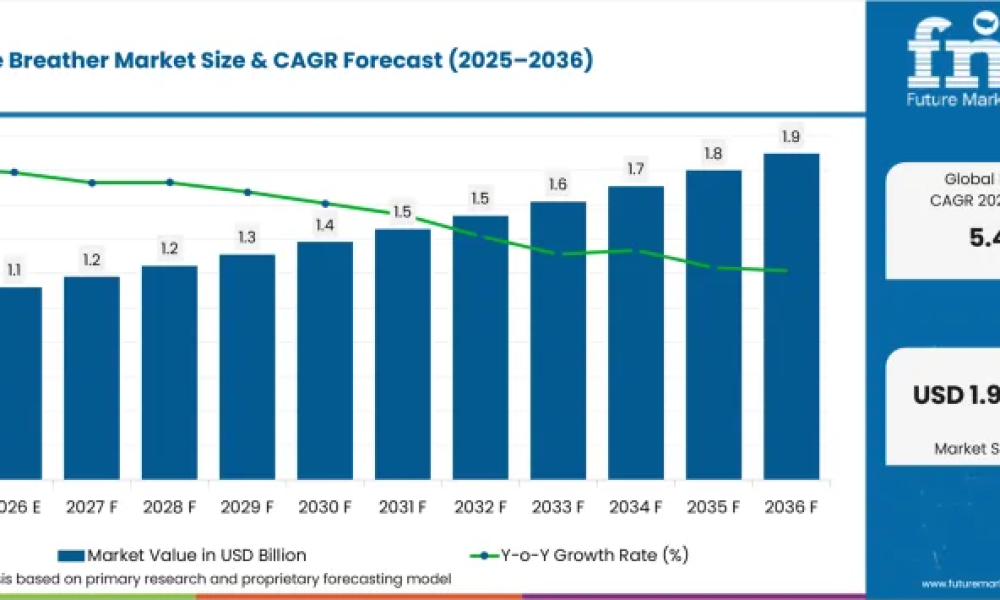
The global crankcase breather market is projected to expand from USD 1.1 billion in 2026 to USD 1.9 billion by 2036, advancing at a 5.4% CAGR during the forecast period. Demand remains linked to the operating life of combustion engines, as crankcase ventilation systems continue to regulate pressure and control oil aerosol emissions after the original equipment has entered service.
Industrial-engine maintenance is reinforcing replacement demand because buyers often require components matched to exact engine references rather than generic filter dimensions. MANN+HUMMEL stated in January 2025 that its industrial guide covers 330 engines from 20 manufacturers and includes crankcase-ventilation filters. Such engine-specific coverage illustrates the importance of reference-based sourcing when replacement components must preserve the original ventilation and oil-separation characteristics.
The addressable combustion-engine base also varies substantially by country. Norway’s Ministry of Transport stated in January 2025 that electric vehicles represented 88% of new passenger-car sales at the end of 2024. Higher passenger-vehicle electrification can reduce new ICE fitment opportunities, while older combustion vehicles and non-passenger engines continue to generate replacement requirements. Markets with larger combustion-engine fleets therefore retain broader aftermarket exposure.
What Are the Key Segments in the Crankcase Breather Market?
- Closed Crankcase Ventilation Units — 29.0% share: Closed crankcase ventilation units are projected to account for 29.0% share in 2026, supported by controlled blowby recirculation within combustion-engine systems.
- Diesel Engines — 39.0% share: Diesel engines are estimated to hold 39.0% share in 2026 because high-load operation increases the importance of blowby management and oil separation.
- Passenger Vehicles — 29.0% share: Passenger vehicles are expected to lead the vehicle-equipment segment with 29.0% share in 2026, supported by integrated PCV hardware across the combustion fleet.
- Engine-Specific Replacement: Exact engine references remain important because crankcase ventilation components must maintain appropriate pressure behavior, oil return, hose routing, and system compatibility.
- Aftermarket Service: Replacement demand remains connected to combustion-engine service life, creating opportunities for filtration manufacturers, engine distributors, fleet-service providers, and aftermarket suppliers.
Get detailed market forecasts, competitive benchmarking, and pricing trends:
https://www.futuremarketinsights.com/reports/sample/rep-gb-34920
How Is Engine Service Demand Influencing the Crankcase Breather Market?
Crankcase breathers remain important throughout the operating life of combustion engines because crankcase pressure and oil aerosol management cannot simply be treated as original-equipment requirements. As engines accumulate operating hours, ventilation components can require inspection, servicing, or replacement.
The replacement process is highly dependent on engine configuration. Breather systems can differ according to engine type, ventilation architecture, hose routing, oil-separation requirements, and pressure-control characteristics. This limits the usefulness of generic replacement products when a fleet or service provider needs to restore the original system behavior.
Industrial engines further strengthen the reference-based nature of the market. MANN+HUMMEL’s industrial guide covering hundreds of engines from multiple manufacturers demonstrates how filtration suppliers can organize replacement products around specific engine platforms rather than relying solely on dimensions.
Which Countries Are Showing the Strongest Growth in Crankcase Breathers?
Norway is projected to record the highest CAGR among the profiled countries at 6.3% through 2036. While high electric-vehicle penetration reduces new passenger ICE installations, replacement requirements remain relevant across older combustion vehicles and non-passenger engine applications.
Brazil is expected to expand at a 6.0% CAGR, supported by its combustion-engine vehicle base and ongoing automotive service requirements. Replacement filtration and crankcase ventilation components can benefit from continued maintenance of vehicles already operating in the market.
The United States is projected to grow at a 5.1% CAGR. Its established automotive and industrial engine base provides opportunities for both OEM and aftermarket crankcase ventilation components.
Germany is expected to record a 4.8% CAGR. Although passenger-vehicle electrification is changing the future ICE installation mix, existing combustion vehicles and industrial engines continue to require ventilation and oil-separation components.
Japan is projected to grow at a 4.2% CAGR, reflecting a more mature automotive market in which replacement and maintenance requirements remain important as the vehicle fleet continues operating.
How Is Regional Demand Shaping the Crankcase Breather Market?
Country-level demand increasingly depends on the composition and age of the combustion-engine fleet. Higher EV penetration can reduce fresh passenger-vehicle fitment, but it does not immediately eliminate the installed ICE base. Older vehicles continue to require service components throughout their operating life.
Industrial, commercial, off-highway, and marine engines provide additional addressable demand. These applications can have different replacement cycles and operating requirements from passenger vehicles, creating opportunities for suppliers with broad engine-reference coverage.
What Is Changing the Competitive Landscape?
The competitive landscape includes MANN+HUMMEL, Donaldson Company, Inc., Parker Hannifin Corporation, Atmus Filtration Technologies Inc., MAHLE GmbH, Hengst SE, Standard Motor Products, Inc., and Alfdex AB.
Competition is increasingly influenced by the ability to match crankcase ventilation products to validated engine platforms. Engine-specific references can help service providers select components that preserve the required pressure behavior and oil-separation performance.
Oil aerosol management is another area of differentiation. Suppliers must balance filtration and separation efficiency with appropriate airflow and crankcase pressure characteristics. A component that reduces aerosol carryover but changes the engine’s validated pressure behavior may not deliver the required system performance.
Aftermarket support is also becoming important as combustion engines remain in service after original vehicle production. Suppliers with broad reference catalogs and distribution coverage can address replacement demand across passenger, commercial, industrial, marine, and off-highway applications.
What Does the Analyst Say About the Crankcase Breather Market?
“Crankcase breather economics depend on the pressure curve preserved after oil separation, since lower aerosol carryover has limited value if the engine leaves its validated range. Replacement margins are earned through fitment control that restores oil return, hose routing and service intervals without changing the original pressure behavior.”
— Nikhil Kaitwade, Principal Consultant, Future Market Insights
Drive Your Business Growth Strategy: Checkout the Report for Key Insights!
https://www.futuremarketinsights.com/checkout/34920
What Is Driving Demand for Crankcase Breathers?
Combustion-Engine Service Life Sustains Replacement
Crankcase ventilation systems remain necessary while combustion engines operate. As engines accumulate service hours, replacement of breathers, separators, and associated filtration components creates recurring aftermarket demand.
Diesel Engines Require Effective Blowby Management
Diesel engines can generate significant blowby and oil-mist management requirements under high-load operating conditions. This supports demand for systems capable of separating oil aerosols while maintaining appropriate crankcase pressure.
Engine References Improve Replacement Accuracy
Exact engine references help suppliers identify compatible ventilation components. Dimensions alone may not capture pressure behavior, hose connections, oil-return arrangements, and other requirements necessary for correct system operation.
Industrial and Non-Passenger Engines Expand the Addressable Base
Passenger-vehicle electrification is changing the long-term ICE installation mix, but industrial, commercial, marine, and off-highway engines continue to provide demand for crankcase ventilation components.
What Are the Key Challenges in the Crankcase Breather Market?
Passenger-vehicle electrification represents a structural challenge because fewer new combustion vehicles reduce the potential for fresh crankcase breather installations in highly electrified markets.
However, the installed combustion fleet does not disappear immediately. Suppliers therefore need to balance declining new-vehicle fitment opportunities with continuing aftermarket requirements.
Technical qualification also creates barriers to component switching. Changes to crankcase ventilation modules can affect pressure regulation, oil return, hose routing, and filtration behavior. Engine manufacturers and service providers may therefore be reluctant to replace validated components without adequate fitment and performance evidence.
How Is the Crankcase Breather Market Segmented?
The crankcase breather market is segmented by product type, engine type, vehicle-equipment, sales channel, function, and region.
By Product Type: Closed crankcase ventilation units, open breathers, oil mist separators, breather filters, and integrated PCV modules.
By Engine Type: Diesel, gasoline, natural gas, hybrid ICE, and marine engines.
By Vehicle and Equipment: Passenger vehicles, commercial vehicles, off-highway equipment, marine engines, and industrial engines.
By Sales Channel: OEM supply, aftermarket replacement, fleet or service, and engine distributors.
By Function: Oil separation, emission control, pressure regulation, and filter protection.
What Is the Crankcase Breather Market Demand Outlook?
The crankcase breather market is expected to remain supported by the large installed base of combustion engines even as electrification reduces future passenger-vehicle ICE fitment. Replacement demand will increasingly depend on engine age, service requirements, operating conditions, and the availability of compatible components.
Suppliers that maintain accurate engine-reference coverage can strengthen their aftermarket position by reducing fitment uncertainty. The opportunity extends beyond passenger vehicles into industrial, commercial, marine, and off-highway applications where combustion engines continue to operate under demanding conditions.
About Future Market Insights
Future Market Insights (FMI) is a leading provider of market research and consulting services, offering syndicated and customized research across automotive, marine, energy, industrial, and other industries. FMI provides market forecasts, competitive intelligence, strategic analysis, and data-driven insights to support business decisions across global markets.



