
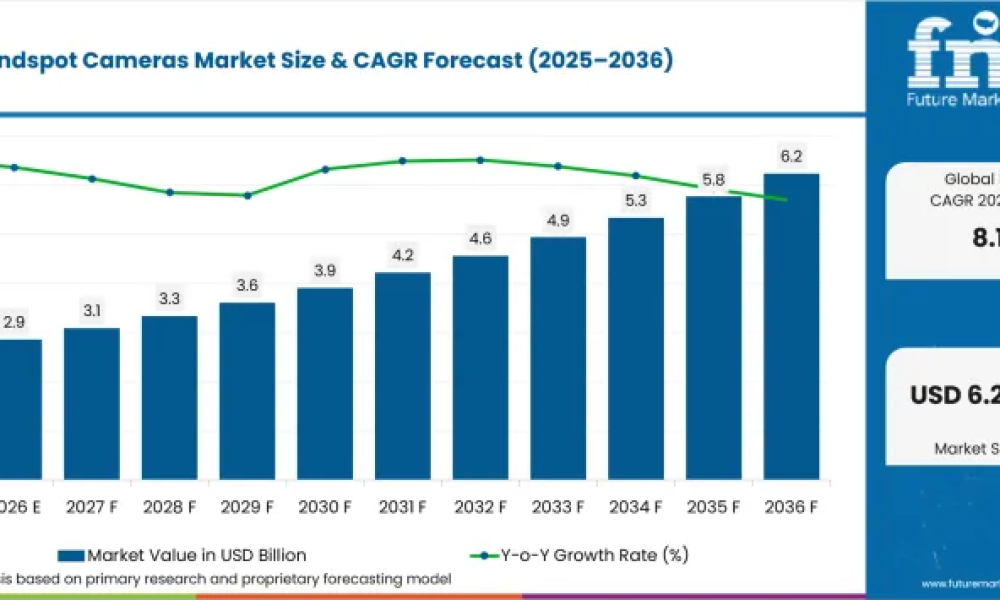
The global vehicle blindspot cameras market is projected to expand from USD 2.9 billion in 2026 to USD 6.2 billion by 2036, advancing at an 8.1% CAGR during the forecast period. Vehicle blindspot cameras are becoming a more established part of vehicle safety and advanced driver assistance system (ADAS) architecture as regulators and automakers place greater emphasis on lateral visibility and surrounding-area perception.
Regulatory requirements are increasing the importance of camera performance and integration. The European Union’s General Safety Regulation has strengthened requirements related to indirect vision and blind-spot protection for relevant vehicle categories, while the National Highway Traffic Safety Administration maintains detailed rear-visibility testing procedures for camera systems in the United States. These requirements increase expectations around field of view, image quality, display performance, mounting, calibration, and environmental durability.
Commercial value is also increasing as exterior cameras are reused across multiple vehicle functions. Passenger vehicles can use camera feeds for lane-change assistance, parking, and low-speed perception, while commercial vehicles can use side visibility to improve awareness around vulnerable road users. This multi-function architecture allows a single camera installation to contribute to several safety and convenience functions when the supporting electronics and software are properly integrated.
What Are the Key Segments in the Vehicle Blindspot Cameras Market?
- Side-View Cameras — 28.0% share: Side-view cameras are projected to lead the Camera Type segment with 28.0% share in 2026 because lateral coverage directly addresses adjacent-lane and vehicle-flank visibility gaps.
- CMOS Camera Modules — 31.0% share: CMOS camera modules are projected to lead Technology with 31.0% share in 2026, supported by compact packaging and established automotive image-sensor economics.
- Passenger Cars — 42.0% share: Passenger cars are projected to lead Vehicle Type with 42.0% share in 2026 as OEMs reuse camera imagery across safety, parking, and low-speed functions.
- OEM Fitment — 48.0% share: OEM fitment is projected to lead Sales Channel with 48.0% share in 2026 because factory integration determines mounting geometry, wiring, calibration, and display interfaces before production.
- ADAS Safety — 39.0% share: ADAS safety is projected to lead End Use with 39.0% share in 2026 as camera feeds increasingly support active warnings and perception rather than passive viewing alone.
Get detailed market forecasts, competitive benchmarking, and pricing trends:
https://www.futuremarketinsights.com/reports/sample/rep-gb-34935
How Is ADAS Integration Influencing Vehicle Blindspot Cameras?
Blindspot cameras are increasingly being developed as part of broader vehicle perception architectures rather than isolated viewing systems. Their value rises when the same image stream can support several functions without requiring separate hardware for every application.
For passenger vehicles, a side-mounted camera can contribute to lane-change assistance, parking visibility, low-speed maneuvering, and other surrounding-area functions. This can improve hardware utilization while allowing automakers to consolidate sensing architectures across vehicle platforms.
Commercial vehicles have a different but related requirement. Side visibility can help drivers monitor vehicle flanks and areas near vulnerable road users, particularly during turns, lane changes, loading operations, and low-speed maneuvering. The ability to integrate camera feeds into existing displays and vehicle computing systems is therefore becoming an important part of supplier selection.
Which Countries Are Showing the Strongest Growth in Vehicle Blindspot Cameras?
South Korea is projected to record the highest CAGR among the profiled countries at 9.0% through 2036. The market benefits from its established automotive manufacturing ecosystem and continued development of advanced vehicle safety and perception technologies.
Mexico is expected to expand at an 8.3% CAGR, supported by its automotive manufacturing base and integration of electronic safety systems into vehicle production. Factory-installed camera systems can benefit from OEM platform development and manufacturing integration.
Brazil is projected to grow at an 8.0% CAGR, supported by demand for vehicle safety technologies and increasing integration of electronic driver-assistance features.
The United States is expected to record a 7.7% CAGR. Regulatory attention to vehicle visibility and established ADAS development programs support demand for validated camera systems with reliable image quality and integration.
Poland is projected to expand at a 7.4% CAGR, supported by its role in European automotive manufacturing and increasing integration of safety electronics into vehicle platforms.
Germany is expected to record a 7.1% CAGR, supported by automotive engineering capabilities and the development of advanced vehicle safety and perception architectures.
Japan is projected to grow at a 6.8% CAGR. Its established automotive technology ecosystem continues to support demand for compact, reliable camera systems integrated into vehicle safety architectures.
How Is Regional Demand Shaping the Vehicle Blindspot Cameras Market?
Regional market development reflects differences in vehicle production, regulatory requirements, ADAS penetration, and OEM technology strategies. Markets with established automotive engineering capabilities are increasingly focused on integrating cameras with vehicle displays, computing platforms, and other sensing technologies.
The value proposition is also moving beyond standalone blindspot viewing. Camera systems that can support several vehicle functions can reduce hardware duplication and create greater value from the same exterior installation. This encourages suppliers to develop solutions that combine imaging hardware, diagnostics, perception capabilities, and calibration support.
What Is Changing the Competitive Landscape?
The competitive landscape includes Magna International, Valeo, Bosch, Continental, Denso, Aptiv, Gentex, Ficosa, Hyundai Mobis, and Stoneridge.
Competition is increasingly focused on complete camera-system integration rather than camera hardware alone. Suppliers need to demonstrate consistent optical performance, robust environmental durability, reliable communication with vehicle electronics, and compatibility with display and computing architectures.
Platform reuse is another important competitive factor. When a camera can support lane-change assistance, parking, towing visibility, and other functions, automakers can potentially reduce the number of separate sensing components required across a vehicle platform.
Calibration and diagnostics are also becoming important purchasing considerations. Factory-installed camera systems must maintain consistent performance across vehicle builds, while service networks need diagnostic capabilities that allow camera alignment and performance issues to be identified without excessive repair time.
What Does the Analyst Say About the Vehicle Blindspot Cameras Market?
“Vehicle blindspot cameras create more value when a single exterior vision architecture can support lane-change, parking and low-speed safety functions without multiplying integration work. Suppliers that combine robust optics with diagnostics, perception software and platform-level calibration are better positioned to convert camera content into repeat OEM nominations and fleet programs.”
— Nikhil Kaitwade, Principal Consultant, Future Market Insights
Drive Your Business Growth Strategy: Checkout the Report for Key Insights!
https://www.futuremarketinsights.com/checkout/34935
What Is Driving Demand for Vehicle Blindspot Cameras?
Vehicle Safety Requirements Strengthen Camera Integration
Regulatory requirements concerning vehicle visibility and safety are increasing the need for validated camera systems. This places greater emphasis on field of view, image quality, calibration, environmental durability, and display performance during vehicle qualification.
One Camera Feed Can Support Multiple Functions
Automakers can increase the commercial value of exterior cameras when a single camera feed supports several applications. Lane-change assistance, parking, low-speed perception, and towing visibility can potentially share camera hardware and processing infrastructure.
CMOS Technology Supports Compact Vehicle Packaging
CMOS camera modules offer a mature imaging architecture suited to high-volume automotive applications. Their compact form factor supports exterior integration where available packaging space can be limited.
Perimeter Perception Creates Additional Value
The market opportunity is expanding as blindspot cameras become part of active vehicle perception systems. AI-based object detection and camera-radar fusion can potentially transform side-view cameras from passive visibility devices into broader perimeter-safety sensors.
What Are the Key Challenges in the Vehicle Blindspot Cameras Market?
Vehicle-level qualification remains a major restraint because camera performance depends on the complete integration of optics, mounting, wiring, processing, displays, and calibration. A camera module that performs well in isolation must still maintain consistent performance after installation on a specific vehicle platform.
Environmental exposure creates another challenge. Exterior cameras must operate reliably under changing temperatures, moisture, road contamination, vibration, and other conditions while maintaining image quality. Mounting position and lens contamination can also influence practical field of view.
System integration can increase development complexity. When camera feeds are shared across several functions, suppliers and OEMs must validate data paths, diagnostics, processing behavior, display performance, and functional interactions across the vehicle architecture.
How Is the Vehicle Blindspot Cameras Market Segmented?
The Vehicle Blindspot Cameras Market is segmented by Camera Type, Technology, Vehicle Type, Sales Channel, End Use, and Region.
By Camera Type: The market covers viewing configurations designed to address side, rear-quarter, and vehicle-flank visibility requirements.
By Technology: The market includes automotive imaging and perception architectures, with CMOS camera modules representing the leading technology segment.
By Vehicle Type: Passenger vehicles and commercial vehicle applications reflect different packaging, visibility, duty-cycle, and safety requirements.
By Sales Channel: OEM fitment and other supply routes address differences between factory-installed systems and aftermarket integration.
By End Use: ADAS safety, parking, low-speed perception, and related visibility applications determine how camera feeds are used within vehicle architectures.
What Is the Vehicle Blindspot Cameras Market Demand Outlook?
The vehicle blindspot cameras market is expected to benefit from the convergence of regulatory requirements, ADAS integration, and increasing reuse of exterior camera feeds. As automakers seek to extract more functionality from each sensing component, camera suppliers can compete through system-level integration rather than image capture alone.
Future demand will increasingly depend on the ability to deliver validated optics, diagnostics, calibration, perception software, and reliable integration with vehicle computing and display systems. Suppliers that can support multiple functions from a common exterior vision architecture may gain stronger opportunities across vehicle platforms and fleet programs.
About Future Market Insights
Future Market Insights (FMI) is a leading provider of market research and consulting services, offering syndicated and customized research across automotive, mobility, energy, industrial, and other industries. FMI provides market forecasts, competitive intelligence, strategic analysis, and data-driven insights to support business decisions across global markets.



