
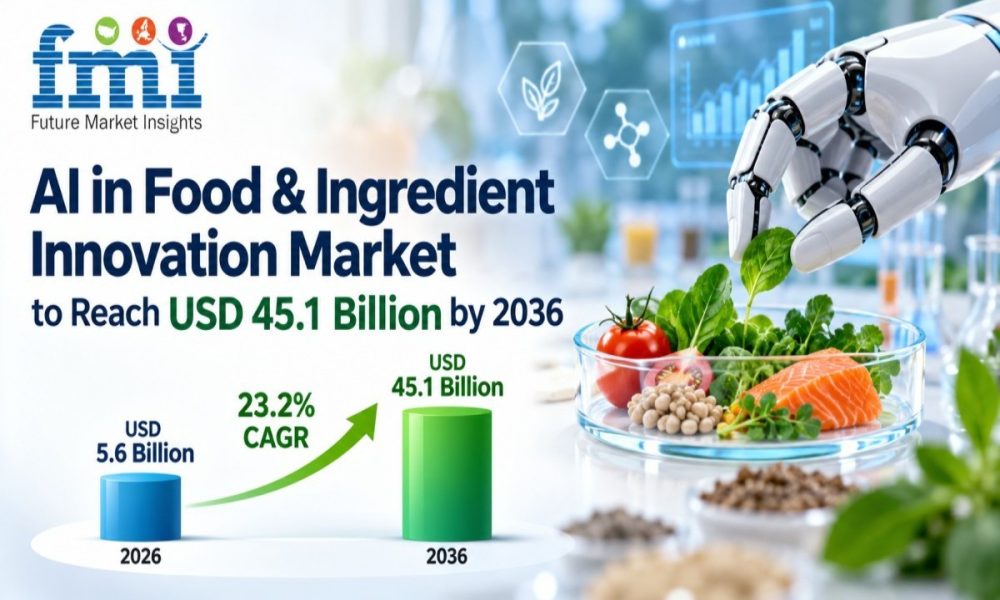
The global AI in Food & Ingredient Innovation Market is projected to reach USD 45.1 billion by 2036, up from approximately USD 5.6 billion in 2026, expanding at a 23.2% CAGR during the forecast period, according to the latest analysis by Future Market Insights (FMI).
The market is being supported by increasing use of artificial intelligence across food research and development workflows. Food R&D teams are adopting AI to reduce formulation search times, screen ingredient candidates and improve predictive decision-making before expensive physical laboratory trials.
Get Detailed Market Forecasts, Competitive Benchmarking, and Pricing Trends:
https://www.futuremarketinsights.com/reports/sample/rep-gb-34588
Formulation Continues to Anchor Application Demand
Formulation is estimated to account for 41.0% of application demand in 2026, making it the leading application segment. AI-based formulation systems help food R&D teams rank ingredient and recipe candidates before physical bench testing, reducing the number of options that require laboratory evaluation.
The growing complexity of food formulation briefs is increasing the value of computational screening. Health targets, alternative proteins, ingredient substitutions and multiple product-performance requirements can create large search spaces that are difficult to evaluate manually.
Food additive reformulation also creates recurring demand as ingredient substitutions can affect texture, processing behavior and other product characteristics that must ultimately be validated through physical testing.
Machine Learning Leads Technology Adoption
Machine learning is projected to account for 51.8% of technology demand in 2026, making it the leading technology category.
ML provides food R&D teams with predictive capabilities for ranking ingredient candidates across large datasets. These systems can support screening and property-estimation workflows while allowing laboratories to concentrate physical testing on candidates with stronger predicted suitability.
The technology is particularly relevant for protein ingredient development, where sequence-to-function relationships can require computational filtering before physical testing confirms performance within specific food matrices.
Food Manufacturers Lead End-user Demand
Food manufacturers are projected to account for 38.1% of end-user demand in 2026, making them the leading end-user category.
Manufacturers control commercial formulas and remain responsible for scale-up, product qualification and final product performance. As a result, they require AI systems that can integrate with sensory evaluation, processing controls and physical validation.
Recurring product-development pipelines also create repeated opportunities for AI-assisted formulation, ingredient screening and scale-up decisions.
Data Lineage and Validation Requirements Restrain Adoption
Weak data lineage and insufficient application evidence can raise the cost of AI qualification.
Manufacturers need to reproduce the path from input data to model recommendation when AI systems are used in commercial food development. Poorly documented data and untraceable inputs can therefore delay deployment and increase technical and regulatory review requirements.
Discovery-to-Scale Services Create New Revenue Opportunities
AI companies can expand revenue opportunities by connecting digital ingredient discovery with laboratory validation, application development and manufacturing scale-up.
Selected ingredients gain greater commercial value when companies can produce sufficient material for application testing and move promising candidates toward industrial production.
In March 2025, Shiru and GreenLab announced a partnership involving corn-based protein expression, linking AI-driven discovery with sustainable protein production. Such collaborations demonstrate how AI-enabled ingredient discovery can extend beyond software into co-development and scale-up services.
USA Shows the Fastest Growth Among Highlighted Markets
Among the highlighted country markets, the USA is projected to record a 21.3% CAGR through 2036, followed by India at 20.9%, China at 20.5%, the United Kingdom at 19.7% and Germany at 19.3%.
The USA benefits from strong food R&D capabilities and extensive manufacturer and research networks that connect computational screening with laboratory validation. India combines expanding food-processing innovation with increasing investment in digital tools, although smaller processors can face technical and integration constraints.
Competitive Landscape
The AI in Food & Ingredient Innovation Market includes global ingredient and flavor companies, AI-native discovery platforms and specialized technology providers.
Key companies profiled by FMI include IFF, Givaudan, dsm-firmenich, Ingredion, Brightseed, NotCo AI, Shiru and Barry Callebaut.
Competitive positioning is influenced by AI discovery capabilities, formulation expertise, physical validation, application testing, enterprise co-development, scale-up capabilities and geographic reach.
Key Industry Developments
The market continues to see AI platform launches, ingredient discovery collaborations and innovation-center investments.
In May 2026, Brightseed launched Hummingbird, extending its AI platform from biological discovery into development-stage evaluation and prioritization for product opportunities.
In March 2026, Ingredion detailed its collaboration with Shiru using a curated database containing more than 77 million natural protein sequences to identify naturally derived prebiotic candidates.
In February 2026, Barry Callebaut opened its Singapore Global Innovation Center, featuring an AI center of excellence and pilot facilities for chocolate formulation and process testing.
Analyst Perspective
“Food manufacturers should judge AI systems by how much they narrow a formulation search without weakening evidence needed for pilot production. Repeat use depends on recommendations surviving sensory review and process testing across more than one product brief.”— Nandini Roy Choudhury, Principal Consultant, Future Market Insights
Exclusive Discounts on Full Report
https://www.futuremarketinsights.com/reports/ai-in-food-ingredient-innovation-market
Report Scope
The FMI study covers the AI in Food & Ingredient Innovation Market by application, technology, end user and region. Applications include formulation, predictive sensory, supply chain and sustainability. Technology categories include machine learning, generative AI and computer vision. End users include food manufacturers, foodservice operators, retailers and household users.
The research covers North America, Latin America, Europe, East Asia, South Asia and Pacific, and the Middle East and Africa, with country-level analysis including the USA, China, India, UK, Germany and 20+ additional countries.
Key Executive Benefits
- Decision-Ready Insights
- Reduced Strategic Risk
- Market Entry Confidence
- Competitive Advantage
- Faster Growth Decisions
- Primary Market Validation
To explore how FMI Custom Research can support your strategic priorities, connect with our team at [email protected].
About Future Market Insights (FMI)
Future Market Insights, Inc. is an ESOMAR-certified, ISO 9001:2015 market research and consulting organization trusted by Fortune 500 companies. With a global presence across the U.S., UK, India and Dubai, FMI delivers data-driven insights across 30+ industries and 1,200 markets worldwide.



