
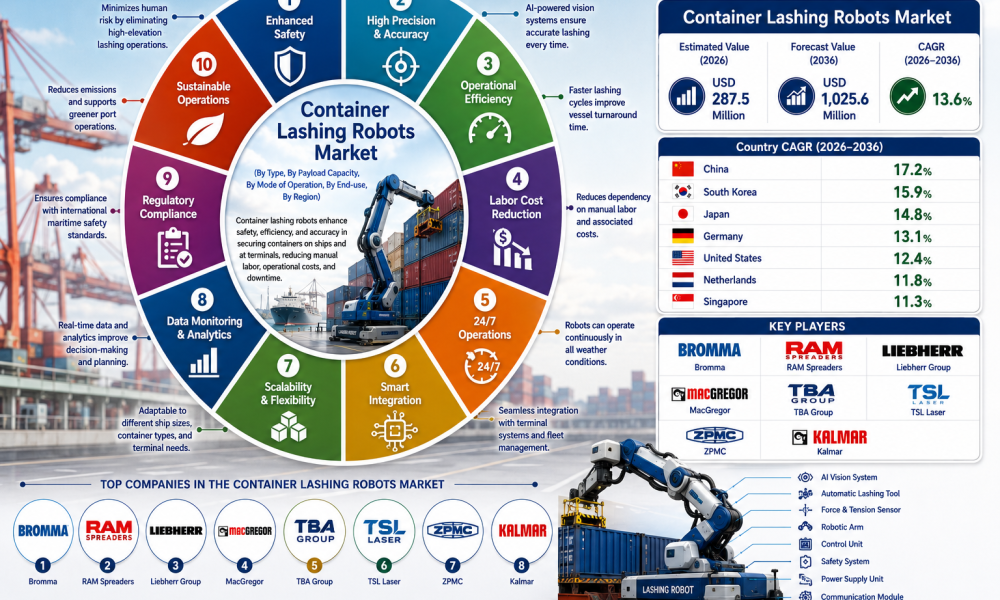
The global container lashing robots market is projected to increase from USD 35 million in 2026 to USD 413.2 million by 2036, expanding at a 28.0% CAGR from 2026 to 2036. The market crossed USD 27.3 million in 2025, with demand supported by growing port automation, worker-safety priorities, mega-vessel turnaround requirements, and the need to automate repetitive twistlock handling near quay crane operations.
Port automation is a key growth driver as automated yards and crane systems leave manual twistlock and lashing activities as remaining workflow gaps. Worker exposure to suspended loads, moving containers, deck congestion, and repetitive strain is also encouraging terminal operators to evaluate robotic alternatives. RAM Spreaders’ February 2026 PinSmart brochure describes a quay-crane-mounted machine in which robots pick and handle container twistlocks to and from integrated storage cassettes, supporting the development of automated twistlock handling as an early commercial pathway.
Get detailed market forecasts, competitive benchmarking, and pricing trends: https://www.factmr.com/connectus/sample?flag=S&rep_id=15472
Global Segment Leaders
- Automation Level — Robotic units: 38.0% share in 2026. Robotic units represent a practical bridge between manual twistlock handling and fully automated quay workflows.
- Operation — Twistlock handling: 42.0% share in 2026. Twistlock handling is the most defined and repeatable automation task around container securing.
- Terminal Type — Automated terminals: 34.0% share in 2026. These terminals already have control systems, remote-operation capabilities, and equipment integration that can support robotic deployment.
- Technology — Robot arms: 37.0% share in 2026. Robot arms provide the precise picking, placement, and tool interaction required for twistlock handling.
- Buyer Type — Terminal operators: 44.0% share in 2026. Terminal operators directly manage quay productivity, worker safety, and vessel turnaround requirements.
Country-Level Performance
| Country | CAGR | Key Growth Driver |
| Singapore | 30.8% | Automated terminal operations and quay-side safety priorities are encouraging robotic handling and supervised automation. |
| Netherlands | 29.6% | Mega-vessel berths and automated terminal modernization are supporting demand for quay-side robotic tools. |
| China | 28.7% | ZPMC’s large container-handling equipment base and automated terminal expansion support robotic handling pilots. |
| Germany | 27.4% | Engineering-led terminal automation and safety-focused equipment retrofit programs are supporting adoption. |
| United States | 26.2% | Terminal safety programs and stevedoring workflow modernization are driving interest in safer twistlock handling and remote inspection. |
Regional Context
Fast-growing markets include Singapore, the Netherlands, China, and Germany. Singapore’s growth is linked to automated terminal operations and safety-led quay workflows, while the Netherlands is benefiting from mega-vessel berths and automated terminal modernization. China’s outlook is supported by the scale of ZPMC container-handling equipment and expanding automation pilots. Germany is advancing through engineering-led terminal automation and equipment retrofit programs.
The United States, while recording the lowest CAGR among the five profiled countries at 26.2%, is still expected to experience rapid market expansion as terminal operators and port automation vendors test safer twistlock handling and remote inspection systems. Adoption is expected to develop gradually because labor rules and vessel variability can affect deployment.
The report covers North America, Western Europe, East Asia, South Asia, Latin America, and the Middle East & Africa, with country coverage extending across markets including Singapore, the Netherlands, China, Germany, the United States, Canada, Mexico, the United Kingdom, Belgium, Spain, Japan, South Korea, India, Thailand, Brazil, Chile, the UAE, Saudi Arabia, and South Africa.
Competitive Landscape
The competitive landscape includes RAM Spreaders, Bromma / Kalmar, ZPMC, MacGregor, and ABB Ports / ABB Robotics. RAM Spreaders has direct relevance through its PinSmart automated twistlock handling system, while MacGregor provides automatic twistlocks and container lashing systems. Bromma / Kalmar contributes spreader and container-handling capabilities, ZPMC supports the market through automated terminal equipment and smart-terminal projects, and ABB Ports / ABB Robotics provides enabling robotics, AI, and port-automation capabilities.
Recent developments include MacGregor’s June 2025 announcement that it would deliver fully automatic twistlocks for Hapag-Lloyd’s 19,900 TEU vessels. ABB’s June 2025 ports article highlighted AI’s potential to improve productivity and safety in container terminals. RAM Spreaders’ February 2026 PinSmart brochure also describes automated twistlock handling using a quay-crane-mounted system.
Market Outlook
The market’s development is expected to remain closely tied to technology readiness and terminal workflow integration. Quay-crane-mounted twistlock robots represent an early commercial opportunity because they can fit existing container-handling workflows without requiring complete automation of vessel-deck operations.
Safety inspection robots using vision and sensors, remote-operated lashing tools, and shipping-line adoption of automatic twistlocks provide additional opportunities. However, commercial maturity, vessel and terminal layout variation, reliability in harsh operating environments, and labor and workflow considerations remain constraints.
The market scope includes semi-automatic tools, robotic units, remote-operated lashing, fully automated concepts, lashing, unlashing, twistlock handling, safety inspection, and deck operations. Technology coverage includes robot arms, mobile platforms, vision guidance, remote control, and safety sensors.
Top Trending Reports:
About Fact.MR
Fact.MR is a market research and consulting provider offering market intelligence and strategic research across industries including industrial automation, transportation, logistics, and technology.



