
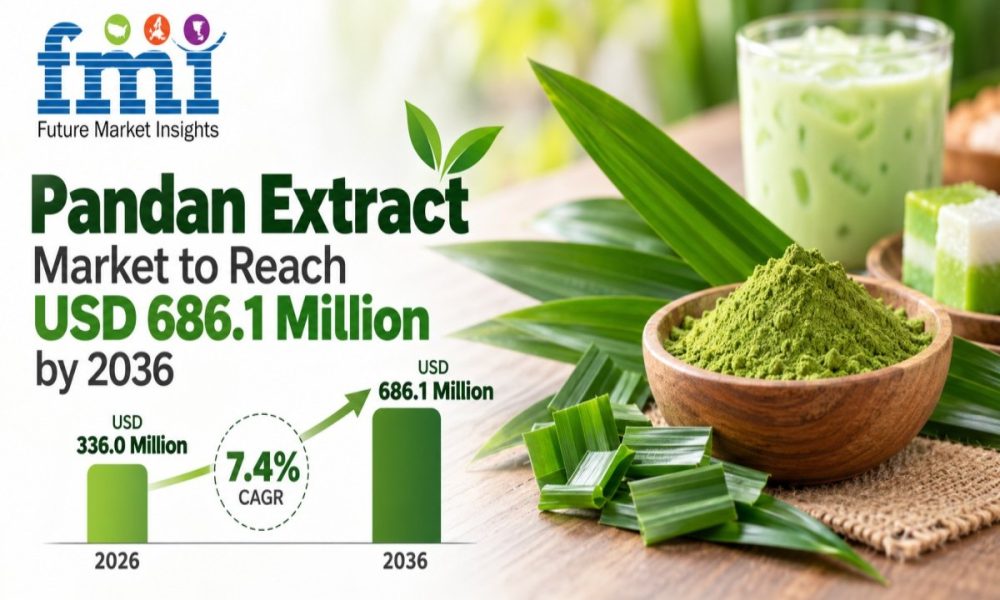
The global Pandan Extract Market is projected to reach USD 686.1 million by 2036, up from approximately USD 336.0 million in 2026, expanding at a 7.4% CAGR during the forecast period, according to the latest analysis by Future Market Insights (FMI).
The market is being supported by food developers increasingly using standardized pandan extracts in beverage and dessert concepts that require consistent aroma performance across commercial production. Manufacturers are replacing fresh-leaf preparation with standardized flavor ingredients to reduce formulation variability and improve repeatability across production facilities.
Get Detailed Market Forecasts, Competitive Benchmarking, and Pricing Trends:
https://www.futuremarketinsights.com/reports/sample/rep-gb-34585
Natural Pandan Extract Leads Extract Type Demand
Natural pandan extract is estimated to account for 34.0% of extract type demand in 2026, making it the leading extract category.
Natural pandan extract provides formulators with a recognizable plant-linked aroma without requiring fresh leaves at production sites. Standardized extraction separates aroma delivery from the narrow handling window associated with fresh leaves during industrial production.
Water-Soluble Formats Hold the Leading Solubility Share
Water-soluble formats are projected to account for 62.0% of solubility demand in 2026.
Water-soluble pandan formats fit beverage syrups and dairy mixes without requiring a separate oil phase. Product teams can evaluate dosage and aroma directly within aqueous bases during repeated commercial formulation trials.
Bakery & Desserts Lead Application Demand
Bakery and desserts are projected to account for 34.0% of application demand in 2026.
Sweet bakery and dessert products provide familiar applications for pandan’s floral and nut-like flavor profile. Product teams can test pandan in cakes and frozen desserts before evaluating broader commercial scale-up.
Flavor Houses Lead Sales Channels
Flavor houses are forecast to account for 38.0% of sales channel demand in 2026, making them the leading channel.
Flavor houses combine ingredient access with sensory matching and documentation before manufacturers establish production specifications. Pandan application development varies according to solubility, dosage and labeling requirements across different food and beverage bases.
Standardized Ingredients Expand Commercial Pandan Applications
Food and beverage teams are adapting familiar Asian flavor profiles into scalable beverage and sweet-product concepts that require standardized ingredients.
The Philippine FDA registered Flavorites Enterprises’ pandan flavor 888374 as a raw material in October 2025 with approval valid until October 2030. Such registrations provide product developers with traceable inputs for commercial trials and repeat orders once the flavor performs consistently in finished products.
Thailand Shows the Fastest Growth Among Highlighted Markets
Among the highlighted country markets, Thailand is projected to record an 8.6% CAGR through 2036, followed by Indonesia at 8.4%, Malaysia at 8.1%, Singapore at 6.7% and the United States at 6.2%.
The 2.4 percentage-point range separates the faster-growing Southeast Asian markets from slower commercialization markets. Thailand and Indonesia form the upper pair, while Malaysia remains close behind. Singapore and the United States require additional concept differentiation before interest converts into regular ingredient purchasing.
United States Builds Demand Through Foodservice Applications
The United States pandan extract market is forecast to expand at a 6.2% CAGR through 2036.
Foodservice provides flavor developers with an early-stage testing channel for botanical profiles across restaurant and beverage programs. Menu experimentation and cross-cultural beverage concepts can increase familiarity before packaged-food manufacturers commit to broader production.
USDA reported in June 2026 that food-away-from-home represented 56.3% of U.S. food expenditures in 2025, highlighting the size of the potential trial channel.
Competitive Landscape
The Pandan Extract Market includes global flavor houses and regional ingredient specialists competing through botanical sourcing, format breadth, application support and regulatory expertise.
Key companies profiled by FMI include Kerry Group plc, Givaudan SA, Symrise AG, DSM-Firmenich AG, International Flavors & Fragrances Inc., Sensient Technologies Corporation, V. MANE FILS and McCormick & Company, Incorporated.
Competitive positioning is influenced by format breadth, botanical capability, application support, regulatory documentation, manufacturing capabilities and geographic reach.
Key Industry Developments
The market continues to see production expansion, regional logistics investments and technology-driven flavor development.
In July 2026, Givaudan SA opened a 24,000-square-metre Cikarang facility for Southeast Asian customer programs, producing sweet and savory flavor powders and snack flavor systems closer to regional application teams.
In June 2026, V. MANE FILS inaugurated its Cikarang logistics expansion to improve ingredient and sample movement across Indonesia and Southeast Asia.
In November 2025, Symrise AG expanded Symvision AI with sensory-prediction tools intended to reduce formulation changes before physical validation.
Analyst Perspective
“Pandan extract earns repeat business by keeping its leaf aroma stable during shipping, storage and the customer’s production process. Commercial teams should compare sensory stability with format fit and documentation first because reformulation during scale-up can erase a lower ingredient cost.” — Nandini Roy Choudhury, Principal Consultant, Future Market Insights
Exclusive Discounts on Full Report
https://www.futuremarketinsights.com/reports/pandan-extract-market
Report Scope
The FMI study covers the Pandan Extract Market by extract type, solubility, application, source, sales channel and region.
Extract types include natural pandan extract, pandan flavor concentrate, pandan paste, pandan powder and pandan essential oil. Solubility categories include water-soluble, oil-soluble and emulsion-based formats.
Applications include bakery and desserts, beverages, dairy and ice cream, sauces and ready meals, and fragrance/personal care. Sources include fresh pandan leaves, dried pandan leaves, cultivated/contract farming and wild/smallholder sourcing.
Sales channels include flavor houses, food ingredient distributors, direct processor supply and retail/foodservice packs.
The research covers North America, Latin America, Europe, East Asia, South Asia and Pacific, and the Middle East and Africa, with Thailand, Indonesia, Malaysia, Singapore, the United States and 20+ additional countries included in the full report.
Key Executive Benefits
- Decision-Ready Insights
- Reduced Strategic Risk
- Market Entry Confidence
- Competitive Advantage
- Faster Growth Decisions
- Primary Market Validation
To explore how FMI Custom Research can support your strategic priorities, connect with our team at [email protected].
About Future Market Insights (FMI)
Future Market Insights, Inc. is an ESOMAR-certified, ISO 9001:2015 market research and consulting organization trusted by Fortune 500 companies. With a global presence across the U.S., UK, India and Dubai, FMI delivers data-driven insights across 30+ industries and 1,200 markets worldwide.



