
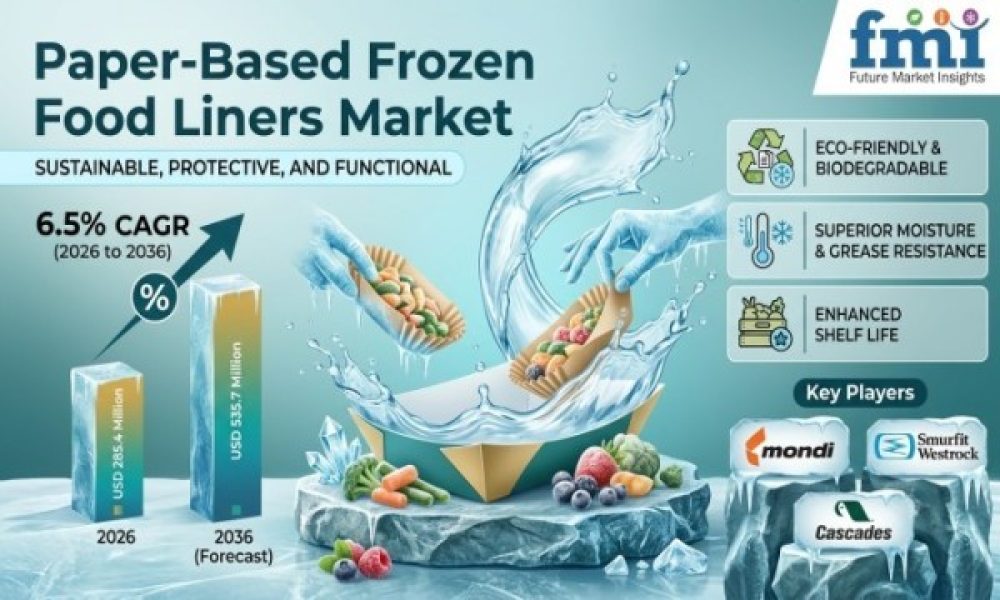
The global Paper-Based Frozen Food Liners Market is projected to grow from USD 285.4 million in 2026 to USD 535.7 million by 2036, registering a 6.5% CAGR during the forecast period, according to Future Market Insights (FMI). Demand is being supported by recurring liner consumption across frozen-food processing, where paper sheets and liners are used for wrapping, interleaving, separation, and surface protection.
Frozen-food processors are placing greater attention on paper structures that can maintain performance under moisture, grease, and low-temperature conditions while meeting food-contact and recovery requirements. Qualification is becoming more detailed as processors compare barrier performance, wet strength, release behavior, coating chemistry, and compatibility with existing converting routines.
Get detailed market forecasts, competitive benchmarking, and pricing trends:
https://www.futuremarketinsights.com/reports/sample/rep-gb-34683
Frozen-food throughput supports recurring liner consumption
Frozen-food production creates repeat demand because wrapping and interleaving materials are consumed during production runs. Additional cold-chain processing capacity can therefore add recurring liner-use points.
India’s Ministry of Food Processing Industries listed 408 approved cold-chain projects as of March 31, 2026, illustrating the continued development of infrastructure that can support frozen-food processing and distribution.
Within applications, frozen meat and seafood are projected to account for 32.0% of the market in 2026. These products can expose liners to purge, surface fat, moisture, and sharp product edges during portioning and storage, increasing the importance of wet strength and clean release.
USDA reported 1.16 billion pounds of frozen poultry in cold storage on June 30, 2026, providing further evidence of the scale of frozen-food inventory that requires protection and separation during storage and handling.
Freezer paper liners and coated kraft lead key segments
Freezer paper liners are estimated to hold 32.0% of the product-type segment in 2026. Their use across direct wrapping and interleaving tasks supports their position across established frozen-food converting routines.
By paper grade, coated kraft is projected to hold 34.0% in 2026. Its combination of fiber strength and adjustable barrier treatment allows processors to assess moisture protection, grease resistance, wet strength, and release behavior for different frozen-food formats.
The to -18 C temperature-rating segment is projected to account for 46.0% in 2026. This rating represents a mainstream frozen-storage duty range, while lower-temperature applications require additional checks related to brittleness, delamination, and liner integrity.
Coating qualification becomes a critical purchasing consideration
Paper-based liners must balance freezer performance with food-contact and end-of-life requirements. Coating chemistry can influence whether a paper structure meets both functional and regulatory expectations.
From August 12, 2026, Regulation (EU) 2025/40 bars food-contact packaging containing targeted PFAS at or above 25 ppb. Such requirements make coating composition a direct consideration during qualification programs.
Heat-sealable paper also provides an opportunity for fiber-based substitution where the finished structure can meet food-contact and low-temperature requirements without forcing extensive machinery changes.
Brazil records the fastest growth among profiled countries
Brazil is forecast to record the highest CAGR among the five profiled countries at 6.9% through 2036, followed by the United Kingdom at 6.4%, Germany at 6.3%, the United States at 5.9%, and Japan at 5.1%.
Brazil’s growth outlook is linked to protein-processing activity and demand for moisture-resistant paper conversion. The United States benefits from an established cold-storage network, while Japan’s slower pace reflects detailed composition and material documentation requirements.
Competitive landscape
The market includes integrated fiber and packaging companies as well as specialty paper producers. Mondi, Smurfit Westrock, Sappi, Billerud, Cascades, Seaman Paper, Twin Rivers Paper, and Koehler Paper are among the notable companies profiled by FMI.
Competition centers on food-contact performance, barrier properties, wet strength, conversion consistency, technical support, and geographic supply capabilities.
Recent developments include Cascades installing new equipment at its Kingsey Falls uncoated recycled boxboard plant in March 2026, Mondi extending its food-packaging portfolio in November 2025 with solid board boxes for frozen products, and Smurfit Westrock documenting a closed-loop packaging partnership with Belgian frozen-food contract packer Sivafrost in May 2025.
Analyst Perspective
“Processors should compare coating adhesion and clean release at the intended storage temperature ahead of unit-price review. Grades that run consistently on existing lines and carry food-contact plus recovery documentation reduce qualification work for recurring programs.”
— Nandini Roy Choudhury, Principal Consultant, Future Market Insights
Report Scope
The FMI study covers the Paper-Based Frozen Food Liners Market by product type, paper grade, temperature rating, application, end use, sales channel, and region. Product types include freezer paper liners, wet-strength carton liners, coated tray liners, interleaving sheets, and others.
The study covers North America, Latin America, Europe, East Asia, South Asia and Pacific, and the Middle East and Africa. The forecast period runs from 2026 to 2036, with revenue measured in USD million and growth reported as CAGR.
Access the Full Market Research Report
Industry professionals can access the full Paper-Based Frozen Food Liners Market study, including segment analysis, country-level forecasts, competitive benchmarking, market methodology, and regional insights: https://www.futuremarketinsights.com/reports/paper-based-frozen-food-liners-market
FMI Custom Research: Strategic Intelligence for Confident Decision-Making
In today’s rapidly evolving business environment, leadership teams need more than market data—they need clear, actionable intelligence tailored to their strategic objectives. FMI’s Custom Research solutions are designed around the specific business questions organizations need answered, enabling executives to evaluate growth opportunities, validate investments, assess competitive dynamics, and reduce uncertainty before making critical decisions. By combining deep industry expertise, primary research, and proprietary market intelligence, FMI delivers insights that help organizations move from assumptions to evidence-based strategies with greater speed and confidence.
Business Impact
FMI helps organizations transform market complexity into strategic clarity, enabling leadership teams to identify growth opportunities faster, optimize resource allocation, strengthen competitive positioning, and make high-stakes business decisions with confidence.
To explore how FMI Custom Research can support your strategic priorities, please connect with our team at – [email protected]
About Future Market Insights (FMI)
Future Market Insights, Inc. (FMI) is an ESOMAR-certified, ISO 9001:2015 market research and consulting organization, trusted by Fortune 500 clients and global enterprises. With operations in the U.S., UK, India, and Dubai, FMI provides data-backed insights and strategic intelligence across 30+ industries and 1200 markets worldwide.



