
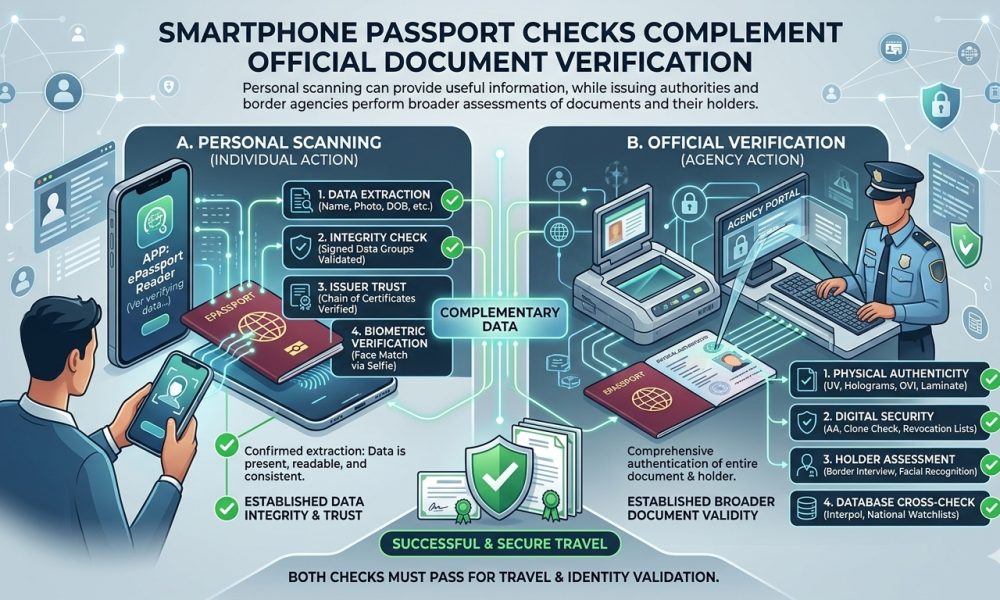
Personal scanning can provide useful information, while issuing authorities and border agencies perform broader assessments of documents and their holders.
WASHINGTON, DC, October 5, 2026, A modern smartphone can read the electronic chip inside many passports, display the holder’s digitally stored photograph and biographical information, and perform meaningful cryptographic checks. Still, personal scanning remains fundamentally different from the broader verification conducted by issuing governments, immigration authorities, and border inspection systems.
Understanding that distinction lets travelers use passport-reading applications intelligently, because a successful personal scan can reveal useful information about electronic data integrity and supported security protocols without establishing every fact an authorized government inspection may consider before accepting a document or admitting its holder.
Consumer Applications Can Perform Genuine Security Checks
A capable passport Application can use the smartphone’s Camera to read the Machine Readable Zone, establish authorized communication with the contactless chip, retrieve standardized electronic data groups, compare information, examine digital signatures, and perform additional Authentication protocols when both the passport and software support those capabilities.
These functions are genuine security procedures rather than decorative demonstrations, and the electronic passport framework established through ICAO Doc 9303 specifically defines mechanisms by which inspection systems can authenticate signed data and, where supported, obtain additional evidence about the Authenticity of the contactless chip itself.
Personal Scanning Can Reveal Important Inconsistencies
When a smartphone successfully reads a passport chip, the user can compare electronically stored names, document numbers, nationality information, dates, and facial images with information printed or engraved on the physical data page, creating a useful opportunity to identify obvious discrepancies that require further investigation.
A capable Application can also perform Passive Authentication, which allows the software to calculate cryptographic hashes from relevant electronic data groups and compare those values with digitally signed references, providing evidence that protected information has not been altered after the issuing process applied its signature.
Passive Authentication Has a Defined Boundary
ICAO explains that Passive Authentication can establish the Authenticity and integrity of protected electronic passport contents. Still, the same standard specifically notes that this mechanism does not prevent exact copying of chip contents or substitution of the electronic component, which is why additional physical inspection remains important.
A smartphone reporting successful Passive Authentication can therefore provide meaningful cryptographic evidence concerning the electronically signed information. However, that result should not automatically lead to the conclusion that every physical feature, government record, biometric relationship, or travel-status question associated with the document has also been verified.
Some Apps Can Check the Chip More Deeply
Depending upon the passport generation and Application capabilities, smartphones can sometimes perform Active Authentication or Chip Authentication, allowing the electronic component to demonstrate possession of protected cryptographic information that should not become available merely by copying readable files from an authentic passport.
These protocols can provide evidence against straightforward electronic cloning. However, they still answer specific technical questions about the contactless chip rather than independently determining whether a traveler remains entitled to use the passport, whether authorities have canceled it, or whether another governmental restriction currently applies.
Official Inspection Systems Have Different Resources
Government border systems operate in a different institutional environment because they can combine document examination with immigration records, government databases, traveler histories, biometric systems, law-enforcement information, lost-and-stolen-document resources, visa records, and other systems unavailable to ordinary consumer applications.
A personal passport reader therefore examines information available through the document and whatever trusted cryptographic resources the Application possesses. At the same time, an authorized border system can evaluate the document alongside information held independently by government authorities about both the passport and the person presenting it.
Government Systems Can Verify the Traveler as Well as the Document
One key difference is biometric identity, because official systems increasingly compare a live facial Image against trusted photographs already linked to passports, visas, or previous government encounters, helping authorities determine whether the person at inspection appears to be the legitimate bearer of the travel document.
U.S. Customs and Border Protection explains through its Simplified Travel biometric process that facial comparison can use photographs associated with passports, visas, and previous encounters specifically to verify identity and help confirm that the traveler is the person entitled to present the relevant travel documents.
A Smartphone Usually Cannot Establish Current Government Status.
A passport can remain physically intact and contain correctly signed electronic information even after the issuing authority has canceled, revoked, administratively invalidated, or otherwise changed the governmental status associated with that document, creating a verification question that an ordinary offline reader may not be able to resolve.
Cryptographic Authentication principally addresses whether protected electronic information corresponds with the issuing infrastructure that signed it. In contrast, current validity can depend on later governmental decisions recorded in systems entirely separate from the NFC chip and inaccessible through ordinary personal scanning applications.
Lost and Stolen Documents Present the Same Distinction
A genuine passport reported lost or stolen can still possess authentic printing, an original chip, valid digital signatures, and correctly functioning electronic Authentication mechanisms, because reporting the document stolen does not physically rewrite every security element already incorporated into the booklet.
Government and law-enforcement systems can therefore consider status information beyond the passport itself, showing why successful chip Authentication should never be interpreted as proof that authorities currently regard the document as valid, unreported, unrestricted, and lawfully possessed by the individual presenting it.
Border Inspection Is Also an Admissibility Process
Passport Authenticity represents only one component of international border processing because immigration authorities must frequently determine whether a traveler satisfies legal requirements for admission, possesses the necessary visa or authorization, complies with immigration conditions, and presents information consistent with applicable national laws.
A consumer Application has neither the legal authority nor the information required to make those determinations, meaning even an exceptionally sophisticated personal passport scan cannot reproduce the broader decision-making process performed by an immigration officer or government-controlled automated border system.
Official Systems May Conduct Multiple Database Queries
Modern border environments can use biographical and biometric information to run system queries that extend far beyond the information physically encoded in the passport, potentially allowing authorized officers to identify government records or security concerns that reading the contactless chip alone could never reveal.
CBP documentation describing contemporary arrival processing shows that biometric comparison operates alongside broader inspection procedures and system checks, illustrating how government verification combines identity technology with official records rather than treating electronic passport Authentication as the entire border examination.
Personal Apps Still Have Considerable Value
The limitations of consumer scanning should not diminish its usefulness, because well-designed applications can help travelers check whether a passport chip responds, examine electronic biographical information, retrieve the chip portrait, identify supported protocols, perform cryptographic Authentication, and better understand the security technology in their own travel documents.
A traveler who understands each result can therefore learn much more from a personal scan than from simply inspecting the printed page, especially when the app clearly distinguishes between successful chip communication, signed-data verification, certificate trust, anti-cloning mechanisms, and other individual procedures.
Personal Scanning Can Help Identify Technical Problems
A smartphone scan can also reveal practical technical issues before travel, including difficulty establishing NFC communication, inconsistent electronic information, unsupported security protocols, or a chip that repeatedly fails to respond when the device and scanning technique appear appropriate.
Such observations can justify further examination or contact with the issuing authority. However, users should avoid treating a single unsuccessful consumer scan as definitive proof of chip failure because smartphone antennas, Application design, device positioning, software compatibility, and communication interruptions can independently affect results.
A Failed App Check Is Not an Official Determination
If a passport Application reports a cryptographic failure, missing certificate, unsupported protocol, or inability to communicate with the chip, that result can provide useful diagnostic information without automatically establishing that the document is fraudulent, invalid, or unacceptable for international travel.
Professional examination requires understanding exactly which operation failed and why, because unavailable certificate resources, unsupported algorithms, software limitations, communication errors, genuine data inconsistencies, and actual document problems can sometimes produce warnings that appear superficially similar within simplified consumer interfaces.
Physical Inspection Adds Information a Phone Cannot Fully Reproduce.
Government officers and trained document examiners can inspect specialized substrates, laser engraving, tactile features, ultraviolet printing, optically variable devices, perforations, microprinting, personalization methods, and other physical characteristics that an ordinary NFC passport-reading Application cannot necessarily evaluate accurately.
Electronic Authentication therefore complements traditional document examination rather than eliminating it, because sophisticated passport security deliberately combines independent physical and electronic protections so that successful reproduction or verification of one security layer does not automatically settle every question concerning the document.
Issuing Authorities Remain the Authoritative Source
When a significant question concerns whether a government actually issued a particular passport, whether that passport remains legally valid, or whether its official record has subsequently changed, the issuing authority and other authorized governmental systems remain more authoritative sources than any independent consumer Application.
A smartphone Application can validate cryptographic evidence when it possesses the necessary trusted certificates and properly implements the required protocols. Still, it does not become the issuing government merely because its software successfully verifies information originally signed through governmental passport infrastructure.
Border Agencies Evaluate Documents in Context
At an international border, authorities are not merely authenticating a plastic data page or electronic chip because they are evaluating a traveler, a travel document, associated government records, applicable immigration requirements, and other information relevant to the inspection under the laws governing entry or departure.
This broader context explains why an authentic passport does not guarantee admission into another country and why an electronic Authentication result, however technically sound, cannot replace the legal and operational assessment conducted by the government responsible for controlling its border.
Automated Border Systems Also Operate Within Government Infrastructure
An automated border portal may appear superficially similar to a consumer scanning Application because both can use cameras, passport readers, electronic data, and biometric comparison. Still, the government terminal operates within an authorized inspection environment connected to systems and records an ordinary smartphone cannot access.
CBP documentation on contemporary biometric processing, for example, describes facial comparison and document scanning as components of a larger government admissions process in which travelers can be cleared, queried further, or referred to an officer when additional inspection becomes necessary.
Smartphone Scanning Should Be Viewed as a Complement
The most useful way to understand personal passport scanning is therefore as an additional source of information that can complement official verification, allowing individuals to examine electronic characteristics without confusing access to sophisticated cryptography with possession of governmental authority or complete border-control capabilities.
As Amicus International Consulting has explained in its broader passport-security coverage, modern travel-document security depends upon overlapping physical, electronic, biometric, and institutional safeguards whose combined strength is greater than any isolated security feature examined independently.
The Question Being Asked Determines the Appropriate Tool
If someone wants to know whether a passport chip can be read, whether electronic data match printed information, or whether supported cryptographic Authentication succeeds, a properly designed smartphone Application can provide meaningful, technically sophisticated answers without requiring specialized border-control equipment.
If the question instead concerns whether the passport remains officially valid, whether it has been reported lost or stolen, whether the traveler is its lawful bearer, or whether that individual is admissible at a particular border, authorized government systems and officials possess capabilities that personal applications generally cannot reproduce.
Useful Evidence Is Not the Same as Complete Verification
Smartphone passport readers have significantly expanded public access to electronic document technology, allowing ordinary users to observe security mechanisms that previously remained largely invisible while providing practical evidence concerning chip readability, data consistency, digital signatures, and supported cryptographic Authentication procedures.
Their strongest use comes from understanding those results precisely, because personal scanning can provide valuable evidence about the electronic passport in hand. At the same time, official document verification remains a broader process involving physical examination, trusted governmental records, biometric identity, document status, immigration requirements, and the authority to make legally consequential decisions.




