
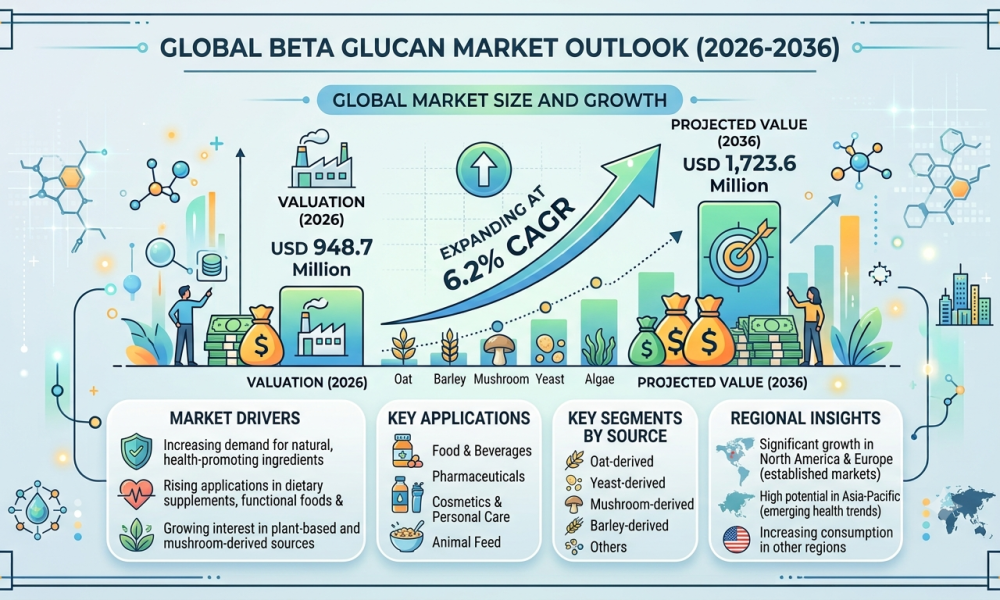
The global beta glucan market is projected to grow from USD 948.7 million in 2026 to USD 1,723.6 million by 2036, registering a 6.2% CAGR during the forecast period. Demand is supported by growing interest in cardiovascular and metabolic health, immune-health positioning, source-defined functional ingredients, and the use of beta glucan in food, beverages, dietary supplements, pharmaceuticals, animal feed, and personal-care applications. Food and supplement formulators are increasingly specifying beta glucan by source because molecular structure influences physiological positioning and processing behavior.
Health-claim pathways are creating additional opportunities for beta glucan suppliers, particularly for qualifying oat and barley soluble fiber products. Processing performance is also becoming important as molecular-weight loss, incomplete dispersion, and changes in solubility can affect functionality in finished products. Better-dispersing grades are opening opportunities in beverages and compact nutrition formats, while standardized powder formats continue to support dry blending, controlled dosing, and repeat commercial production.
Get detailed market forecasts, competitive benchmarking, and pricing trends: https://www.futuremarketinsights.com/reports/sample/rep-gb-489
Global Segment Leaders
- Product Type – Soluble Beta Glucan: 67.0% in 2026. The segment leads as formulators seek water-dispersible functionality, viscosity, and established cereal-fiber health applications. Molecular weight, dissolution behavior, and dose retention remain important qualification factors.
- End User Application – Nutraceutical – Dietary Supplements: 32.0% in 2026. Measured-dose formats allow manufacturers to control beta glucan intake and active levels while supporting combinations with other functional ingredients.
- Source – Yeast: 32.0% in 2026. Yeast beta glucan supports differentiated immune-health formulations, with source-specific purity, branching structure, and technical substantiation influencing commercial qualification.
- Form – Powder: 65.0% in 2026. Powder formats support dry blending, controlled dosing, lower transport weight, and standardized active-content specifications for commercial manufacturing.
Country-Level Performance
Spain is projected to grow at the fastest pace among the profiled markets, with an 8.1% CAGR through 2036. EU claim eligibility and national communication requirements are shaping the commercialization of beta glucan-containing food and supplement products.
Brazil is expected to record an 8.0% CAGR, supported by formal supplement notification routes and permitted functional claims. Suppliers that prepare composition and claim documentation early can reduce rework during national review.
Mexico is projected to expand at a 7.2% CAGR, with defined-dose supplement formats supporting demand. National import and supplement procedures continue to shape compliant commercial entry for finished products.
Germany is forecast to grow at a 7.1% CAGR, supported by demand for functional nutrition ingredients. German supplement companies combine European claim rules with national notification procedures, making source and claim documentation important before product launch.
Argentina is projected to record a 7.0% CAGR, as functional-ingredient options continue to expand within the country’s food and supplement framework.
The United States is expected to grow at a 6.0% CAGR, with FDA pathways for qualifying soluble fiber from oat and barley foods supporting source-defined beta glucan applications.
Regional Context
Spain and Brazil represent the fastest-growing profiled markets, with CAGRs of 8.1% and 8.0%, respectively. Their growth reflects expanding functional-food and dietary-supplement opportunities, while regulatory notification and claim requirements remain important considerations for manufacturers.
Mexico, Germany, and Argentina represent another strong-growth group, with CAGRs ranging from 7.0% to 7.2%. Demand across these markets is supported by functional nutrition applications, source-specific ingredient positioning, and growing use of beta glucan in supplements and formulated foods.
The United States represents a more mature market, with a 6.0% CAGR through 2036. Established health-claim pathways and demand for source-qualified ingredients continue to support commercial adoption.
The full report covers North America, Latin America, Western Europe, Eastern Europe, East Asia, South Asia and Pacific, and the Middle East and Africa, with 20+ countries included in the full report.
Access full Report in PDF Format@ https://www.futuremarketinsights.com/reports/brochure/rep-gb-489
Competitive Landscape
The competitive landscape includes Kemin Industries Inc., Kerry Group plc, Angel Yeast Co., Ltd., Givaudan SA, Lantmännen Biorefineries, Biorigin, part of Phileo by Lesaffre, COSCIENS Biopharma Inc. (Ceapro Inc.), and Leiber GmbH. Competition spans cereal processors, yeast specialists, and functional-ingredient suppliers, with companies differentiating through source control, standardized active content, technical evidence, application support, and geographic reach.
Kemin Industries and Givaudan focus on specialized human-nutrition ingredients, while Lantmännen Biorefineries supplies oat-derived materials for food and supplement formulations. Kerry Group and Leiber provide yeast beta glucan solutions for immune-health applications, while Angel Yeast extends yeast-derived solutions across human nutrition and animal feed. Biorigin supplies beta glucan solutions for animal and pet nutrition, while COSCIENS Biopharma retains Ceapro oat beta glucan and related active-ingredient technology.
Analyst Perspective
“Commercial beta glucan decisions start with source identity because structure determines both claim options and formulation behavior. Suppliers that document dose retention during processing can shorten qualification without asking formulators to accept weaker sensory performance.”
— Nandini Roy Choudhury, Principal Consultant, Future Market Insights



