
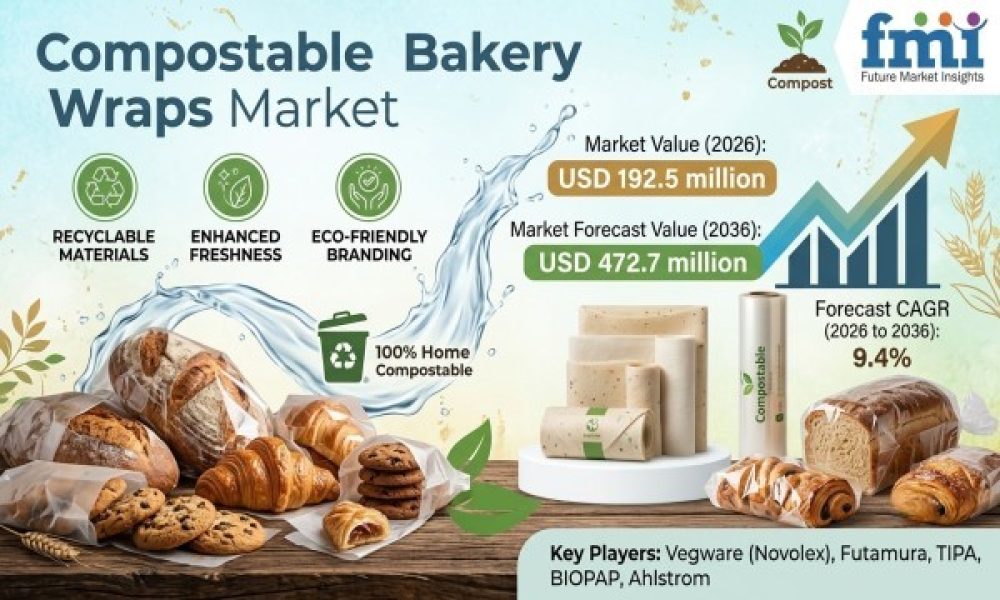
The global Compostable Bakery Wraps Market is projected to grow from USD 192.5 million in 2026 to USD 472.7 million by 2036, advancing at a 9.4% CAGR, according to Future Market Insights (FMI). The forecast reflects growing attention to how certified bakery wraps perform in real collection and composting systems, rather than certification alone.
For bakery operators and foodservice groups, packaging selection is increasingly linked to disposal arrangements. England’s March 2025 Simpler Recycling rules require covered workplaces to separate food waste from dry recyclables and residual waste. This has increased scrutiny of how packaging materials fit into collection and treatment routes.
The issue extends beyond regulation. Compostable bakery wraps need to provide reliable grease resistance while remaining compatible with the disposal system available at the service location. End-of-life infrastructure is therefore becoming an important differentiator between markets.
Get detailed market forecasts, competitive benchmarking, and pricing trends:
https://www.futuremarketinsights.com/reports/sample/rep-gb-34620
Collection Infrastructure Becomes a Commercial Consideration
The availability of organics collection can influence whether compostable packaging moves from trials into regular purchasing. The USA EPA reported in March 2025 that its updated Excess Food Opportunities Map identified more than 15,000 potential food recipients and more than 200 communities with source-separated organics programs.
However, local acceptance policies remain critical. A certified wrap may still be rejected by a contracted composter if it does not fall within the facility’s accepted feedstock list. This creates an additional qualification requirement for bakery groups operating across multiple locations.
The market is also developing along different national pathways. Japan places greater emphasis on material qualification and verification of collection pathways before wider commercial adoption. These differences make country-level packaging specifications and disposal instructions increasingly relevant to procurement teams.
Bakery Applications Put Barrier Performance to the Test
Pastries are expected to account for 28.0% of the market in 2026. Their concentrated grease load can expose barrier weaknesses quickly, while filled and delicate products require wraps that can be folded and handled efficiently during short service cycles.
Certified compostable paper wraps are forecast to represent 36.0% of product type demand in 2026. Their familiarity with existing bakery folding and printing routines supports adoption where operators want documented end-of-life claims without substantially changing staff handling practices.
Paper-fiber is projected to hold 46.0% share in 2026, supported by stiffness and printable surfaces suited to rapid counter wrapping. Meanwhile, industrial compostable formats are expected to lead the certification category with 52.0% share, as commercial standards provide a documented qualification basis for multi-site accounts.
Analyst Perspective
“Bakery groups should qualify compostable wraps against the grease load and collection route used at each service location. Repeat volume depends on one specification surviving printing plus hand wrapping and composter acceptance without becoming a costly composite.”
Nandini Roy Choudhury, Principal Consultant, Future Market Insights
Country Outlook Shows Different Adoption Conditions
Brazil is projected to record the highest CAGR among the five profiled countries at 9.9%, followed by the United Kingdom at 9.5%, Germany at 9.2%, the United States at 8.7%, and Japan at 7.9% through 2036.
The differences reflect more than growth rates. Brazil’s local converting capacity can reduce trial friction, while uneven organics collection remains a constraint. In the United Kingdom, producer-responsibility reporting makes material classification a consideration for bakery specifications. Germany’s biowaste contamination controls increase the need for precise disposal instructions.
In the United States, fragmented municipal acceptance makes hauler and composter coordination important for national accounts. Japan’s defined biodegradability criteria strengthen documentation requirements, while accepted collection routes remain a separate consideration.
Competitive Landscape
The market includes suppliers across certified compostable films, grease-resistant papers, and fiber-based packaging platforms. Notable companies profiled by FMI include Vegware (Novolex), Futamura, Ahlstrom, TIPA, Nordic Paper, Metsä Tissue, BIOPAP and delfort.
Competition centers on end-of-life qualification, grease and heat barrier performance, conversion compatibility, channel access, and geographic reach. This creates opportunities for suppliers that can demonstrate both technical performance and a workable disposal pathway for bakery customers.
Report Scope
The Compostable Bakery Wraps Market is segmented by product type, material, certification, application, end use, sales channel and region.
Product types include certified compostable paper wraps, cellulose window wraps, PLA-coated wraps, unbleached natural wraps and others. Materials include paper-fiber, regenerated cellulose, PLA and bagasse. Certification covers industrial compostable, home compostable and uncertified formats.
Applications include pastries, bread, sandwiches and snacks, cakes and others. End uses cover in-store bakeries, foodservice cafes, households and commercial bakeries. Sales channels include direct OEM supply, packaging distributors, e-commerce and others.
The report covers North America, Latin America, Europe, East Asia, South Asia and Pacific, and the Middle East and Africa, with Brazil, the United Kingdom, Germany, the United States, Japan and more than 20 countries included in the full analysis.
Discover the Full Details in Our Report—Read More Now!
https://www.futuremarketinsights.com/reports/compostable-bakery-wraps-market
FMI Custom Research: Strategic Intelligence for Confident Decision-Making
In today’s rapidly evolving business environment, leadership teams need more than market data—they need clear, actionable intelligence tailored to their strategic objectives. FMI’s Custom Research solutions are designed around the specific business questions organizations need answered, enabling executives to evaluate growth opportunities, validate investments, assess competitive dynamics, and reduce uncertainty before making critical decisions. By combining deep industry expertise, primary research, and proprietary market intelligence, FMI delivers insights that help organizations move from assumptions to evidence-based strategies with greater speed and confidence.
Business Impact
FMI helps organizations transform market complexity into strategic clarity, enabling leadership teams to identify growth opportunities faster, optimize resource allocation, strengthen competitive positioning, and make high-stakes business decisions with confidence.
To explore how FMI Custom Research can support your strategic priorities, please connect with our team at – [email protected]
About Future Market Insights (FMI)
Future Market Insights, Inc. (FMI) is an ESOMAR-certified, ISO 9001:2015 market research and consulting organization, trusted by Fortune 500 clients and global enterprises. With operations in the U.S., UK, India, and Dubai, FMI provides data-backed insights and strategic intelligence across 30+ industries and 1200 markets worldwide.



