
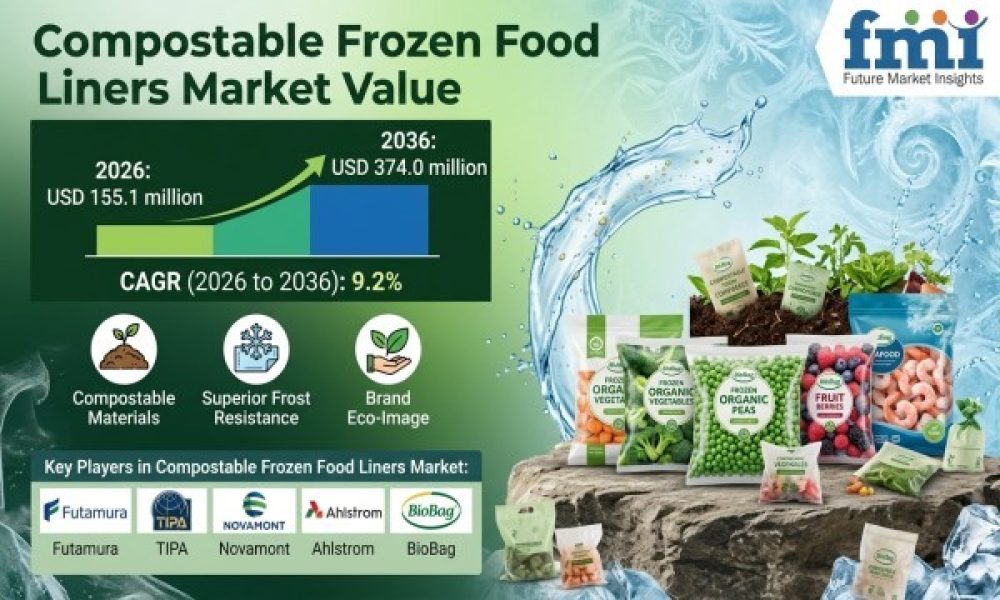
The global Compostable Frozen Food Liners Market is projected to grow from USD 155.1 million in 2026 to USD 374.0 million by 2036, registering a 9.2% CAGR during the forecast period, according to Future Market Insights (FMI).
The market is being shaped by a practical challenge for frozen-food processors: replacing conventional liner materials without compromising sealing, moisture control, freezer performance, or packing-line efficiency. At the same time, packaging regulations and collection requirements are making qualification and end-of-life verification more important before a new liner moves from trial to repeat purchasing.
The European Commission reported in February 2025 that Regulation (EU) 2025/40 had entered into force. The regulatory shift is increasing specification work across frozen-food packaging programs. However, commercial orders still depend on food-contact documentation and validated freezer performance.
Get detailed market forecasts, competitive benchmarking, and pricing trends:
https://www.futuremarketinsights.com/reports/sample/rep-gb-34626
Qualification Is Becoming Central to Liner Selection
Frozen ready meals are expected to account for 26.0% of application demand in 2026, making them the leading application segment. These products place moisture and sealing demands on liners during filling and cold distribution. High-volume production also requires consistent feeding across recipes and tray formats.
Futamura and Biopap reported in April 2026 that NatureFlex-lined compostable foodservice trays tolerate temperatures from -90°C to +175°C. Such performance can support frozen-storage and reheating applications, although individual liner specifications still require migration and sealing checks before food-contact approval.
Among product types, certified compostable coated liners are forecast to hold 34.0% share in 2026. These structures must combine a suitable base material with barrier treatment while maintaining food-contact and compostability qualifications.
Ahlstrom launched LamiBak Flex in March 2025 for pouches and flow packs using coating or extrusion routes, with regional compostability suitability. Such developments illustrate the market’s focus on structures that can meet both functional packaging requirements and specified end-of-life conditions.
Paper-Fiber Materials Hold a Leading Position
Paper-fiber materials are projected to account for 44.0% of the market in 2026. Their established converting base, printing compatibility, stiffness, and adaptability to food-contact barrier treatments support their use in liner development.
However, barrier treatment must not undermine the compostability claim of the finished structure. Delfort’s June 2025 thinbarrier 303 launch provides a food-contact reference for flexible packaging paper across -18°C to +38°C, while converters still need separate evidence for finished coated liners and their intended frozen-food applications.
Certification is another major consideration. Industrial compostable formats are projected to hold 56.0% share in 2026, supported by standardized qualification under controlled treatment conditions.
The commercial challenge is that certification does not automatically guarantee access to a suitable collection or treatment route. Local waste infrastructure can determine whether a certified liner can be recovered through the pathway communicated to customers.
Regional Growth Shows Different Qualification Conditions
Brazil is forecast to record the fastest CAGR among the profiled countries at 9.7%, followed by the United Kingdom at 9.3% and Germany at 9.0%. The United States is projected to grow at 8.5%, while Japan is expected to register 7.7%.
These markets differ in packaging regulation, collection infrastructure, processor qualification practices, and disposal requirements. Germany’s 9.0% forecast, for example, exceeds the United States at 8.5%, but the difference reflects approval and recovery conditions rather than current market size.
Collection acceptance remains a barrier. In February 2026, the London Borough of Hackney directed compostable plastics to general waste because local de-packaging systems separate packaging from organic streams. This demonstrates why certification alone may not be sufficient for a commercial packaging conversion.
Competitive Landscape
The competitive environment includes compostable film platforms, fiber barrier papers, and converted food-packaging formats.
Futamura, TIPA, Vegware (Novolex), Ahlstrom, Delfort, Novamont, BioBag, and Sappi are among the notable companies profiled by FMI.
Futamura, TIPA, and Novamont provide compostable film or biopolymer platforms. Ahlstrom, BioBag, and Vegware (Novolex) provide certified fiber or converted compostable formats. Delfort and Sappi contribute barrier-paper capabilities with documented food-contact performance.
Recent developments include Sappi North America’s April 2026 launch of LusterFSB OGR, TIPA’s September 2025 launch of four high-barrier compostable film and laminate products, and Ahlstrom’s April 2025 home-compostable certification in Australia and New Zealand for Sulpack flexible packaging.
Market Scope
FMI’s analysis covers product type, material, certification, application, end use, sales channel, and region. Product types include certified compostable coated liners, uncoated wet-strength compostable liners, PLA-laminated liners, cellulose film liners, and others.
The material analysis covers paper-fiber, PLA, regenerated cellulose, bagasse-agri-fiber, and others. Applications include frozen ready meals, frozen meat and seafood, frozen fruits and vegetables, and frozen bakery.
The study covers 2026 to 2036 and includes North America, Latin America, Europe, East Asia, South Asia and Pacific, and the Middle East and Africa. The full report profiles Brazil, the United Kingdom, Germany, the United States, Japan, and more than 20 countries.
Explore In-Depth Analysis—Click Here to Access the Report!
https://www.futuremarketinsights.com/reports/compostable-frozen-food-liners-market
FMI Custom Research: Strategic Intelligence for Confident Decision-Making
In today’s rapidly evolving business environment, leadership teams need more than market data—they need clear, actionable intelligence tailored to their strategic objectives. FMI’s Custom Research solutions are designed around the specific business questions organizations need answered, enabling executives to evaluate growth opportunities, validate investments, assess competitive dynamics, and reduce uncertainty before making critical decisions. By combining deep industry expertise, primary research, and proprietary market intelligence, FMI delivers insights that help organizations move from assumptions to evidence-based strategies with greater speed and confidence.
Business Impact
FMI helps organizations transform market complexity into strategic clarity, enabling leadership teams to identify growth opportunities faster, optimize resource allocation, strengthen competitive positioning, and make high-stakes business decisions with confidence.
To explore how FMI Custom Research can support your strategic priorities, please connect with our team at – [email protected]
About Future Market Insights (FMI)
Future Market Insights, Inc. (FMI) is an ESOMAR-certified, ISO 9001:2015 market research and consulting organization, trusted by Fortune 500 clients and global enterprises. With operations in the U.S., UK, India, and Dubai, FMI provides data-backed insights and strategic intelligence across 30+ industries and 1200 markets worldwide.



