
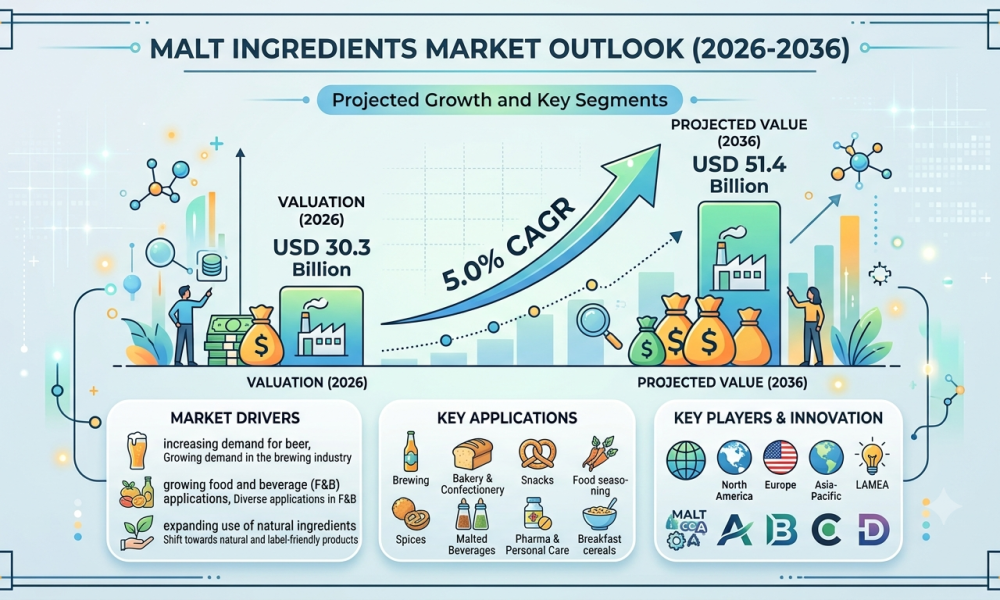
The global malt ingredients market is projected to grow from USD 30.3 billion in 2026 to USD 51.4 billion by 2036, registering a 5.0% CAGR during the forecast period. Demand is supported by recurring use across brewing, distilling, food processing, and beverage applications. Brewers remain major customers, while food manufacturers and distillers increasingly use malt ingredients for flavor, color, fermentable solids, and processing functionality.
Malt extract and specialty formats are creating additional opportunities for suppliers as food and beverage manufacturers seek convenient ways to incorporate malt characteristics without processing whole malt on-site. Demand is also being shaped by alcohol-free beverages, diversified brewing styles, and growing interest in ingredient formats that provide consistent flavor and color. At the same time, the availability of barley that meets malting specifications remains an important supply consideration for maltsters and buyers.
Get detailed market forecasts, competitive benchmarking, and pricing trends: https://www.futuremarketinsights.com/reports/sample/rep-gb-835
Global Segment Leaders
- Raw Material – Barley: 43.0% in 2026. Barley remains central to malt production because its husk structure, enzyme potential, and established malting infrastructure support brewing and distilling applications. Only barley lots that meet required malting specifications can be converted into suitable malt ingredients.
- Product Type – Malt Extract: 42.0% in 2026. Malt extract provides a concentrated source of malt flavor, color, and fermentable solids. It allows food and beverage manufacturers to incorporate malt characteristics without milling and processing whole malt on their production lines.
- Grade – Standard Malt: 51.0% in 2026. Standard malt continues to serve high-volume brewing and other repeat applications where buyers require familiar extract, moisture, and modification specifications.
- End-use – Food & Beverages Industry: 25.0% in 2026. Malt ingredients are used across beverages, bakery-style foods, brewing, and other formulated products, supporting demand for multiple malt formats and specifications.
Country-Level Performance
Russia is projected to record the fastest growth among the profiled countries, with an 11.0% CAGR from 2026 to 2036. A large domestic barley base supports malting potential, although suppliers still need to focus on variety selection, grain screening, lot segregation, and consistent delivery.
The United Kingdom is expected to grow at a 10.0% CAGR during the forecast period. Its established brewing and distilling industries generate recurring demand for malt, while crop quality remains an important procurement consideration. Defra reported a 6.4 million-tonne UK barley harvest in 2025, while noting that spring barley in several regions did not meet malting-quality requirements.
Brazil is projected to expand at a 9.0% CAGR. Brewery activity and product diversification create opportunities for base malt, specialty malt, and extract formats. The Brazil Ministry of Agriculture’s 2026 beer yearbook documents brewery and product activity for 2025.
Italy is forecast to grow at an 8.0% CAGR, supported by established brewing activity and demand for base and specialty malt. Suppliers can address different customer requirements through dependable base malt combined with specialty flavor and color options.
The United States is projected to register a 7.0% CAGR. Its dispersed brewery network provides malt suppliers with a recurring customer base, while specialty malt, recipe support, and reliable delivery can help suppliers serve different brewery requirements.
Canada is expected to grow at a 6.0% CAGR. Statistics Canada projected approximately 9.7 million tonnes of barley for 2026. However, total barley production does not represent malting-grade supply, making variety, germination, protein, and other quality parameters important to malt buyers.
France is forecast to expand at a 5.0% CAGR. The country has an established barley and malting supply chain serving domestic and international customers. Supplier value is influenced by grain quality, energy efficiency, product consistency, and the ability to meet specialty recipe requirements.
Germany is projected to record a 4.0% CAGR. Its established brewing sector continues to support base-malt demand, while alcohol-free beverages and new beverage formulations create demand for different flavor and fermentability profiles.
Regional Context
Russia, the United Kingdom, Brazil, and Italy represent the faster-growing profiled markets, with CAGRs ranging from 11.0% to 8.0% through 2036. Growth in these markets is linked to established or expanding brewing activity, demand for specialty malt, food and beverage applications, and the development of diversified malt ingredient formats.
The United States and Canada represent mid-growth markets, with CAGRs of 7.0% and 6.0%, respectively. Their markets benefit from established brewing industries and broad barley supply bases, while buyers continue to require consistent malt specifications and dependable delivery.
France and Germany show more measured expansion, with CAGRs of 5.0% and 4.0%. Their established brewing and malting industries provide a stable customer base, while specialty products, alcohol-free beverages, and product-mix changes create opportunities for additional malt ingredient demand.
The full report covers North America, Latin America, Western Europe, Eastern Europe, East Asia, South Asia and Pacific, and the Middle East and Africa, with eight countries profiled individually.
Access full Report in PDF Format@ https://www.futuremarketinsights.com/reports/brochure/rep-gb-835
Competitive Landscape
The competitive landscape includes Malteurop Groupe, Boortmalt, Groupe Soufflet, Simpsons Malt Ltd., Rahr Corporation, IREKS GmbH, Muntons PLC, and Axereal. Competition spans global grain-to-malt networks, specialty malt producers, and ingredient platforms, with companies differentiating through barley sourcing, production capacity, malt formats, product consistency, specialty grades, and sustainability initiatives.
Recent developments include Soufflet Malt’s February 2026 announcement of a EUR 100 million investment in a new AI-driven malthouse in South Rajasthan, India, designed to supply beer and distilling customers as well as food and beverage manufacturers. In April 2025, Simpsons Malt Ltd. reported that a new germination and kilning vessel at Tweed Valley Maltings had become fully operational, adding up to 15,000 tonnes of annual malt capacity. In March 2025, Muntons PLC launched Climate Positive Malt at BeerX in Liverpool, reporting up to 30% lower carbon emissions per tonne compared with the UK malt average.
These developments highlight the industry’s focus on expanding production capacity, improving manufacturing efficiency, supporting diversified applications, and addressing sustainability requirements across the malt supply chain.
About Future Market Insights (FMI)
Future Market Insights, Inc. (ESOMAR certified, recipient of the Stevie Award, and a member of the Greater New York Chamber of Commerce) offers profound insights into the driving factors that are boosting demand in the market. FMI stands as the leading global provider of market intelligence, advisory services, consulting, and events for the Packaging, Food and Beverage, Consumer Technology, Healthcare, Industrial, and Chemicals markets. With a vast team of over 400 analysts worldwide, FMI provides global, regional, and local expertise on diverse domains and industry trends across more than 110 countries.



