
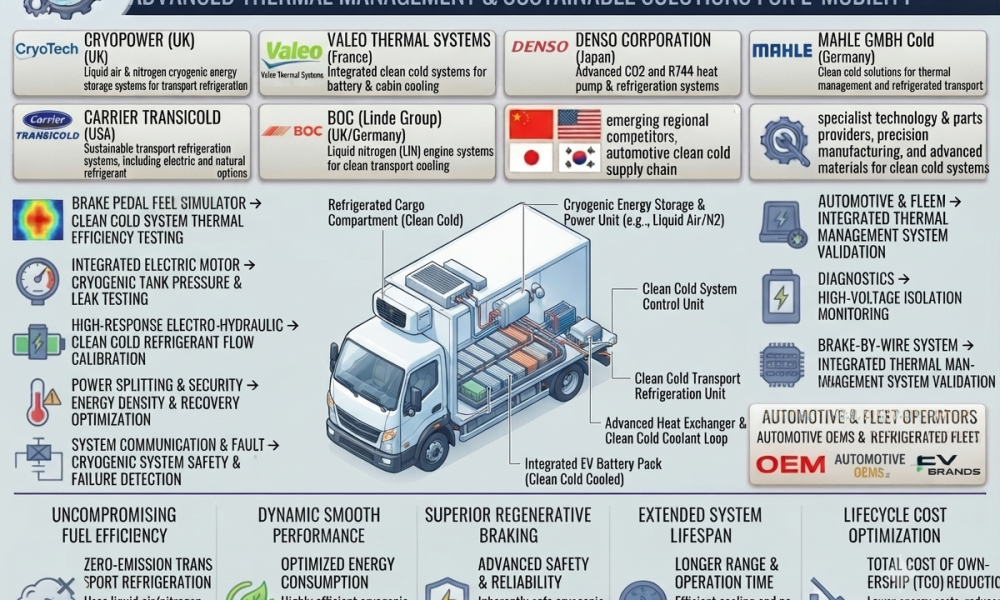
The global automotive clean cold technology market was valued at USD 28.4 billion in 2025 and is projected to reach USD 30.6 billion by 2026-end, expanding at a 7.8% CAGR between 2026 and 2036 to reach USD 64.8 billion by 2036. Market demand is being supported by electric vehicle battery thermal-management requirements, expanding temperature-controlled logistics, and regulatory efforts to reduce emissions from transport refrigeration systems.
Automotive clean cold technology includes cooling approaches such as cryogenic, phase change, and thermoelectric systems that can reduce dependence on conventional diesel-powered refrigeration. These technologies are gaining attention as vehicle manufacturers and fleet operators seek alternatives capable of delivering required cooling performance while addressing increasingly stringent emissions objectives.
EV battery thermal management is another important demand factor. As electric vehicle battery capacities increase, maintaining suitable operating temperatures becomes more important for battery performance, charging behavior, and lifecycle management. Clean cooling technologies can therefore become part of broader vehicle thermal architectures rather than remaining limited to refrigerated transport applications.
Transport refrigeration is also undergoing regulatory change. The U.S. Environmental Protection Agency confirmed updated emission requirements for transport refrigeration units in its 2025 rulemaking, supporting the transition toward cleaner refrigeration technologies. Fleet operators and cold chain logistics companies are consequently evaluating solutions based on cooling capacity, emissions performance, integration requirements, and operating costs.
Procurement decisions increasingly involve automotive OEM thermal engineering teams, fleet operators, and cold chain logistics companies. These buyers are comparing clean cold technologies based on their ability to provide reliable temperature control while meeting zero-emission requirements and maintaining practical vehicle operating economics.
What Are the Key Segments in the Automotive Clean Cold Technology Market?
- Nitrogen is expected to account for 47.0% share in 2026 by fluid used, reflecting the importance of liquid nitrogen-based cooling for applications requiring high-capacity, zero-emission refrigeration.
- Passenger Vehicles are projected to represent 41.6% share in 2026 by vehicle type, supported by growing integration of clean cooling approaches with electric vehicle thermal-management requirements.
- Cryogenic Cooling Systems are anticipated to hold 48.0% share in 2026 by technology, supported by high cooling capacity and the ability to support zero-emission refrigeration applications.
- EV Battery Thermal Management is gaining importance as increasing battery capacity creates greater requirements for controlled cooling across different vehicle operating and charging conditions.
- Transport Refrigeration Applications remain a major demand area as fleet operators seek refrigeration technologies capable of meeting cooling requirements while reducing dependence on diesel-powered systems.
Get detailed market forecasts, competitive benchmarking, and pricing trends:
https://www.futuremarketinsights.com/reports/sample/rep-gb-1736
Which Countries Are Showing the Strongest Growth in Automotive Clean Cold Technology?
China is projected to record the fastest growth among the profiled countries, advancing at a 9.0% CAGR through 2036. Large-scale electric vehicle production and expanding cold chain logistics are creating opportunities for clean cooling technologies. The country’s growing EV manufacturing base also supports integration of clean cold systems with vehicle thermal architectures.
India is forecast to grow at an 8.5% CAGR, supported by increasing vehicle electrification and expansion of temperature-controlled logistics. Demand for efficient cooling technologies can increase as fleet operators evaluate solutions capable of reducing refrigeration emissions while maintaining required cargo temperatures.
South Korea is projected to advance at an 8.0% CAGR, supported by established automotive manufacturing and growing electric vehicle production. Thermal-management integration and zero-emission refrigeration requirements are encouraging interest in compact and efficient clean cooling systems.
The United States is expected to grow at a 7.9% CAGR, with regulatory requirements and fleet sustainability objectives supporting clean cold technology adoption. Transport refrigeration operators are evaluating technologies based on cooling performance, emissions compliance, operating costs, and compatibility with existing vehicle platforms.
The United Kingdom is projected to register a 7.6% CAGR through 2036. Demand is supported by the transition toward cleaner transport technologies and increasing requirements for low-emission temperature-controlled logistics. Fleet operators are evaluating clean refrigeration systems that can maintain operational performance while supporting emissions-reduction objectives.
How Is Regional Demand Shaping the Automotive Clean Cold Technology Market?
Regional demand is being shaped by differences in electric vehicle production, cold chain development, and transport refrigeration regulations. China combines high EV manufacturing volumes with expanding temperature-controlled logistics, creating opportunities for clean cold technologies across both vehicle thermal management and refrigerated transportation.
India and South Korea are developing demand through vehicle electrification and localized automotive manufacturing, while the United States is influenced by transport refrigeration emission requirements and fleet operating considerations. The United Kingdom is also developing opportunities as logistics operators evaluate cleaner refrigeration technologies for temperature-sensitive transportation.
What Is Changing the Competitive Landscape?
Competition is increasingly centered on cooling capacity, zero-emission performance, fleet integration, and the ability to deliver reliable temperature control under commercial operating conditions. Buyers are evaluating complete refrigeration solutions rather than focusing solely on individual cooling components.
Carrier Corporation and Thermo King compete through established global transport refrigeration portfolios. Their market positioning reflects the importance of broad application coverage, refrigeration-system integration, and fleet support capabilities for commercial operators.
Dearman Engine Company gains attention where liquid nitrogen-based clean cold technology provides an alternative pathway for zero-emission refrigeration. Its approach highlights the potential for cryogenic cooling to address transport refrigeration requirements while reducing dependence on conventional diesel refrigeration.
Competitive differentiation increasingly depends on cooling capacity, zero-emission compliance, operating cost, integration with vehicle thermal systems, and fleet-level deployment support. Suppliers that can demonstrate reliable cooling performance while addressing regulatory and operating requirements can participate more deeply in OEM and fleet procurement decisions.
What Does the Analyst Say About the Automotive Clean Cold Technology Market?
“Buyers are expected to judge nitrogen on performance and total cost of ownership rather than headline price. Clean cold technology adoption is expected to depend on EV battery cooling requirements and zero-emission transport refrigeration mandates. Suppliers that combine cooling capacity with emission compliance and fleet integration are likely to secure OEM and fleet operator contracts. Market success is projected to depend on demonstrating total cost competitiveness against diesel refrigeration while meeting zero-emission transport targets.”
– Nikhil Kaitwade, Principal Consultant, Future Market Insights
What Is Driving Demand for Automotive Clean Cold Technology?
Electric Vehicle Battery Thermal Management
EV batteries require controlled temperatures to maintain operating performance and support charging requirements. Increasing battery capacity is therefore creating greater demand for thermal-management technologies capable of delivering reliable cooling across different vehicle conditions.
Zero-Emission Transport Refrigeration
Transport refrigeration has traditionally relied heavily on diesel-powered systems. Increasing emissions requirements are encouraging fleet operators to examine alternatives that can provide required refrigeration performance without relying on conventional diesel refrigeration systems.
Cold Chain Logistics Expansion
Temperature-sensitive food, pharmaceuticals, and other products require dependable refrigeration during transportation. Expanding cold chain logistics increases the number of vehicles and refrigeration systems requiring efficient cooling technologies.
High-Capacity Cryogenic Cooling
Cryogenic systems can provide high cooling capacity and support zero-emission refrigeration applications. The increasing focus on nitrogen-based cooling is therefore creating opportunities for suppliers capable of integrating cryogenic systems with vehicle and fleet operating requirements.
What Are the Key Market Restraints?
Clean cold technologies can involve higher initial system costs and additional integration requirements compared with established diesel refrigeration systems. Fleet operators must evaluate whether energy, maintenance, and emissions benefits justify changes to existing refrigeration infrastructure.
Cryogenic cooling can also require specialized handling, storage, and operating procedures. Fleet operators may need additional infrastructure and workforce capabilities before deploying these systems at scale.
Integration with existing vehicle architectures presents another challenge. Clean cold systems must provide sufficient cooling capacity while fitting within available vehicle space, electrical systems, thermal-management architectures, and operational schedules.
What Opportunities Exist for Automotive Clean Cold Technology Manufacturers?
The expansion of electric vehicle platforms creates opportunities for suppliers developing clean cooling technologies that can integrate with battery thermal-management systems. Solutions capable of coordinating cooling across battery and vehicle thermal requirements can address multiple procurement priorities.
Transport refrigeration represents another significant opportunity. Fleet operators seeking alternatives to diesel-powered refrigeration can evaluate nitrogen, cryogenic, phase-change, and thermoelectric technologies based on cooling capacity and emissions performance.
Suppliers can also expand through fleet-level integration and service models. Installation support, system monitoring, maintenance, and operating assistance can help reduce the complexity associated with deploying clean refrigeration technologies across larger commercial fleets.
Drive Your Business Growth Strategy: Checkout the Report for Key Insights!
https://www.futuremarketinsights.com/checkout/1736
How Is the Automotive Clean Cold Technology Market Segmented?
The automotive clean cold technology market is segmented by fluid used, vehicle type, technology, application, sales channel, and region.
By Fluid Used: Nitrogen and other clean cooling fluids and media.
By Vehicle Type: Passenger Vehicles and commercial transport applications.
By Technology: Cryogenic Cooling Systems, Phase Change Cooling Systems, Thermoelectric Cooling Systems, and other clean cooling technologies.
By Application: EV Battery Thermal Management, Transport Refrigeration, and other automotive cooling applications.
By Sales Channel: OEM Integration, Fleet Purchasing, Direct Sales, and Distribution.
By Region: North America, Latin America, Western Europe, Eastern Europe, South Asia & Pacific, East Asia, and Middle East & Africa.
Why Does Nitrogen Represent a Significant Fluid Category?
Nitrogen is expected to account for 47.0% share in 2026 by fluid used. Liquid nitrogen can provide high-capacity cooling while supporting zero-emission refrigeration requirements, making it relevant to transport refrigeration applications seeking alternatives to diesel-powered systems.
Why Are Passenger Vehicles Important to Market Development?
Passenger vehicles are projected to hold 41.6% share in 2026 by vehicle type. Increasing electric vehicle production creates opportunities to integrate clean cooling technologies into broader vehicle thermal-management architectures, particularly as battery capacity and thermal requirements increase.
How Does Cryogenic Cooling Influence Market Demand?
Cryogenic cooling systems are anticipated to account for 48.0% share in 2026 by technology. Their ability to deliver high cooling capacity and support zero-emission refrigeration objectives is contributing to their relevance in automotive and transport applications.
What Are the Drivers, Restraints and Opportunities in the Automotive Clean Cold Technology Market?
Clean cold technology is becoming increasingly relevant to automotive thermal management and transport refrigeration as manufacturers and fleet operators balance cooling performance, emissions compliance, operating costs, and vehicle integration.
- Driver: Expanding EV production and zero-emission transport refrigeration requirements are increasing demand for cleaner cooling systems.
- Restraint: Higher integration requirements, specialized infrastructure, and upfront costs can complicate adoption compared with conventional refrigeration.
- Opportunity: Nitrogen-based cryogenic systems, fleet integration, and clean battery thermal-management solutions can expand the addressable market.
What Is the Automotive Clean Cold Technology Market Demand Outlook?
Demand is expected to remain closely linked to electric vehicle production, battery thermal-management requirements, and the transition toward lower-emission transport refrigeration. As fleet operators seek alternatives to diesel refrigeration, clean cold systems can become increasingly important across temperature-controlled logistics.
The market is also moving toward greater integration between cooling equipment and vehicle thermal architectures. Suppliers will need to demonstrate that clean cold systems can provide reliable cooling while fitting vehicle packaging, energy, maintenance, and fleet operating requirements.
Why Is Zero-Emission Compliance Important?
Transport refrigeration operators are facing increasing pressure to reduce emissions while maintaining cargo temperature control. Clean cold technologies can provide alternative refrigeration pathways that align cooling operations with emerging zero-emission objectives.
Why Does Total Cost of Ownership Matter?
Fleet operators must evaluate refrigeration technologies over their complete operating lifecycle. Cooling capacity, energy consumption, maintenance requirements, infrastructure needs, and vehicle integration can all influence the commercial case for replacing conventional diesel-powered refrigeration.
How Fast Are Key Countries Growing in the Automotive Clean Cold Technology Market?
China is projected to grow at a 9.0% CAGR, followed by India at 8.5%, South Korea at 8.0%, the United States at 7.9%, and the United Kingdom at 7.6% through 2036. These differences reflect variations in electric vehicle production, cold chain logistics expansion, transport refrigeration requirements, emissions regulations, and adoption of clean cooling technologies.
About Future Market Insights
Future Market Insights (FMI) is a global market intelligence and consulting firm providing syndicated research, custom research, and strategic consulting services across automotive, transportation, aerospace, technology, industrial, and emerging sectors. FMI’s research combines primary research, proprietary forecasting models, and industry analysis to help organizations evaluate market opportunities, technology adoption, competitive dynamics, and investment trends.



