
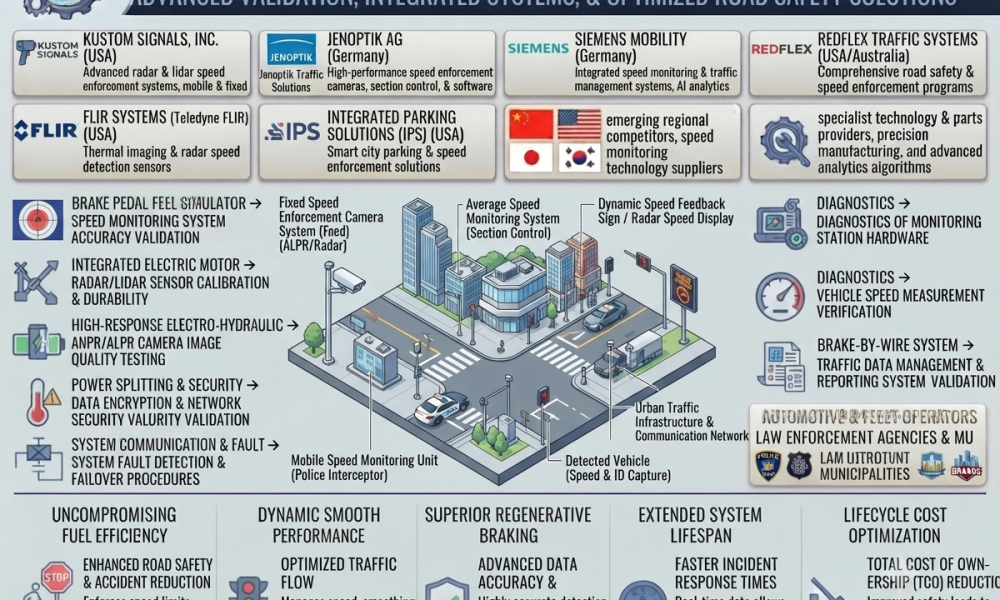
The global vehicle speed monitoring system market was valued at USD 37.8 billion in 2025 and is projected to reach USD 45.0 billion by 2026-end, expanding at a 19.3% CAGR between 2026 and 2036 to reach USD 263.0 billion by 2036. Market demand is being supported by government investment in road safety infrastructure, smart city traffic management, highway enforcement, and commercial fleet speed-compliance programs.
Vehicle speed monitoring systems use technologies including RADAR, LIDAR, and video-based detection to identify vehicle speeds across highways, urban roads, tolling corridors, and fleet operations. Government transport departments and highway authorities are increasingly evaluating these systems as part of automated enforcement and traffic-management infrastructure.
The World Health Organization reported in 2025 that road traffic injuries remained a leading cause of death globally. The continued road-safety burden is supporting government attention toward speed management, automated enforcement, and infrastructure capable of identifying vehicles exceeding prescribed speed limits.
Smart city investment is also broadening the application base. Urban authorities are integrating speed detection with traffic-management platforms, automated enforcement systems, and other intelligent transportation infrastructure. Multi-lane detection and all-weather operation are becoming important purchasing considerations where monitoring systems must operate continuously across complex road environments.
Fleet operators represent another important buyer group. Commercial fleets increasingly require speed monitoring for compliance, driver management, insurance telematics, and operational oversight. These requirements are encouraging demand for systems that can combine accurate speed detection with data integration and fleet-management platforms.
What Are the Key Segments in the Vehicle Speed Monitoring System Market?
- Microwave RADAR Based Systems are expected to account for 62.4% share in 2026 by technology, supported by multi-lane detection capabilities and operation across varying weather conditions.
- Fleet Monitoring is projected to hold 67.1% share in 2026 by application, driven by commercial fleet speed compliance, driver oversight, and insurance telematics requirements.
- Government and Traffic Authorities are anticipated to represent 53.6% share in 2026 by end user, supported by highway enforcement and urban traffic-control programs.
- Automated Enforcement Systems are gaining importance as governments connect speed detection with digital evidence, enforcement workflows, and traffic-management platforms.
- Multi-Lane Monitoring is becoming increasingly relevant as highway authorities and urban traffic operators seek speed detection systems capable of monitoring several vehicles and lanes within a single deployment.
Get detailed market forecasts, competitive benchmarking, and pricing trends:
https://www.futuremarketinsights.com/reports/sample/rep-gb-1745
Which Countries Are Showing the Strongest Growth in Vehicle Speed Monitoring Systems?
China is projected to record the fastest growth among the profiled countries, advancing at a 20.9% CAGR through 2036. Smart city infrastructure investment and highway enforcement expansion are supporting procurement of advanced speed monitoring systems. Integration with broader intelligent transportation infrastructure is also creating opportunities for suppliers capable of providing connected detection and traffic-management solutions.
India is forecast to grow at a 20.4% CAGR, supported by expanding road infrastructure, urban traffic-management programs, and increasing emphasis on road safety. Government authorities and fleet operators are evaluating speed monitoring technologies that can support enforcement, compliance, and traffic-flow management across growing road networks.
The United States is projected to advance at a 19.7% CAGR, supported by highway safety programs, automated enforcement applications, and commercial fleet monitoring requirements. Buyers are placing emphasis on detection accuracy, evidence generation, system integration, and reliable operation across different road environments.
South Korea is expected to grow at a 19.6% CAGR, supported by smart transportation infrastructure and connected traffic-management programs. Speed monitoring systems can integrate with broader intelligent transportation networks, creating opportunities for suppliers offering accurate detection and data connectivity.
The United Kingdom is projected to register an 18.9% CAGR through 2036. Demand is supported by road-safety initiatives, automated enforcement infrastructure, and traffic-management requirements. Authorities and fleet operators are evaluating solutions based on monitoring accuracy, deployment flexibility, and compatibility with existing transportation systems.
How Is Regional Demand Shaping the Vehicle Speed Monitoring System Market?
Regional demand is being shaped by differences in road-safety priorities, smart city investment, enforcement practices, and fleet-management requirements. China combines large-scale smart infrastructure development with extensive highway networks, creating opportunities for integrated speed monitoring and traffic-management systems.
India is developing demand alongside expanding road infrastructure and urbanization, while the United States emphasizes highway enforcement and fleet compliance. South Korea continues to integrate intelligent transportation technologies into connected traffic environments, while the United Kingdom maintains demand around road safety and automated enforcement applications.
What Is Changing the Competitive Landscape?
Competition is increasingly focused on detection accuracy, multi-lane coverage, system reliability, and integration with broader intelligent transportation systems. Buyers are evaluating complete monitoring capabilities rather than individual detection components.
Kapsch TrafficCom and Siemens Mobility compete through comprehensive intelligent transportation and traffic-management platforms. Their positioning reflects demand for speed monitoring systems capable of connecting detection data with broader transportation infrastructure.
Sensys Gatso and Jenoptik gain attention where speed-camera accuracy, automated enforcement, and photo-evidence capabilities influence procurement decisions. Their offerings address the requirements of authorities implementing speed enforcement programs.
Competitive differentiation increasingly depends on detection accuracy, multi-lane coverage, all-weather performance, automated evidence generation, data integration, and deployment flexibility. Suppliers that can connect speed monitoring with existing enforcement and traffic-management infrastructure can address a wider range of government and fleet requirements.
What Does the Analyst Say About the Vehicle Speed Monitoring System Market?
“Buyers are expected to judge microwave radar based systems on performance and total cost of ownership rather than headline price. Vehicle speed monitoring adoption is expected to depend on government enforcement mandates and smart city traffic infrastructure investment. Suppliers that combine detection accuracy with data integration and multi-lane coverage are likely to secure government enforcement contracts. Market success is projected to depend on meeting road safety targets while providing scalable monitoring infrastructure across highway and urban deployment.”
– Nikhil Kaitwade, Principal Consultant, Future Market Insights
What Is Driving Demand for Vehicle Speed Monitoring Systems?
Road Safety Mandates
Government road-safety programs are increasing demand for technologies that can identify speeding vehicles accurately and consistently. Automated speed detection can support enforcement authorities by generating measurable information across highway and urban road environments.
Smart City Traffic Infrastructure
Cities are investing in intelligent transportation infrastructure that connects road sensors, traffic signals, enforcement systems, and centralized management platforms. Speed monitoring can form part of these connected systems by providing real-time or recorded vehicle-speed information.
Fleet Speed Compliance
Commercial fleet operators use speed monitoring to oversee vehicle operations and driver compliance. Fleet monitoring systems can provide data that supports operational management, insurance telematics, and efforts to maintain consistent driving practices.
Multi-Lane Detection Requirements
Highways and major urban corridors often contain multiple traffic lanes. Systems capable of monitoring several lanes can reduce infrastructure duplication while providing authorities with broader coverage across busy transportation routes.
What Are the Key Market Restraints?
Vehicle speed monitoring systems used for enforcement applications require high levels of detection accuracy and reliable evidence generation. Technical performance requirements can increase system qualification and deployment costs.
Integration with existing traffic-management and enforcement infrastructure can also create implementation complexity. Government agencies may need to connect new detection systems with legacy databases, communication networks, enforcement platforms, and operational workflows.
Privacy, data management, and regulatory requirements can present additional challenges. Authorities and system providers must manage vehicle and speed information according to applicable legal and operational requirements while maintaining reliable access for authorized enforcement activities.
What Opportunities Exist for Vehicle Speed Monitoring System Manufacturers?
Smart city expansion provides opportunities for suppliers that can integrate speed monitoring with broader intelligent transportation systems. Connected detection platforms can allow authorities to combine speed information with traffic-flow management and automated enforcement infrastructure.
Fleet monitoring is another significant opportunity. Commercial operators can use speed data alongside broader telematics and fleet-management platforms to improve operational visibility and compliance.
Suppliers can also expand through multi-technology platforms combining RADAR, LIDAR, and video detection. Integrated systems can provide authorities with greater flexibility when deploying monitoring infrastructure across different road types, traffic conditions, and enforcement environments.
Drive Your Business Growth Strategy: Checkout the Report for Key Insights!
https://www.futuremarketinsights.com/checkout/1745
How Is the Vehicle Speed Monitoring System Market Segmented?
The vehicle speed monitoring system industry is segmented by technology, application, end user, sales channel, deployment environment, and region.
By Technology: Microwave RADAR Based Systems, LIDAR-Based Systems, Video-Based Systems, and other speed detection technologies.
By Application: Fleet Monitoring, Highway Enforcement, Urban Traffic Control, Automated Enforcement, and related traffic-management applications.
By End User: Government and Traffic Authorities, Fleet Operators, Highway Authorities, and other transportation organizations.
By Sales Channel: Direct Procurement, System Integrators, Distributors, and Technology Partnerships.
By Deployment Environment: Highways, Urban Roads, Tolling Corridors, Fleet Operations, and other monitored road environments.
By Region: North America, Latin America, Western Europe, Eastern Europe, South Asia & Pacific, East Asia, and Middle East & Africa.
Why Do Microwave RADAR Based Systems Represent a Significant Technology Category?
Microwave RADAR Based Systems are expected to account for 62.4% share in 2026 by technology. Their ability to support multi-lane detection and operation across varying weather conditions makes them relevant to highway enforcement, urban traffic control, and fleet-monitoring deployments.
Why Is Fleet Monitoring Important to Market Development?
Fleet Monitoring is projected to hold 67.1% share in 2026 by application. Commercial fleet operators require speed data for compliance, operational oversight, driver management, and insurance telematics, creating recurring demand for accurate vehicle-speed information.
Why Do Government and Traffic Authorities Represent a Major End User?
Government and Traffic Authorities are expected to account for 53.6% share in 2026 by end user. Highway enforcement, urban speed control, and automated traffic-management programs require infrastructure capable of continuously detecting and documenting vehicle speeds.
What Are the Drivers, Restraints and Opportunities in the Vehicle Speed Monitoring System Market?
Vehicle speed monitoring is becoming an important component of road-safety and intelligent transportation infrastructure as authorities and fleet operators balance detection accuracy, enforcement requirements, data integration, and deployment scalability.
- Driver: Road-safety mandates, smart city investment, and fleet compliance requirements are expanding demand for speed monitoring infrastructure.
- Restraint: High accuracy requirements, infrastructure integration, and data-management obligations can increase deployment complexity and costs.
- Opportunity: Multi-lane RADAR, connected enforcement platforms, and integrated traffic-management solutions can expand monitoring coverage and system applications.
What Is the Vehicle Speed Monitoring System Market Demand Outlook?
Demand is expected to remain closely linked to government road-safety investment, smart city infrastructure development, and the expansion of commercial fleet monitoring. As authorities increase their use of automated enforcement, accurate speed detection will remain an important part of connected transportation infrastructure.
The market is also moving toward integrated traffic-management platforms. Speed monitoring systems increasingly need to share information with enforcement, tolling, fleet, and urban traffic-management systems. Suppliers that can provide reliable detection alongside flexible data integration can address broader procurement requirements.
Why Is Detection Accuracy Important?
Speed monitoring data can influence enforcement and operational decisions, making accurate detection essential. Authorities require systems capable of reliably identifying vehicle speeds across different traffic conditions, road configurations, and weather environments.
Why Does Data Integration Matter?
Modern traffic infrastructure increasingly connects individual monitoring technologies to centralized platforms. Speed monitoring systems that can integrate with enforcement, traffic management, tolling, and fleet platforms can provide broader operational value than standalone detection equipment.
How Fast Are Key Countries Growing in the Vehicle Speed Monitoring System Market?
China is projected to grow at a 20.9% CAGR, followed by India at 20.4%, the United States at 19.7%, South Korea at 19.6%, and the United Kingdom at 18.9% through 2036. These differences reflect variations in smart city infrastructure investment, highway enforcement programs, road-safety priorities, fleet monitoring requirements, and adoption of connected intelligent transportation systems.
About Future Market Insights
Future Market Insights (FMI) is a global market intelligence and consulting firm providing syndicated research, custom research, and strategic consulting services across automotive, transportation, aerospace, technology, industrial, and emerging sectors. FMI’s research combines primary research, proprietary forecasting models, and industry analysis to help organizations evaluate market opportunities, technology adoption, competitive dynamics, and investment trends.



