
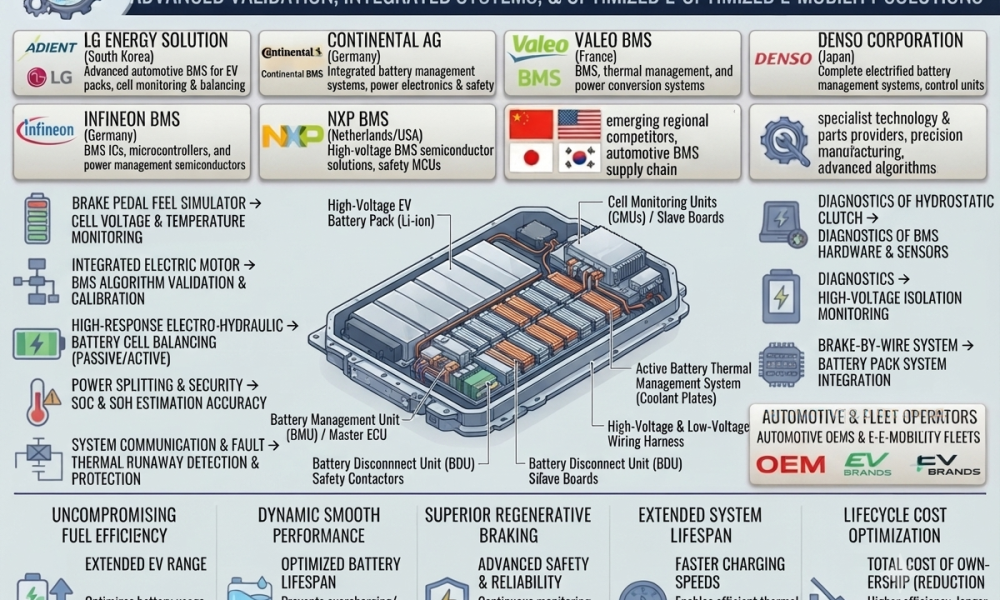
The global automotive battery management system market was valued at USD 6.5 billion in 2025 and is projected to reach USD 7.7 billion by 2026-end, expanding at a 17.9% CAGR between 2026 and 2036 to reach USD 39.8 billion by 2036. Market demand is being supported by expanding electric vehicle production and the growing electronic complexity of battery packs used across passenger and commercial electric vehicles.
Automotive battery management systems coordinate cell monitoring, balancing, fault detection, and battery safety functions. As battery capacities increase, OEM engineering teams require increasingly precise measurement and control capabilities to maintain battery performance, safety, and usable lifecycle across different operating conditions.
The International Energy Agency reported in 2025 that global electric vehicle sales exceeded 17 million units, highlighting the production scale supporting continued BMS procurement. Increasing battery pack capacity is also raising the number of cells and monitoring points that must be managed within vehicle battery architectures.
Battery packs exceeding 80 kWh in passenger electric vehicles are encouraging interest in distributed and modular BMS topologies. These architectures can support larger battery configurations while allowing monitoring functions to be distributed across multiple pack sections rather than concentrating every measurement function within a single control unit.
Automotive BMS procurement is therefore becoming an integrated electronics decision. EV platform engineering teams, battery pack assemblers, and OEM purchasing departments are evaluating monitoring accuracy, balancing performance, fault-detection capability, thermal-management integration, scalability, and compatibility with different battery architectures.
What Are the Key Segments in the Automotive Battery Management System Market?
- Hardware is expected to account for 63.9% share in 2026, reflecting the importance of BMS circuit boards, cell-monitoring integrated circuits, wiring harnesses, and related electronic components in overall system procurement.
- Integrated BMS is projected to hold 66.5% share in 2026 by system type, as OEMs increasingly favor battery-management solutions integrated within battery-pack assemblies to support space and cost efficiency.
- Lithium-Ion Batteries are anticipated to represent 72.0% share in 2026 by battery type, supported by their broad use across passenger and commercial electric vehicle battery architectures.
- Passenger Electric Vehicles remain a major application area as rising battery capacities increase the need for accurate cell-level monitoring, balancing, and protection.
- Commercial Electric Vehicles are also creating BMS requirements as larger battery packs and demanding operating cycles increase the importance of battery health monitoring and thermal-management coordination.
Get detailed market forecasts, competitive benchmarking, and pricing trends:
https://www.futuremarketinsights.com/reports/sample/rep-gb-1694
Which Countries Are Showing the Strongest Growth in the Automotive Battery Management System Market?
China is projected to record the fastest growth among the profiled countries, advancing at a 24.1% CAGR through 2036. Strong domestic electric vehicle production and extensive battery manufacturing capacity are sustaining demand for BMS hardware and integrated systems. Large-scale battery production also creates opportunities for suppliers capable of supporting high-volume cell-monitoring and pack-integration requirements.
India is forecast to grow at a 22.3% CAGR, supported by expanding electric mobility production and increasing localization of vehicle and battery manufacturing. BMS suppliers can benefit from demand for scalable battery electronics capable of supporting different vehicle platforms and battery configurations.
Germany is projected to advance at an 18.2% CAGR, with automotive manufacturers emphasizing battery safety, monitoring accuracy, and system integration across electric vehicle platforms. Engineering requirements for reliable cell data and battery control are supporting demand for qualified BMS technologies.
The United States is expected to grow at a 16.6% CAGR, supported by expanding electric vehicle production and investment in increasingly sophisticated battery architectures. OEMs and battery assemblers are evaluating BMS systems based on accuracy, fault detection, thermal-management integration, and scalability across vehicle programs.
The United Kingdom is projected to register a 15.2% CAGR through 2036. Demand is supported by electric vehicle development and the requirement for battery electronics that provide reliable monitoring and safety management across increasingly complex battery systems.
How Is Regional Demand Shaping the Automotive Battery Management System Market?
Regional BMS demand reflects differences in electric vehicle production scale, battery manufacturing capacity, and OEM platform development. China benefits from a large domestic EV ecosystem and established battery manufacturing base, creating substantial procurement opportunities for both BMS hardware and integrated solutions.
India is developing demand alongside vehicle electrification and battery manufacturing localization, while Germany and the United States place strong emphasis on system validation, battery safety, and OEM integration. The United Kingdom represents another market where electric vehicle platform development supports demand for reliable battery-management electronics.
What Is Changing the Competitive Landscape?
Competition is increasingly centered on the ability to combine accurate battery-monitoring integrated circuits with software algorithms and complete system integration. Buyers are moving beyond component-level comparisons and assessing whether suppliers can support battery architecture development throughout vehicle programs.
Analog Devices and Texas Instruments compete through broad BMS monitoring IC portfolios that provide the electronic foundation for cell measurement, balancing, and battery monitoring. Their capabilities address the increasing requirement for accurate data acquisition across larger battery packs.
Continental and Bosch compete through system-level BMS integration and OEM platform co-development. Their positioning reflects demand for solutions that connect battery monitoring with wider vehicle electronics and thermal-management architectures.
Competitive differentiation is increasingly influenced by monitoring accuracy, software algorithm capability, fault detection, thermal-management integration, scalability, and the ability to support multiple battery configurations. Suppliers that can connect IC-level performance with complete battery-system requirements are positioned to participate more deeply in OEM platform procurement.
What Does the Analyst Say About the Automotive Battery Management System Market?
“Buyers are expected to judge hardware on performance and total cost of ownership rather than headline price. Automotive BMS adoption is expected to depend on EV production scale and battery pack complexity growth. Suppliers that combine IC-level monitoring accuracy with system-level OEM integration are likely to secure multi-platform BMS contracts. Market success is projected to depend on meeting battery safety and lifecycle requirements while scaling BMS production across rapidly expanding EV platforms.”
– Nikhil Kaitwade, Principal Consultant, Future Market Insights
What Is Driving Demand for Automotive Battery Management Systems?
Rising Electric Vehicle Production
Every electric vehicle battery pack requires systems capable of monitoring cell conditions, balancing individual cells, detecting faults, and managing battery safety. Increasing EV production therefore directly expands the addressable base for automotive BMS hardware and software.
Increasing Battery Pack Capacity
Larger battery packs contain more cells and require additional monitoring and control capabilities. Battery capacities exceeding 80 kWh in passenger EVs are encouraging OEMs to consider distributed and modular BMS architectures capable of managing larger pack configurations.
Growing Need for Battery Safety
BMS technologies provide continuous visibility into battery conditions and support protective functions when abnormal operating conditions are detected. As battery packs become more complex, reliable fault detection and monitoring become increasingly important to vehicle engineering programs.
Integration with Thermal Management
Battery temperature directly influences performance, charging behavior, and battery lifecycle. BMS architectures increasingly need to coordinate with thermal-management systems so that cell data can support appropriate temperature-control decisions across different operating conditions.
What Are the Key Market Restraints?
BMS development requires accurate measurement across large numbers of battery cells, increasing electronics and software complexity as pack capacity rises. Validation requirements can also increase development timelines for new battery architectures.
Compatibility across different battery chemistries and pack configurations creates another challenge. Suppliers must demonstrate that their BMS architectures can support the electrical characteristics, monitoring requirements, and control strategies specified by individual OEM programs.
Cost pressure remains relevant because BMS hardware contributes directly to battery-system economics. Buyers must balance monitoring accuracy and safety functionality against overall electronics costs while maintaining production scalability.
What Opportunities Exist for Automotive Battery Management System Manufacturers?
The expansion of high-capacity EV batteries creates opportunities for suppliers offering modular and distributed BMS architectures. These systems can provide scalable monitoring across larger battery packs while supporting different vehicle configurations.
Software represents another opportunity as OEMs seek increasingly sophisticated algorithms for state estimation, fault detection, balancing, and battery health management. Suppliers that combine monitoring hardware with software capabilities can participate across a larger portion of the BMS value chain.
System-level integration also creates opportunities for BMS providers to connect battery monitoring with thermal-management systems and broader vehicle electronics. This can support OEM efforts to simplify battery architecture development and standardize electronics across multiple EV platforms.
Drive Your Business Growth Strategy: Checkout the Report for Key Insights!
https://www.futuremarketinsights.com/checkout/1694
How Is the Automotive Battery Management System Market Segmented?
The automotive battery management system market is segmented by component type, system type, battery type, vehicle application, and region.
By Component Type: Hardware and associated BMS electronics.
By System Type: Integrated BMS and other BMS architectures, including distributed and modular approaches.
By Battery Type: Lithium-Ion and other battery technologies used across electric vehicle platforms.
By Vehicle Application: Passenger Electric Vehicles and Commercial Electric Vehicles.
By Region: North America, Latin America, Western Europe, Eastern Europe, South Asia & Pacific, East Asia, and Middle East & Africa.
Why Does Hardware Represent a Significant Market Category?
Hardware accounts for 63.9% share in 2026 because BMS circuit boards, cell-monitoring ICs, wiring harnesses, and related electronics form the physical foundation of battery-management systems. As battery packs become larger, accurate measurement hardware becomes increasingly important for reliable cell-level monitoring.
Why Are Integrated BMS Architectures Gaining Attention?
Integrated BMS solutions are projected to hold 66.5% share in 2026 because OEMs can integrate battery-management functions directly within battery-pack assemblies. Integration can help reduce space requirements and support more standardized battery-pack architectures.
How Does Lithium-Ion Battery Adoption Influence BMS Demand?
Lithium-ion batteries are expected to represent 72.0% share in 2026 by battery type. Their widespread use across passenger and commercial electric vehicles creates a large installed base requiring cell monitoring, balancing, protection, and thermal-management coordination.
What Are the Drivers, Restraints and Opportunities in the Automotive Battery Management System Market?
Automotive battery management systems are becoming central to EV battery architecture as automakers balance battery safety, performance, lifecycle, electronics cost, and scalable production.
- Driver: Expanding EV production and larger battery packs are increasing requirements for cell monitoring, balancing, and battery safety.
- Restraint: Increasing battery complexity, validation requirements, and pressure on electronics costs can complicate BMS development and procurement.
- Opportunity: Modular BMS architectures, advanced software algorithms, and system-level OEM integration can support larger battery platforms and multi-vehicle deployment.
What Is the Automotive Battery Management System Market Demand Outlook?
Demand is expected to remain closely connected to global electric vehicle production and the continued increase in battery pack capacity. As automakers develop larger and more complex battery architectures, BMS systems will need to manage increasing numbers of cells while maintaining accurate monitoring and reliable fault detection.
The market is also moving toward greater integration between BMS electronics, software, and thermal-management systems. OEMs increasingly require battery-management platforms that can be scaled across vehicle programs while maintaining consistent performance and safety requirements.
Why Is BMS Accuracy Important for EV Platforms?
Accurate cell-level measurements allow BMS software to monitor battery conditions and support balancing, state estimation, and fault detection. Measurement accuracy therefore influences how effectively an OEM can manage battery performance and safety throughout the vehicle lifecycle.
Why Does Scalability Matter to BMS Suppliers?
Automakers increasingly develop related EV models using common battery architectures. BMS suppliers that can scale monitoring hardware and software across different pack sizes and vehicle configurations can support platform standardization while reducing duplicated development work.
How Fast Are Key Countries Growing in the Automotive Battery Management System Market?
China is projected to grow at a 24.1% CAGR, followed by India at 22.3%, Germany at 18.2%, the United States at 16.6%, and the United Kingdom at 15.2% through 2036. These differences reflect variations in electric vehicle production, battery manufacturing capacity, battery pack complexity, OEM platform development, and the adoption of integrated battery-management architectures.
About Future Market Insights
Future Market Insights (FMI) is a global market intelligence and consulting firm providing syndicated research, custom research, and strategic consulting services across automotive, transportation, aerospace, technology, industrial, and emerging sectors. FMI’s research combines primary research, proprietary forecasting models, and industry analysis to help organizations evaluate market opportunities, technology adoption, competitive dynamics, and investment trends.



