
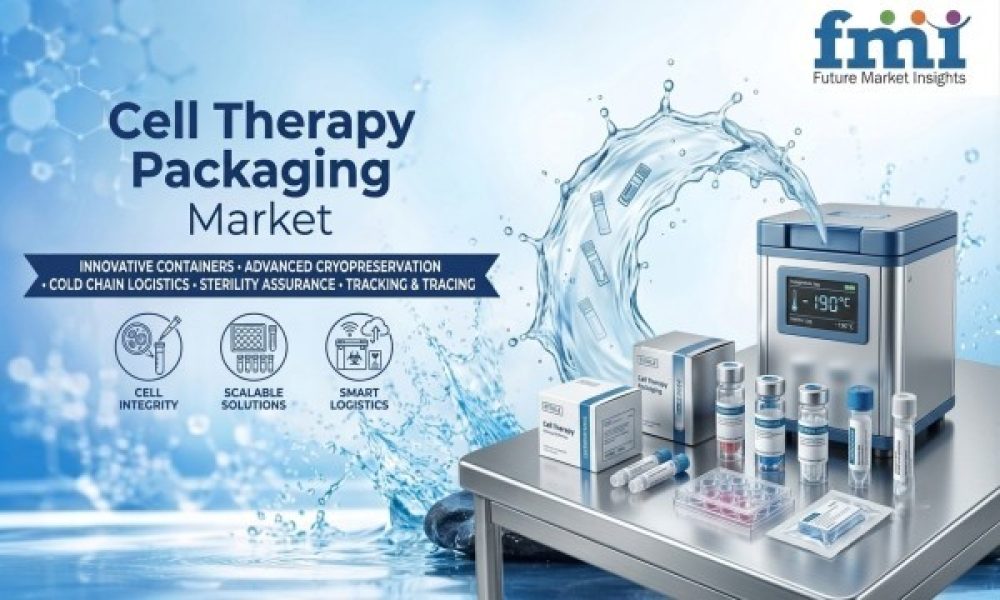
The global cell therapy packaging market is projected to grow from USD 1.9 billion in 2026 to USD 5.3 billion by 2036, registering a compound annual growth rate (CAGR) of 10.7%, according to Future Market Insights (FMI). Increasing commercial activity in cell and gene therapies is creating demand for packaging systems that preserve product integrity, maintain temperature conditions and protect patient identity throughout the treatment journey.
Packaging requirements are becoming more closely linked to manufacturing and clinical operations. Containers, labels, insulated shippers and monitoring components must work together across collection, filling, storage, transportation and administration. These requirements are particularly relevant to patient-specific therapies, where a packaging deviation can complicate product release and treatment scheduling.
Get detailed market forecasts, competitive benchmarking, and pricing trends:
https://www.futuremarketinsights.com/reports/sample/rep-gb-34521
Cryogenic Packaging Accounts for a Significant Share of Demand
Cryogenic packaging is projected to account for 38.0% of the cell therapy packaging market by product type in 2026. Its share reflects the need to protect frozen cellular products during deep-temperature storage and transportation between manufacturing facilities and specialized treatment centers.
Packaging qualification involves more than selecting a container with suitable temperature resistance. Manufacturers must also assess closure integrity, material compatibility, thermal cycling and handling performance. Protective overpacks and validated transfer procedures help maintain packaging consistency across clinical supply networks.
Autologous cell therapy is estimated to represent 39.0% of market demand by application in 2026. These treatments require patient-specific identification throughout manufacturing and distribution. Packaging must accommodate collection schedules, manufacturing delays and changes to administration appointments without compromising chain-of-identity controls.
Commercial Expansion Brings New Packaging Requirements
The expansion of clinical and commercial cell therapy programs is increasing the need for qualified packaging. The US Food and Drug Administration reported in January 2026 that it had approved close to 50 cell and gene therapies during the preceding decade. Each additional therapy program creates requirements for suitable containers, documented handling procedures and controlled product release.
Biopharmaceutical companies are expected to account for 36.0% of the market by end user in 2026. Their responsibility for container qualification, stability studies and change control makes packaging a central consideration in product development and commercial supply planning.
Direct sales are projected to hold a 42.0% share by distribution channel in 2026. Technical consultation, specification control and replenishment agreements support this channel, particularly when packaging configurations require coordination between manufacturers and biopharmaceutical quality teams.
Qualification Remains a Central Industry Challenge
Cell therapy packaging providers face qualification requirements spanning primary containers, secondary packaging and transportation systems. A change in container materials, closure design or monitoring equipment may require additional technical assessment. These activities can increase adoption costs and extend implementation timelines for packaging suppliers and therapy developers.
Distributed manufacturing introduces further complexity. Packaging must remain compatible with filling equipment, storage conditions and transportation procedures across different facilities. Standard interfaces between sterile packaging and processing equipment offer an opportunity to reduce manual transfers and simplify operations.
The United Kingdom’s regulatory framework for point-of-care and modular manufacturing, effective in July 2025, adds relevance to consistent packaging specifications across different production environments. Providers serving these networks must account for variations in equipment, handling procedures and distribution routes.
Regional Markets Show Different Growth Trajectories
FMI projects the United States to record an 11.2% CAGR through 2036, followed by Japan at 11.0% and Germany at 10.9%. The United Kingdom is forecast to grow at 10.7%, while Canada and South Korea are projected to register CAGRs of 10.5% and 10.1%, respectively.
These country forecasts reflect different market conditions, regulatory pathways and treatment-network structures. Qualification lead times, technical support and logistics coverage remain relevant considerations for packaging companies assessing opportunities across national markets.
Competitive Landscape Focuses on Specialized Capabilities
The cell therapy packaging market includes companies serving different stages of the therapy supply chain. Cryoport Systems, LLC, Azenta Life Sciences and CSafe Global focus on cryogenic storage and transportation capabilities. Thermo Fisher Scientific Inc., Sartorius AG, Avantor, Inc. and Ori Biotech Ltd. participate in manufacturing and processing workflows, while BioLife Solutions, Inc. provides primary containment and biopreservation products.
Recent developments illustrate the relationship between processing technology and packaging requirements. Thermo Fisher Scientific introduced its Gibco CTS Compleo Fill and Finish System in the first quarter of 2026. Cryoport Systems introduced its Cryoport Express Cryogenic HV3 Shipping System in February 2025 for biologics requiring temperatures at or below minus 150 degrees Celsius.
Cell Therapy Packaging Market Report Scope
FMI’s report examines the market by product type, application, end user, distribution channel, packaging type and region. It covers cryogenic, primary, secondary and temperature-controlled packaging, alongside autologous and allogeneic therapies, clinical trials and commercial manufacturing.
The geographic assessment covers North America, Latin America, Europe, East Asia, South Asia and Pacific, and the Middle East and Africa. The study includes market sizing, a 2026–2036 forecast, competitive analysis and country-level growth estimates.
Discover the Full Details in Our Report—Read More Now!
https://www.futuremarketinsights.com/reports/cell-therapy-packaging-market
FMI Custom Research: Strategic Intelligence for Confident Decision-Making
In today’s rapidly evolving business environment, leadership teams need more than market data—they need clear, actionable intelligence tailored to their strategic objectives. FMI’s Custom Research solutions are designed around the specific business questions organizations need answered, enabling executives to evaluate growth opportunities, validate investments, assess competitive dynamics, and reduce uncertainty before making critical decisions. By combining deep industry expertise, primary research, and proprietary market intelligence, FMI delivers insights that help organizations move from assumptions to evidence-based strategies with greater speed and confidence.
Business Impact
FMI helps organizations transform market complexity into strategic clarity, enabling leadership teams to identify growth opportunities faster, optimize resource allocation, strengthen competitive positioning, and make high-stakes business decisions with confidence.
To explore how FMI Custom Research can support your strategic priorities, please connect with our team at – [email protected]
About Future Market Insights (FMI)
Future Market Insights, Inc. (FMI) is an ESOMAR-certified, ISO 9001:2015 market research and consulting organization, trusted by Fortune 500 clients and global enterprises. With operations in the U.S., UK, India, and Dubai, FMI provides data-backed insights and strategic intelligence across 30+ industries and 1200 markets worldwide.



