
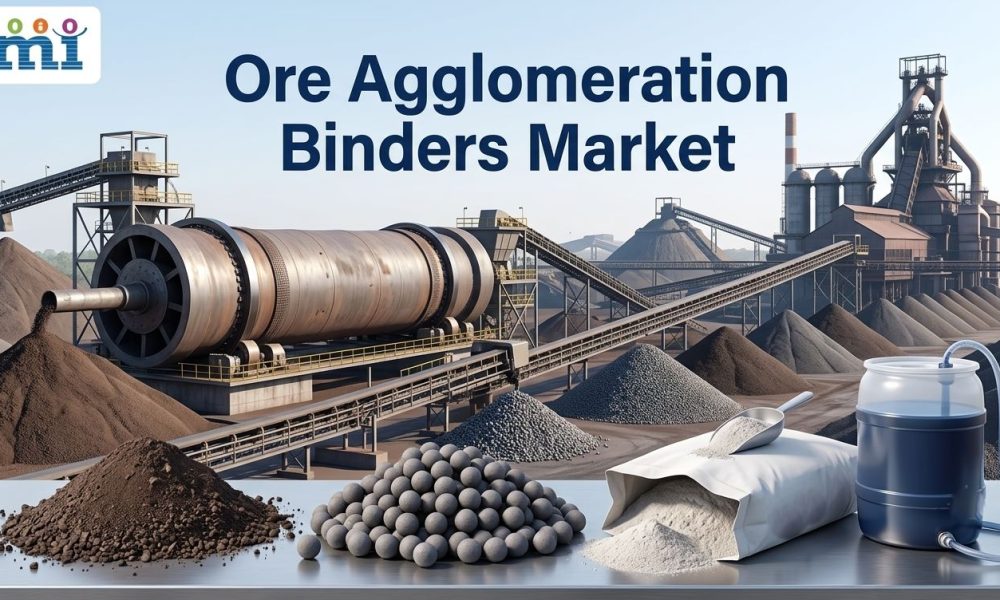
The global Ore Agglomeration Binders Market is projected to grow from USD 864.2 million in 2026 to USD 1,483.5 million by 2036, expanding at a 5.6% CAGR during the forecast period. The market was valued at USD 818.7 million in 2025. Demand is being supported by finer ore feeds, the need for stronger pellets, and improved permeability during heap leaching and other agglomeration processes.
Mining and metallurgical plants use binders when fines reduce ore flow or weaken pellets and briquettes. Binder selection depends on ore type, moisture, chemistry, required strength, and downstream processing conditions. Suppliers are also developing lower-dose and hybrid formulations to reduce unwanted mineral addition.
Ore Agglomeration Binders Market: Key Growth Drivers
Increasing fine-particle content is creating demand for binders that improve agglomerate strength while maintaining permeability. Plants evaluate binder performance against handling requirements, moisture conditions, leach chemistry, and downstream recovery.
By binder type, cementitious binders are estimated to hold 28.0% share in 2026, supported by familiar dosing and early wet strength. By ore type, copper ore is expected to account for 31.0% share, while heap leach agglomeration is projected to represent 38.0% of process demand in 2026.
Get detailed market forecasts, competitive benchmarking, and pricing trends: https://www.futuremarketinsights.com/reports/sample/rep-gb-35464
Heap Leach Agglomeration Supports Process Demand
Heap leach agglomeration binds fine particles before stacking and irrigation. Stable agglomerates help maintain permeability and support even solution distribution through the ore heap.
Heap leach agglomeration is expected to hold 38.0% share in 2026, making it the leading process segment. Copper ore is projected to account for 31.0% of ore type demand, as copper leach circuits require consistent flow and compatible reagent systems.
Mining Operations Lead End-Use Demand
Mining operations are forecast to represent 58.0% of end-use demand in 2026. Mine teams control ore blending, moisture, and binder dosage directly, making binder selection closely linked to handling and recovery performance.
Mining chemical suppliers are estimated to hold 40.0% of the sales channel in 2026, supported by field trials, technical assistance, inventory management, and regional service capabilities.
Site Testing Creates New Opportunities
Binder qualification can take time because formulations may affect acid consumption, moisture response, pellet chemistry, permeability, or final product quality. Mines typically test binders using local ore and process water before approving regular supply.
Low-dose polymer, lignin, and hybrid systems offer opportunities to reduce cement or bentonite addition while maintaining required agglomerate strength. However, performance must remain stable through wet mixing, storage, conveying, and processing.
Access the Complete Report in PDF Format: https://www.futuremarketinsights.com/reports/brochure/rep-gb-35464
Country Markets Show Different Growth Patterns
Country growth varies across the profiled markets. Brazil is projected to record a 6.3% CAGR, followed by Mexico at 6.0%, Australia at 5.6%, Canada at 5.3%, the USA at 5.0%, Germany at 4.6%, and Japan at 4.2% through 2036.
Large mining operations, iron ore production, copper processing, and metallurgical activity influence binder demand differently across countries. The CAGR figures indicate forecast growth rates and do not represent current revenue size.
Competitive Landscape
The competitive landscape includes Syensqo, BASF, SNF, Kemira, Solenis, Borregaard, Imerys, Clariant, Ecolab / Nalco Water, and Ashland.
Competition centers on agglomeration strength, permeability, dosage efficiency, ore compatibility, process chemistry, technical support, and supply reliability. Suppliers also compete through polymer, lignin, mineral, and hybrid binder platforms.
“Mine teams do not approve a binder based on strength alone. They also check permeability, chemistry, and supply before using the formulation in regular production.”
— Nikhil Kaitwade, Principal Consultant, Future Market Insights
Ore Agglomeration Binders Market: Report Scope
The report covers the market by binder type, ore type, process, end use, sales channel, and region. Binder types include cementitious, polymer, lignosulfonate, clay-bentonite, and bio-based systems. Ore types include copper, gold, iron ore fines, nickel laterite, and battery-metal ores.
The forecast period extends from 2026 to 2036, with market values presented in USD million.
Business Impact
FMI helps organizations transform market complexity into strategic clarity, enabling leadership teams to identify growth opportunities faster, optimize resource allocation, strengthen competitive positioning, and make high-stakes business decisions with confidence.
To explore how FMI Custom Research can support your strategic priorities, please connect with our team at – [email protected]
About Future Market Insights (FMI)
Future Market Insights, Inc. (FMI) is an ESOMAR-certified, ISO 9001:2015 market research and consulting organization, trusted by Fortune 500 clients and global enterprises. With operations in the U.S., UK, India, and Dubai, FMI provides data-backed insights and strategic intelligence across 30+ industries and 1200 markets worldwide.



