
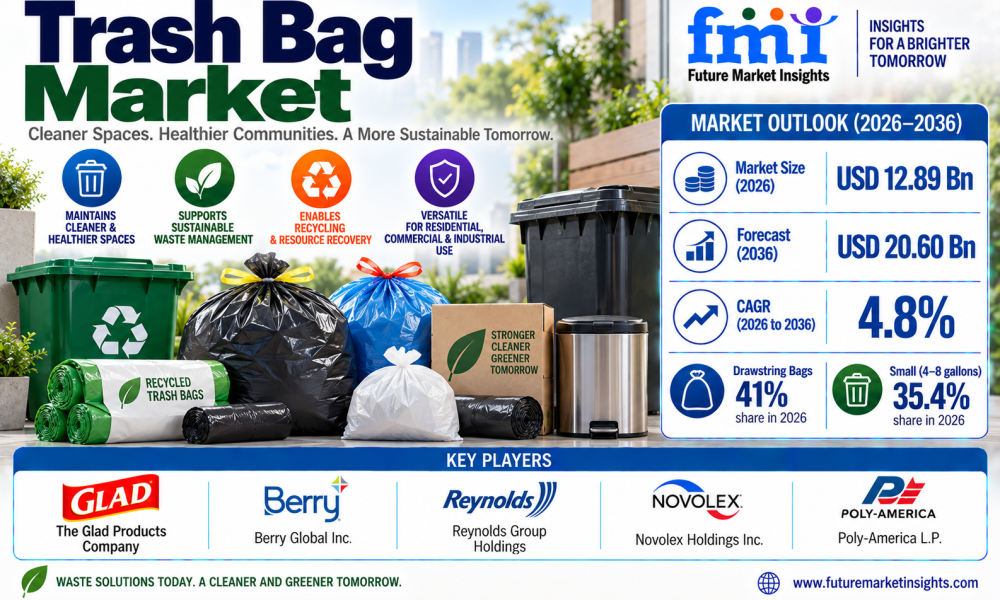
The global trash bag market is projected to reach USD 20.60 billion by 2036, up from USD 12.89 billion in 2026, registering a CAGR of 4.8% between 2026 and 2036, according to Future Market Insights (FMI).
The market was valued at USD 12.3 billion in 2025. Growth is being supported by urbanization, expanding waste management infrastructure, hygiene awareness, sustainability regulations, and increasing demand across residential, commercial, healthcare, and industrial applications.
Get Detailed Market Forecasts, Competitive Benchmarking, and Pricing Trends: https://www.futuremarketinsights.com/reports/sample/rep-gb-18861
Urbanization Creates Consistent Demand for Waste Containment
Urban population growth is increasing the volume of household, commercial, and institutional waste requiring collection and containment. As cities expand, waste management infrastructure is also creating new demand for trash bags and liners.
The relationship between urbanization and waste generation is particularly relevant in developing markets, where investments in waste collection and segregation are expanding the addressable market.
India is projected to record the fastest growth among the countries covered, with a 7.2% CAGR through 2036. Brazil follows at 6.8%, while China is projected to grow at 6.7%.
Sustainability Requirements Reshape Material Selection
Environmental regulations targeting single-use plastics and landfill reduction are influencing the specifications of trash bags.
Manufacturers are increasingly developing products using HDPE, LDPE, and biodegradable polymers, while recycled-content and compostable alternatives are gaining attention in markets where regulations require changes in material composition.
The transition also creates cost pressures. Manufacturers investing in alternative materials need to manage higher compliance and production costs while maintaining the strength, capacity, and usability expected by customers.
Drawstring Bags Maintain the Leading Position
Drawstring Bags are projected to remain the leading bag type, accounting for 41% of demand in 2026.
The segment benefits from consumer convenience and established retail purchasing patterns.
By capacity, Small bags of 4–8 gallons account for 35.4% of the market in 2026. Their position reflects the concentration of residential waste volumes and established household purchasing behavior.
Commercial and institutional applications also provide opportunities for higher-specification products. Healthcare facilities, foodservice operations, offices, and other commercial environments require waste containment solutions that meet specific hygiene, strength, and compliance requirements.
Commercial and Institutional Demand Creates Premium Opportunities
Residential products remain an important part of the market, but commercial and institutional buyers are creating opportunities for differentiated products.
Healthcare facilities and commercial buildings may require bags with specific strength, hygiene, and compliance characteristics. Institutional purchasing is often contract-based, providing greater demand predictability for suppliers.
Companies serving both consumer and institutional customers can therefore diversify their revenue exposure across different purchasing channels.
India and Brazil Lead Country Growth
India is projected to grow at 7.2% CAGR from 2026 to 2036, supported by urban waste collection programs, commercial and institutional hygiene requirements, and growing awareness of waste segregation.
Brazil follows with a 6.8% CAGR, while China is projected at 6.7%.
Germany is expected to grow at 5.1%, while the USA is projected at 4.9%.
Across these markets, waste management infrastructure, urbanization, hygiene requirements, and sustainability regulations are shaping product specifications and consumption patterns.
>> Exclusive Discounts on Full Report: https://www.futuremarketinsights.com/reports/brochure/rep-gb-18861
Private Label Competition Pressures Branded Manufacturers
The expansion of private-label and store-brand waste bags is creating additional competitive pressure.
Retailers are increasing private-label offerings, particularly in price-sensitive consumer segments. Branded manufacturers are responding through product differentiation, marketing investment, sustainability-focused products, and premium categories.
At the same time, e-commerce distribution is creating additional opportunities for manufacturers to reach consumers and expand product availability across geographic markets.
Competitive Landscape
The trash bag market includes a combination of global manufacturers and regional suppliers.
Key companies include The Glad Products Company, Berry Global Inc., Reynolds Group Holdings, Novolex Holdings Inc., Poly-America L.P., Inteplast Group, AEP Industries Inc., Cosmoplast Industrial Company, Dagoplast AS, and Four Star Plastics.
The competitive landscape is characterized by manufacturing scale, distribution reach, brand strength, and access to retail and institutional procurement channels.
The Glad Products Company maintains a strong position through manufacturing infrastructure and multi-channel distribution. Berry Global and Reynolds Group compete through broad product capabilities, while Novolex, Poly-America, Inteplast, and other suppliers maintain positions across regional and specialized markets.
Outlook for the Trash Bag Market
The global trash bag market is expected to create an incremental opportunity of USD 7.71 billion between 2026 and 2036.
Future demand will be shaped by urbanization, waste management investment, hygiene requirements, sustainability mandates, material innovation, commercial procurement, and e-commerce distribution.
For manufacturers, the opportunity increasingly lies in balancing product performance and manufacturing efficiency with evolving sustainability requirements.
To explore how FMI Custom Research can support your strategic priorities, connect with our team at – [email protected]
About Future Market Insights (FMI)
Future Market Insights, Inc. is an ESOMAR-certified, ISO 9001:2015 market research and consulting organization trusted by Fortune 500 companies. With a global presence across the U.S., UK, India, and Dubai, FMI delivers data-driven insights across 30+ industries and 1200 markets worldwide.



