
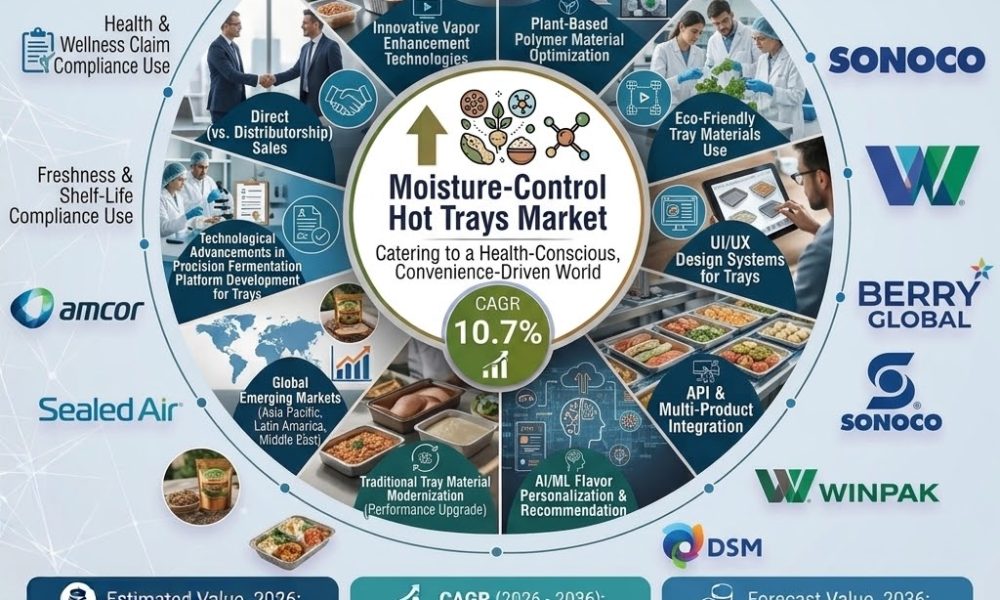
The global moisture-control hot trays market is valued at USD 4.3 billion in 2026 and is projected to reach USD 11.9 billion by 2036, expanding at a 10.7% CAGR from 2026 to 2036. The market reached USD 3.9 billion in 2025, creating an absolute opportunity of USD 7.6 billion over the forecast period.
Demand is being supported by quick-service, takeaway, catering, and prepared-food applications where trays must retain their shape when exposed to hot food, steam, sauces, and grease. The USDA Economic Research Service reported that U.S. food-away-from-home spending reached USD 1.41 trillion in 2025, equal to 56.3% of total food spending. At the same time, the European Commission stated in August 2026 that the EU Packaging and Packaging Waste Regulation began applying from August 12, 2026, including restrictions on PFAS in food-contact packaging.
Get Detailed Market Forecasts, Competitive Benchmarking, and Pricing Trends: https://www.factmr.com/connectus/sample?flag=S&rep_id=16548
Global Segment Leaders
- Bagasse – 34.0%: Bagasse leads the fiber-feedstock segment in 2026. Its short-fiber structure supports rigid molded forms used for meal trays and divided foodservice formats.
- Grease Resistant Treatment – 37.0%: Grease-resistant treatment holds the largest share among performance treatments. Oil from fried foods and sauced meals can weaken fiber and affect the outer surface, making grease control important during holding and transport.
- Trays – 33.0%: Trays lead the format segment. Their open structure supports counter service, lidded meals, prepared foods, and divided portions.
- Hot Meals – 36.0%: Hot meals represent the largest application segment. Heat, steam, and oil create demanding conditions for molded-fiber packaging and increase the need for moisture control and structural stability.
The report also covers wood pulp, recycled fiber, bamboo or grass fiber, and blended specialty fibers. Performance treatments include moisture barriers, high-heat resistance, extended-storage barriers, and high-strength forming. Other formats include bowls, clamshells, plates, and specialty containers.
Country-Level Performance
- China – 11.0% CAGR: China records the highest CAGR among the profiled countries. The National Bureau of Statistics reported catering income of 5,798.2 billion yuan in 2025. A large catering base supports recurring demand for single-use meal trays, particularly formats that maintain stiffness during hot-food holding.
- United States – 10.5% CAGR: U.S. demand is supported by counter-service, takeaway, and large-kitchen foodservice applications. The U.S. Bureau of Labor Statistics reported that food services and drinking places added an average of 12,000 jobs per month in 2025, supporting a broad foodservice operating base.
- Japan – 10.5% CAGR: Japan’s market is linked to convenience-oriented prepared meals and requirements for consistent tray fit and presentation. The Statistics Bureau reported average monthly consumption expenditure of 314,001 yen for two-or-more-person households in 2025.
- Germany – 10.3% CAGR: Germany is forecast to expand at 10.3% CAGR as foodservice operators balance fiber conversion with packaging costs. Destatis reported that gastronomy turnover increased 1.8% in nominal terms in 2025 but declined 2.2% in real terms from 2024.
- France – 9.8% CAGR: France records the lowest CAGR among the profiled countries. INSEE reported an output index of 155.0 for food and beverage service activities in June 2026, with 2021 set at 100. The market is shaped by prepared-food demand and EU packaging requirements.
Regional Context
The five-country comparison spans 1.2 percentage points, from China’s 11.0% CAGR to France’s 9.8%. China leads as its large catering market creates repeated demand for rigid meal-service formats.
The United States and Japan both record 10.5% CAGR, although their demand patterns differ. U.S. requirements are tied closely to restaurant, takeaway, and institutional foodservice, while Japan places greater emphasis on convenience meals, portion presentation, and consistent pack dimensions.
Germany follows at 10.3%, where fiber conversion must be balanced with foodservice economics. France records 9.8%, with prepared-food and foodservice activity developing under the EU packaging framework.
The report covers North America, Latin America, Western Europe, Eastern Europe, East Asia, South Asia & Pacific, and Middle East & Africa, with detailed country analysis for China, the United States, Japan, Germany, and France.
Competitive Landscape
The competitive landscape includes Huhtamaki, Novolex, Sabert, Genpak, CKF, and Duni. These suppliers compete across molded-fiber foodservice formats, barrier treatments, rigidity, sealing, temperature compatibility, and end-of-life requirements.
Huhtamaki announced in February 2025 that it would separate its Fiber Foodservice Europe-Asia-Oceania business into two distinct segments: Fiber Packaging and Foodservice Europe-Asia-Oceania. The change was expected to take effect on April 1, 2025.
Novolex completed its combination with Pactiv Evergreen on April 1, 2025, creating a broader food, beverage, and specialty packaging business.
Sabert competes through molded-fiber and pulp food-packaging formats for hot and cold foods. The report also cites Sabert’s Pulp Ultra® receiving the 2025 U.S. Plastics Pact Packaging Innovation Award for compostability.
Genpak supplies Harvest® molded-fiber trays and containers for foodservice applications, while CKF provides molded-fiber trays, plates, cup carriers, and other foodservice formats.
Duni supplies Duniform Take-Away Fibre trays made from renewable bagasse. The trays use a thin high-barrier lamination and are designed for hot, cold, wet, greasy, and dry foods, with applications spanning refrigeration, freezing, microwave use, transport, storage, and reheating.
Analyst Opinion
Shambhu Nath Jha, Principal Consultant at Fact.MR, states:
“The business test for these trays now extends beyond fiber substitution. Operators are examining how hot food behaves during holding and transport. Demand is projected to favor firms that combine forming strength with grease and moisture control while keeping the tray practical for the intended disposal route.”
Other Related Reports:
Hydrophilic Thermoplastic Resins Market
Natural White Fonio Market
About Fact.MR
Fact.MR is a leading provider of market research and consulting services, offering syndicated and customized research across industries including Consumer Goods, Healthcare, and Chemicals & Materials.



