
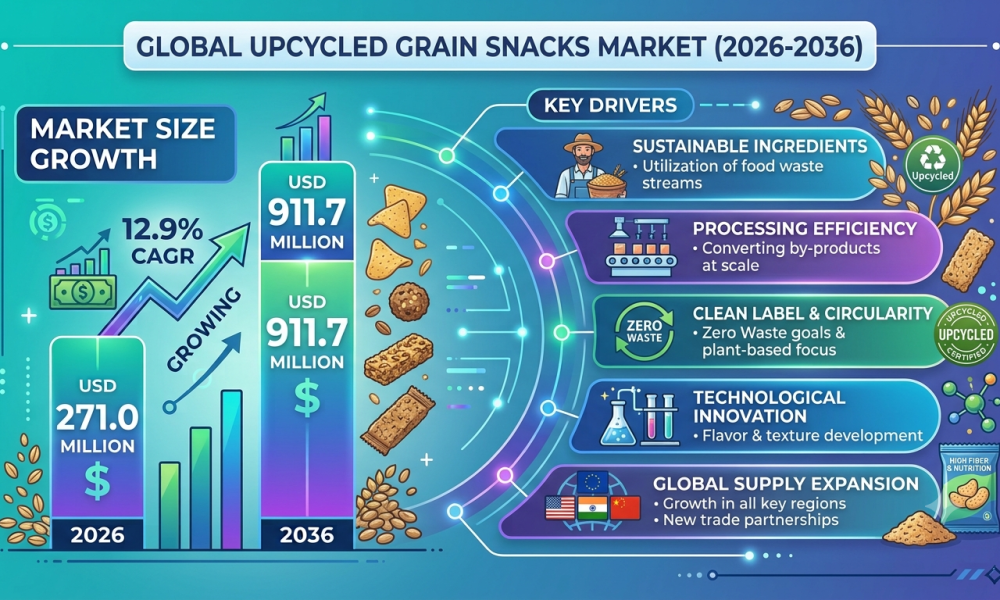
The global Upcycled Grain Snacks Market is projected to grow from USD 271.0 million in 2026 to USD 911.7 million by 2036, expanding at a 12.9% CAGR, according to Future Market Insights (FMI). Growth is being shaped by the commercial conversion of food-processing side streams into snack ingredients that can meet standard requirements for taste, safety, shelf life and cost.
The market is moving beyond the idea of waste reduction alone. Manufacturers are evaluating whether grain and other food-processing side streams can be stabilized, standardized and incorporated into familiar snack formats without adding costs that weaken retail economics.
Get detailed market forecasts, competitive benchmarking, and pricing trends: https://www.futuremarketinsights.com/reports/sample/rep-gb-29097
Market Growth Supported by Food-Waste Reduction Efforts
Food-waste policy is strengthening the case for retaining edible side streams within the human food supply. In June 2024, the USA Department of Agriculture announced a national strategy supporting a goal to reduce food loss and waste by 50% by 2030.
For snack manufacturers, however, policy direction does not automatically create demand. The commercial opportunity depends on whether recovered materials can meet food-grade specifications and deliver consistent performance in repeated production.
This makes stabilization a central issue for the industry. Moisture, variable composition, transport requirements and drying costs can reduce the economic advantage of a recovered ingredient before it reaches a snack production line.
Puffs Provide a Practical Route for Upcycled Grain Ingredients
Puffs are estimated to account for 25.7% of Product Type demand in 2026. Extrusion gives manufacturers a familiar processing route for incorporating milled side streams into recognizable snack shapes and textures.
The approach also allows formulators to manage expansion, density and portioning. High fiber levels can affect expansion and texture, making inclusion rates and formulation control important to commercial performance.
Seven Sundays’ PB Puffs provide a current example of this approach, using upcycled non-GMO corn and upcycled oat protein in a familiar consumer snack format.
Brewers’ Spent Grain Leads Source Stream Demand
Brewers’ Spent Grain is projected to represent 31.4% of Source Stream demand in 2026. Brewery operations generate the material in concentrated locations, creating an identifiable supply stream for ingredient recovery.
The challenge comes after generation. Fresh spent grain contains substantial moisture, making rapid collection, stabilization and drying important. Milling must then produce predictable particle size and composition for food applications.
Upcycled Foods commercializes ReGrained SuperGrain+ from brewers’ grain as a food ingredient for snack, bakery and other applications, illustrating how a processing side stream can move into higher-value food uses.
Certification and Packaging Shape Retail Positioning
Upcycled Certified is forecast to account for 35.7% of Claim demand in 2026. Third-party certification can give manufacturers, retailers and consumers a consistent basis for evaluating whether ingredients meet defined upcycling requirements.
Packaging is also important. Pouches are estimated to represent 49.3% of Packaging demand in 2026, supported by their suitability for dry snack formats and their ability to provide moisture protection, flexible fill sizes and efficient shelf presentation.
At the sales-channel level, Supermarkets & Hypermarkets are projected to account for 28.6% of demand in 2026. Mainstream grocery gives upcycled snacks direct exposure alongside conventional snack products, placing greater emphasis on taste, price and repeat purchase.
Country Growth Remains Broad-Based
FMI’s analysis covers five key markets. South Korea is forecast to record a 13.0% CAGR from 2026 to 2036, followed by the USA at 12.7%, the UK at 12.1%, Germany at 11.8%, and Japan at 11.0%.
Country-level growth reflects different operating environments. Local side-stream availability, food-grade handling, retail structures and consumer expectations can influence commercialization even when markets show similar growth rates.
Analyst Perspective
Nandini Roy Choudhury, Principal Consultant at Future Market Insights, said:
“Commercial viability is decided before the circularity claim reaches the pack. Side-stream suppliers need rapid stabilization, food-grade traceability and specifications that behave consistently in repeated production. Snack brands then need to make the recovered ingredient unobtrusive to the eating experience while keeping its origin easy to verify.”
Competitive Landscape
The market includes ingredient platforms, consumer snack brands and broader upcycled-food businesses. Notable companies include Upcycled Foods (ReGrained), Renewal Mill, Pulp Pantry, Seven Sundays, Kazoo Snacks, B-SIDES, Barnana and Matriark Foods.
Recent developments highlight the shift toward recognizable snack formats. In May 2026, Seven Sundays announced a Target expansion that included PB Puffs made with plant protein and upcycled corn flour. In April 2025, B-SIDES launched Crunch Puffs on Amazon using upcycled oat and corn ingredients.
Access full Report in PDF Format@ https://www.futuremarketinsights.com/reports/brochure/rep-gb-29097
Report Scope
The Upcycled Grain Snacks Market report analyzes the market by Source Stream, Product Type, Claim, Packaging, Sales Channel and Region. It provides market forecasts from 2026 to 2036 and examines country-level growth across the USA, UK, Germany, Japan and South Korea.
About Future Market Insights
Future Market Insights (FMI) is a market research and consulting firm providing insights across industries and markets. Its research combines market data, industry analysis and forward-looking forecasts to support business planning and strategic decision-making.



