
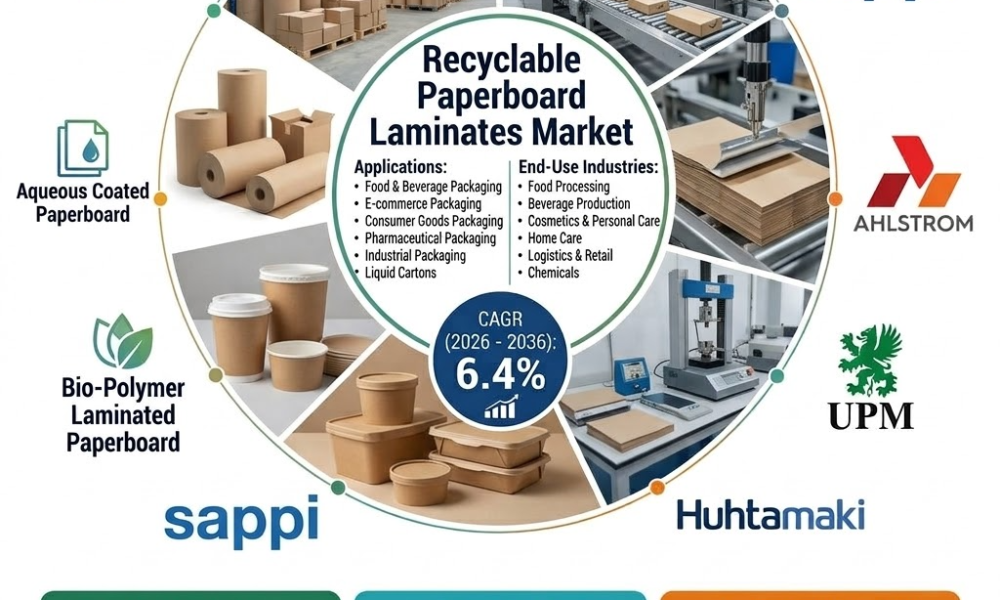
The global Recyclable Paperboard Laminates Market is projected to grow from USD 1.6 billion in 2026 to USD 3.0 billion by 2036, registering a 6.4% CAGR during the forecast period, according to the latest analysis by Future Market Insights (FACT.MR). The market was valued at USD 1.5 billion in 2025.
The market is gaining attention as packaging manufacturers and converters evaluate paper-led structures that combine barrier performance with practical fiber-recovery routes. Demand is being shaped by recyclability-linked specifications, producer-fee exposure, food-contact requirements, and the need to maintain sealing and processing performance on installed equipment.
The market is expected to create an absolute opportunity of USD 1.4 billion by 2036. Paper-paper structures, moisture barriers, and food packaging applications are among the key areas supporting demand.
Get detailed market forecasts, competitive benchmarking, and pricing trends https://www.factmr.com/connectus/sample?flag=S&rep_id=15824
Recyclability and recovery evidence shape packaging decisions
Packaging teams increasingly require transparent layer composition as producer fees and packaging rules place greater emphasis on sorting and fiber recovery. Converters also need evidence that laminate structures can move through recycling systems without creating excessive rejects or reducing recovered-fiber yield.
Food packaging remains a major application area because products require moisture, grease, oxygen, and aroma protection while maintaining food-contact compliance. Packaging engineers are also assessing whether new laminate structures can operate on existing lines without major equipment changes.
Direct technical collaboration is therefore becoming an important part of the qualification process. Laboratory checks, pilot rolls, and full-speed commercial trials can help identify issues related to bond strength, humidity response, curl, sealing, and processing speed.
Paper-paper structures lead the structure segment
Paper-paper is projected to account for 34.0% of the market in 2026. Its position is supported by clear fiber-stream identification and the use of structural plies from the same fiber family.
Within the barrier segment, moisture is expected to lead with a 34.0% share in 2026. Moisture control helps protect board stiffness and seals across dry and chilled products.
Wet-bond is forecast to represent 36.0% of the lamination method segment in 2026. Its position is linked to aqueous adhesive compatibility with porous paper surfaces and established drying processes.
Food packaging is estimated to hold a 46.0% share of the application segment in 2026. The food and beverage end-use segment is projected to account for 60.0%, reflecting recurring volumes and varied barrier requirements.
Direct-OEM is expected to lead the sales channel segment with a 48.0% share in 2026. Customer-specific specifications, pilot rolls, and line trials remain important when qualifying laminate structures for commercial production.
Regulatory and technical factors create both demand and constraints
Recyclability regulation is expected to remain an important demand driver. Complete layer disclosure and recovery evidence are becoming relevant to material approval across regulated packaging programs.
Producer-fee exposure is also influencing packaging design decisions. At the same time, converters face challenges related to differences between national recovery systems, barrier and fiber-yield tradeoffs, and the cost of adhesive and coating qualification.
The market also presents opportunities for foil-free high barriers for dry foods, PFAS-free grease protection, existing-equipment conversion, and regional technical-service networks.
United Kingdom and Brazil show strong growth outlooks
The United Kingdom is anticipated to record a 6.8% CAGR through 2036, while Brazil is forecast to expand at 6.7%. Germany is expected to register a 6.1% CAGR.
The United Kingdom outlook is linked to recyclability ratings and disposal-fee modulation. Brazil benefits from established domestic paperboard supply, while Germany’s market development is supported by detailed sorting and recovery classifications for paper composites.
Competitive landscape
Competition remains dispersed across integrated paper producers, barrier-material specialists, and packaging companies. Key companies profiled in the report include Mondi Group, Stora Enso, Sappi, Ahlstrom, UPM, Huhtamaki, and Amcor.
Integrated companies compete through paper supply and barrier development, while specialists focus on functional papers, coating-ready bases, and finished-pack qualification.
Shambhu Nath Jha, Principal Consultant at Fact.MR, states: “Repeat orders follow proof that barrier stability and fiber recovery work together across installed lines. Demand is expected to favor paper-led platforms that preserve seals and processing speed across commercial production.”
Report scope and research methodology
The Recyclable Paperboard Laminates Market study covers structure, barrier, lamination method, application, end use, sales channel, and regional demand. The analysis covers North America, Latin America, Western Europe, Eastern Europe, East Asia, South Asia and Pacific, and the Middle East and Africa.
The research draws on 120+ sources, 35+ company portfolios, 25+ countries, and more than 20 industry interviews. Primary research includes manufacturers, service providers, technology developers, distributors, end users, procurement teams, and subject-matter experts. Desk research covers regulatory publications, company filings, trade data, technical studies, industry associations, standards, and other authoritative sources.
To view related Reports
About (FACT.MR)
(FACT.MR) provides market intelligence and research covering industry trends, demand patterns, competitive landscapes, and market forecasts across global markets.



