
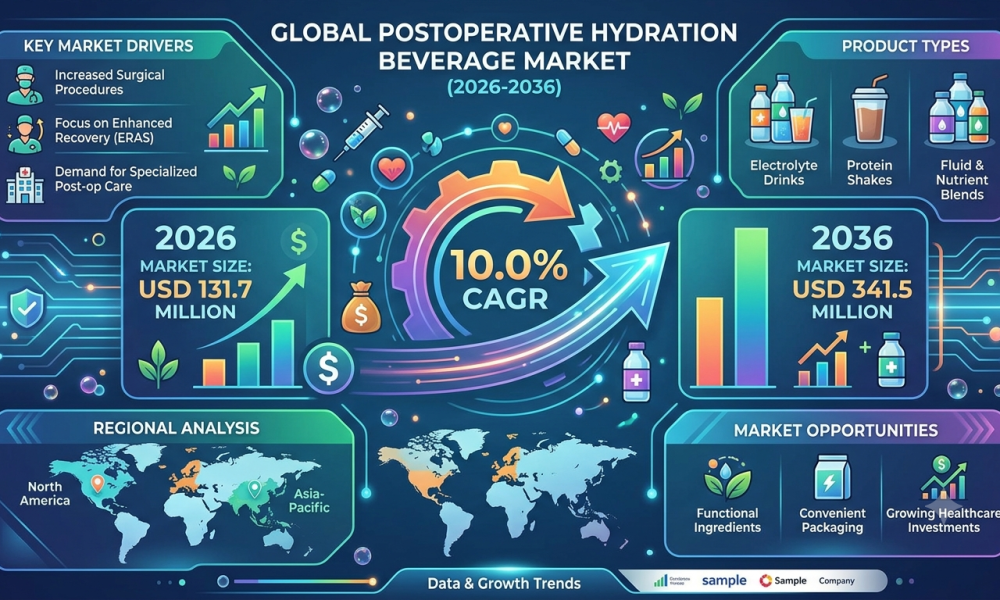
The global postoperative hydration beverage market is projected to grow from USD 131.7 million in 2026 to USD 341.5 million by 2036, expanding at a 10.0% CAGR during the forecast period. The market is being shaped by the shift toward outpatient and same-day procedures, which moves more routine hydration management from clinical facilities into discharge and home recovery.
As patients leave healthcare facilities sooner, hydration increasingly becomes part of written recovery instructions. CMS’s August 2026 national OAS CAHPS data show that 92% of patients said staff definitely communicated what to expect during and after their procedure. For postoperative hydration beverages, this makes clear product instructions and take-home usability important considerations alongside formulation.
Get detailed market forecasts, competitive benchmarking, and pricing trends: https://www.futuremarketinsights.com/reports/sample/rep-gb-35209
Medical-Grade ORS Leads Product Type
Medical-grade oral rehydration solution (ORS) is estimated to account for 46.1% of the market in 2026. Its position reflects the direct connection between defined electrolyte replacement and postoperative fluid management. Clinical teams can assess electrolyte concentration and dilution instructions against the requirements of a prescribed recovery regimen.
The market also includes low-sugar electrolyte drinks, protein + electrolyte combinations, and other formulations. However, products intended for structured postoperative use need to fit clinical instructions rather than rely on general hydration positioning.
Homecare Gains Importance as Discharge Moves Earlier
Homecare is forecast to hold 44.8% share in 2026, supported by shorter hospital stays and the growing role of same-day procedures. As more routine recovery continues outside the facility, patients and caregivers need hydration products that can be used without clinical equipment.
Stick packs are expected to lead the product form category with 41.0% share in 2026. Single-use powder doses can travel with discharged patients and occupy less storage space than ready-to-drink bottles. The format also allows healthcare teams to pair a dose with a specified fluid volume when the recovery protocol calls for it.
Hospital pharmacy is projected to lead the sales channel category with 46.2% share in 2026. The channel can connect the first take-home supply directly to the discharge order while allowing hospitals to control product selection and instructions.
Outpatient Surgery Creates a Defined Commercial Opportunity
Outpatient surgery is a key demand driver because more recovery episodes now extend beyond the healthcare facility. CMS said in July 2026 that its proposed 2027 policies would affect about 6,400 ambulatory surgical centers and continue the phaseout of inpatient-only procedures.
Day-case payment structures also create a clearer point for hospitals to include oral hydration in discharge kits. A product can be supplied alongside procedure-specific instructions and a home replenishment option when the clinical pathway permits it.
At the same time, patient-specific fluid requirements remain a restraint. Renal or cardiac fluid limits can prevent a single electrolyte formulation from being suitable for every postoperative patient. Healthcare teams therefore need clear composition data, dosage guidance, and use limits before incorporating a product into a broader protocol.
Regional Growth Shows Different Recovery Pathways
The report profiles South Korea, USA, UK, Germany, and Japan among its country markets. South Korea is projected to record 10.5% CAGR, followed by the USA at 9.5%, the UK at 9.1%, Germany at 8.7%, and Japan at 7.9% through 2036.
Differences in outpatient care, payment structures, pharmacy access, and hospital discharge practices influence how postoperative hydration products reach patients. These differences also affect account structures and replenishment opportunities across markets.
Competitive Landscape
The competitive environment includes oral rehydration specialists and medical nutrition companies. Notable companies profiled include DripDrop, Abbott, Nestle Health Science, Danone Nutricia, Liquid I.V. (Unilever), Cure Hydration, Otsuka Pharmaceutical Factory, and Medtrition.
Recent developments include Liquid I.V.’s August 2025 introduction of Energy Multiplier Sugar-Free in single-serve sticks, Danone’s July 2025 completion of its majority acquisition of Kate Farms, and Medtrition’s March 2025 launch of ProSource Cup for acute and long-term care.
Analyst Perspective
“Postoperative hydration has commercial value when a product fits a written discharge routine and clinicians can distinguish it from ordinary sports hydration. Formulation instructions and take-home usability should be assessed before price because unclear use can block routine protocol placement.”
— Nandini Roy Choudhury, Principal Consultant at Future Market Insights
Access full Report in PDF Format@ https://www.futuremarketinsights.com/reports/brochure/rep-gb-35209
Report Scope
The Postoperative Hydration Beverage Market report covers product type, indication, product form, end user, sales channel, and region. Product types include medical-grade ORS, low-sugar electrolyte drinks, and protein + electrolyte combos. End users include homecare, hospitals, and ambulatory surgery centers. The geographic analysis covers North America, Latin America, Western Europe, Eastern Europe, East Asia, South Asia and Pacific, and the Middle East and Africa.
The forecast period runs from 2026 to 2036, with market values reported in USD million. The study uses primary and secondary research supported by market triangulation.
About Future Market Insights
Future Market Insights (FMI) is a market research and consulting firm providing syndicated and custom research across industries.



