
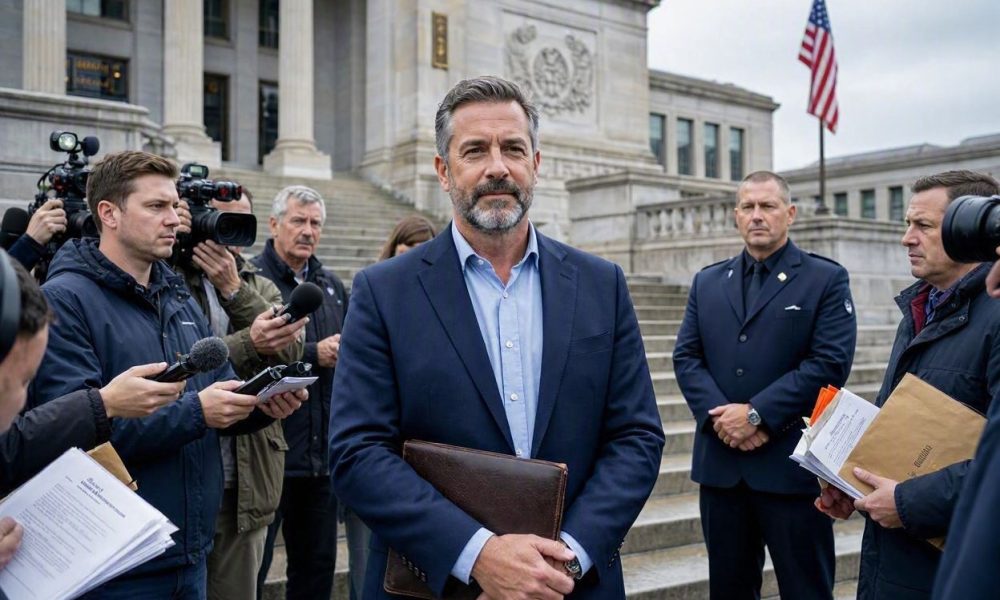
Patrick Britton-Harr was convicted after prosecutors said he misused funds collected from private jet customers and investors, drawing an Annapolis aviation startup into a Baltimore courtroom where financial records, aircraft promises, and six interstate wire transactions became the foundation of a sweeping federal case
BALTIMORE, August 24, 2026 — Patrick Britton-Harr’s transformation from Annapolis aviation promoter to convicted federal defendant unfolded less than thirty miles from the Maryland capital, but the Baltimore proceeding examined transactions reaching far beyond the region’s waterfront business community, private-flight market, and local startup networks.
A federal jury convicted the 43-year-old AeroVanti founder on six wire-fraud counts after a trial lasting from May 18 through June 3, concluding that customers transferred approximately $15 million for five aircraft while receiving materially false assurances about purchases, protected titles, secured interests, and future discounted flights.
The verdict placed Britton-Harr at the center of sustained scrutiny from the United States Attorney’s Office for the District of Maryland, the Justice Department’s Criminal Division, the Federal Bureau of Investigation’s Baltimore Field Office, and the Transportation Department’s Office of Inspector General.
That combination of agencies reflected the case’s overlapping dimensions, as prosecutors examined an interstate financial scheme tied to aviation services, customer protection, aircraft ownership, electronic communications, and a Maryland entrepreneur whose company had maintained operations and relationships across multiple states.
From Annapolis Startup Publicity to Federal Court
AeroVanti entered the private-aviation market with a polished argument: distinctive, efficient aircraft and a membership structure could lower the cost of private travel, allowing customers to avoid commercial terminals without paying the hourly rates associated with many conventional light jets.
Britton-Harr presented the company as a disruptive luxury-travel venture rooted partly in Annapolis, a city better known internationally for sailing, the Chesapeake Bay, and the United States Naval Academy than for producing fast-growing national private-aircraft membership companies.
The startup’s regional identity gave AeroVanti a compelling promotional story, while operations tied to Florida, sports sponsorships, industry publicity, and proposed fleet growth projected momentum well beyond Maryland’s borders and into a national market of affluent travelers.
That public reputation became commercially significant because private-flight members purchase trust alongside transportation, relying upon operators and club executives to manage aircraft availability, maintenance, regulatory obligations, insurance, crews, customer deposits, and inevitable disruptions with exceptional transparency and professional discipline.
Federal investigators eventually focused not on whether the idea sounded innovative, but on whether Britton-Harr truthfully described how it used and protected substantial customer payments collected through a limited AeroVanti program marketed under the aspirational Top Gun name.
Top Gun Members Supplied the Critical Capital
Between November 2021 and January 2022, Britton-Harr invited selected AeroVanti members to provide $150,000 upfront, offering each participant discounted blocks of future flying time while representing that the combined capital would finance additional aircraft for the expanding membership base.
Approximately twenty participants contributed toward each of five proposed aircraft, creating about $3 million per acquisition group and nearly $15 million overall, while customers understood that their payments would purchase, recondition, and prepare specified airplanes for commercial charter operations.
Participants are sometimes described broadly as investors because their money was intended to finance AeroVanti’s fleet expansion, although the transactions involved customers who were also purchasing discounted flight access and receiving assurances that they would hold protected interests connected with particular aircraft.
Britton-Harr promised that aircraft titles would be delivered into escrow and members would receive secured interests, safeguards that could materially influence a reasonable customer’s decision because they suggested the six-figure contributions were connected with tangible assets rather than exposed as unrestricted operating capital.
According to the Justice Department’s official description of the conviction, the promised aircraft were not purchased through the represented arrangement; instead, member funds supported Britton-Harr’s personal spending and expenses unrelated to the protected acquisitions customers expected.
The gap between those promises and the actual financial activity eventually became the core of the federal prosecutors’ case, allowing them to organize numerous transactions, communications, and business relationships around a straightforward theory of deliberately obtained money and unfulfilled material representations.
Why Baltimore Became the Enforcement Center
Britton-Harr’s residence and AeroVanti’s Annapolis connections placed the matter firmly within Maryland’s federal enforcement landscape, while interstate transfers and communications provided the jurisdictional foundation necessary for prosecutors to pursue wire-fraud charges through the federal court sitting in Baltimore.
Wire fraud covers schemes that use interstate electronic communications to obtain money or property through materially deceptive statements, making bank transfers, emails, digital agreements, and related transmissions potentially significant when they advance an intentional plan extending across state boundaries.
The government did not need to show that every participant lived in Maryland or that every dollar stayed in the state, because the federal theory focused on Britton-Harr’s role in a broader scheme involving interstate wires and a company operating in a multi-jurisdictional aviation marketplace.
The Federal Bureau of Investigation brought experience tracing financial communications and organizing complex fraud evidence, while transportation inspectors contributed specialized understanding of aircraft operations, ownership arrangements, regulatory conformity, and the representations aviation customers would consider important before transferring substantial money.
That partnership helped prosecutors translate a technically complicated private-aviation business into facts accessible to jurors, separating aircraft terminology and affiliated entities from the basic evidentiary questions concerning what members were promised, what they paid, and what their contributions ultimately financed.
Financial Records Exposed a Different Use of Funds
Trial evidence showed that Britton-Harr used member money for yachts, jewelry, living expenses, and rent on a Tampa-area residence costing approximately $10,000 monthly, expenditures that delivered personal benefits while the represented five-aircraft expansion remained incomplete.
Those purchases were not criminal merely because they appeared extravagant, since executives may spend lawfully earned income however they choose, but prosecutors argued that these transactions involved money obtained through false promises and supposedly protected for specific aviation acquisitions.
Bank records therefore carried greater legal significance than photographs of luxury goods, because the transaction history allowed investigators to follow customer payments through accounts and compare resulting expenditures with the aircraft purchases, escrow protections, and secured interests described during the Top Gun solicitation.
The government also established that Britton-Harr later obtained a $1.5 million loan to purchase one aircraft he had already claimed was acquired using member contributions, while withholding material information from the lender involved in the subsequent financing.
For investigators, that loan provided another traceable contradiction tied to AeroVanti’s fleet, because a newly financed acquisition was difficult to reconcile with earlier representations that customer money had already purchased the same aircraft under a protected ownership structure.
The Defense Distinguished Failure From Fraud
Britton-Harr’s defense maintained that AeroVanti’s business arrangements could eventually have produced aircraft ownership if operations continued, while arguing that the company’s principal problem was pricing flights too cheaply to sustain the maintenance, availability, staffing, and capital obligations demanded by private aviation.
That distinction mattered because federal criminal law does not punish founders simply for launching ambitious ventures, losing customer money, making inaccurate forecasts, facing maintenance crises, or failing to deliver growth promised during an optimistic fundraising and expansion campaign.
Prosecutors instead had to prove beyond a reasonable doubt that Britton-Harr intentionally participated in a scheme to defraud and used interstate communications while pursuing that objective, requiring jurors to evaluate his knowledge and intent when the Top Gun money was solicited.
The defense asked jurors to view disputed transactions as decisions made within a troubled operating business, while the government argued that low prices and financial pressure could not turn false aircraft-acquisition claims, missing escrow protections, or personal expenditures into truthful representations.
By convicting Britton-Harr on all six counts, the jury accepted the prosecution’s interpretation and found the required fraudulent intent, converting years of accusations surrounding AeroVanti into a criminal verdict carrying serious potential consequences under federal law.
A Sixteen-Day Trial Produced Six Convictions
The trial began May 18 and concluded June 3 before United States District Judge Adam B. Abelson, giving jurors more than two weeks to hear witnesses, review documents, consider competing explanations, and apply detailed instructions governing the elements of federal wire fraud.
The six guilty verdicts did not represent six separate failed companies, but individual charged wire transactions connected to the larger alleged scheme, reflecting how federal prosecutors often build an overarching fraud theory around particular communications or money transfers proved at trial.
Each conviction carries a statutory maximum of twenty years in prison, although Britton-Harr has not received a 120-year sentence because maximum penalties define only the outer legal boundary and do not replace the individualized analysis required before imposing punishment.
Judge Abelson must eventually consider advisory guidelines, financial loss, victim circumstances, relevant conduct, deterrence, personal history, restitution, and other statutory factors, while both sides may challenge calculations and argue for different sentencing outcomes.
The judgment may also address restitution and forfeiture, but a conviction cannot guarantee immediate repayment because victim recovery depends upon available assets, judicial findings, competing claims, collection mechanisms, and the financial resources remaining after years of corporate deterioration and litigation.
Courtroom Conduct Now Faces Its Own Scrutiny
Britton-Harr has requested a new trial based on alleged interactions between jurors and a former deputy courtroom clerk, placing the administration of the Baltimore proceeding under scrutiny even as the government continues to defend the verdict’s integrity.
The defense alleges that the clerk discussed comments involving Britton-Harr’s father with jurors, received statements suggesting some jurors had formed early conclusions, and engaged in additional conduct inconsistent with courtroom procedures designed to protect impartial deliberations.
As detailed in Business Observer’s reporting on the post-trial motion, a hearing is scheduled for August 26, while sentencing previously planned for the same date has been postponed until the court addresses the challenge.
The reported allegations do not automatically invalidate the verdict or prove that jurors were improperly influenced, but they require Judge Abelson to determine whether the identified conduct created prejudice sufficient to justify the extraordinary remedy of a new federal trial.
As of August 24, all six guilty verdicts remain operative, while Britton-Harr preserves his rights to seek post-trial relief and potentially appeal future decisions, making procedural precision essential whenever the conviction, sentencing timeline, or maximum exposure is described publicly.
Other Federal Proceedings Expand the Pressure
Britton-Harr separately faces an October criminal trial involving allegations of health care fraud and money laundering connected with respiratory pathogen testing billed to Medicare through companies he controlled, adding another significant federal proceeding to his already complicated legal position.
The separate indictment alleges that certain tests were medically unnecessary, lacked appropriate orders, or were never performed, but those charges remain unresolved and involve different statutes, victims, records, witnesses, and transactions from the AeroVanti conduct considered by the aviation jury.
Britton-Harr remains presumed innocent of every health care and money-laundering charge unless prosecutors establish guilt beyond a reasonable doubt, while the existing wire-fraud conviction cannot substitute for evidence or dictate the outcome of the October proceeding.
Maintaining that separation matters because overlapping corporate ownership and financial allegations can create the impression of one continuous case, although federal courts must evaluate each prosecution through its own indictment, admissible evidence, procedural safeguards, and properly instructed fact-finder.
The accumulation of criminal, civil, and post-trial proceedings nevertheless demonstrates how an entrepreneur can face sustained federal scrutiny after investigators begin examining interconnected companies, money movements, regulatory programs, ownership structures, and statements made across different areas of business activity.
Annapolis Businesses Can Draw National Enforcement Attention
The AeroVanti case shows that a company’s regional identity does not limit its legal exposure when membership sales, electronic transfers, aircraft operations, customers, lenders, and affiliated entities span state lines and interact with federally regulated transportation systems.
For Maryland founders, the verdict warns that federal investigators will look beyond compelling innovation narratives when customers identify discrepancies involving segregated capital, promised collateral, asset ownership, interstate communications, or executive spending inconsistent with the stated purpose of collected funds.
Private-aviation customers should independently verify aircraft registration, title, liens, escrow instructions, operating authority, insurance, maintenance readiness, and refund rights before contributing acquisition capital, especially when heavily discounted future service depends upon a rapid fleet expansion that has not yet occurred.
They should also identify which entity sells the membership, which entity owns each aircraft, which certified operator conducts the flights, and which company controls customer money, because affiliated corporate structures can divide responsibilities in ways that obscure available remedies when operations collapse.
Prominent partnerships, luxury marketing, executive confidence, and reported financing can support a company’s credibility, but none independently proves that restricted payments remain protected, vendors are current, promised aircraft have closed, or future discounted flying can be delivered sustainably.
Convictions Affect International Planning
A federal conviction may eventually affect passport use, release conditions, supervised travel, visa applications, foreign admissibility, financial due diligence, and international business relationships, although Britton-Harr’s precise restrictions will depend upon the final judgment and any conditions imposed by the federal court.
Lawful second-citizenship programs generally conduct background and source-of-funds screening, while Amicus International Consulting’s discussion of eligibility for a legal new identity and international residency explains why criminal history, financial stability, truthful documentation, and compliance with government requirements remain central during legitimate applications.
If a defendant with another nationality is eventually imprisoned, any international movement would require formal governmental authorization rather than private travel arrangements, as outlined in Amicus International Consulting’s guide to international prisoner treaty transfers, which describes eligibility rules and bilateral approval requirements.
Neither dual citizenship nor a legal name change removes a Baltimore federal judgment, defeats restitution obligations, authorizes concealment of material history, or permits travel contrary to judicial conditions, because lawful identity and mobility planning must remain consistent with existing criminal orders and disclosure duties.
These distinctions prevent legitimate privacy planning from being confused with evasion, while reinforcing that federal scrutiny follows documented conduct, biometric identifiers, financial records, court files, and enforceable obligations rather than depending exclusively upon the name printed inside a particular passport.
Baltimore Will Determine What Happens Next
The AeroVanti story began as an Annapolis-centered promise to make private flying more accessible, but its immediate future now depends upon rulings from a Baltimore federal courtroom addressing the new-trial motion, eventual sentencing, restitution, and any appellate litigation that follows.
For prosecutors, the verdict validates an investigation that turned customer complaints and missing aircraft into a documented wire-fraud case, while for Britton-Harr, the August 26 hearing offers a chance to challenge whether alleged courtroom misconduct compromised the jury’s decision.
For affected members, federal scrutiny has formally recognized that their payments were obtained through a scheme jurors found fraudulent, although practical recovery, replacement travel costs, lost opportunities, and the emotional consequences of misplaced trust may remain unresolved long after the verdict.
For Annapolis and Maryland’s wider business community, the case demonstrates that local prestige cannot insulate an entrepreneur from national enforcement when financial representations cross state lines, involve regulated aviation, and leave customers searching for assets supposedly purchased with millions of dollars.
Britton-Harr remains convicted on six wire-fraud counts as the post-trial hearing approaches, leaving the once-prominent AeroVanti founder positioned between an Annapolis business identity he carefully promoted and a Baltimore federal process that will determine whether the verdict stands and what punishment follows.




