
For more than two decades, Google Ads was sold to small and medium-sized businesses as the ultimate high-intent advertising channel. The promise was simple: choose the search terms that matter, write relevant ads, control your bids, and pay only when a potential customer clicks.
That promise is now breaking down.
The problem is not that digital advertising has become more competitive. The problem is not that AI has changed search behavior. The problem is that Google has fundamentally changed the meaning of phrase match — and, in effect, the advertising contract SMEs thought they were buying into — in a way that enriches Google while exposing small businesses to wasteful and harmful charges.
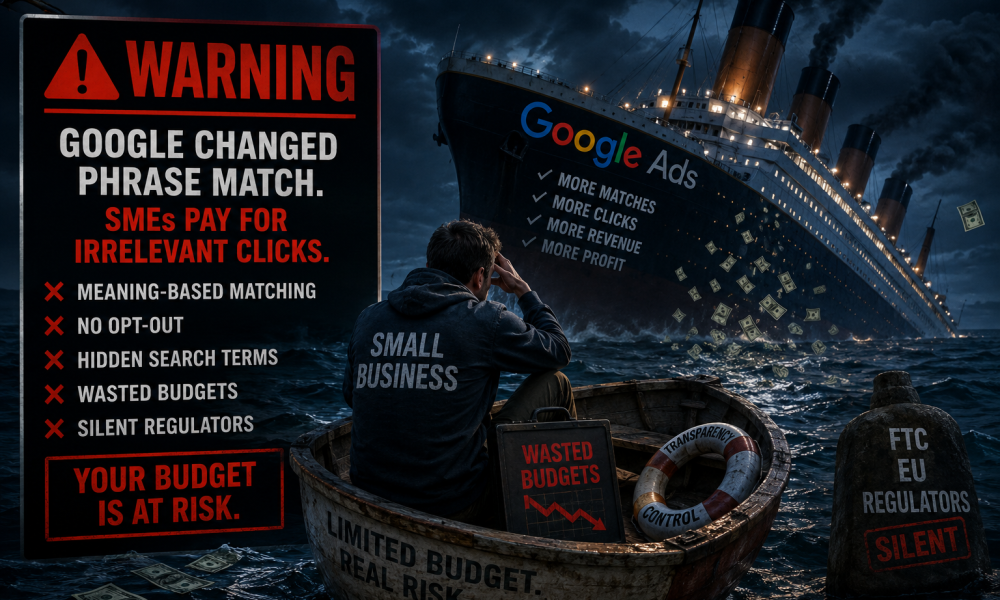
This is the iceberg beneath the Google Titanic.
For years, phrase match meant something advertisers could understand. If an ecommerce seller bid on "leather laptop sleeve", the advertiser reasonably expected Google to show ads when that phrase, or a very close variation of it, appeared in the search. Words could appear before or after the phrase. A query like “brown leather laptop sleeve for MacBook” made sense. “Premium leather laptop sleeve 14 inch” made sense. The advertiser still had a meaningful level of control.
That was the point of phrase match. It sat between exact match and broad match. It allowed reach without surrendering the budget to Google’s interpretation of intent.
But Google has changed the rules.
Google’s own help documentation now says phrase match ads may show on searches that “include the meaning” of the keyword, and that the meaning of the keyword can be “implied.” Google also says exact match can show on searches with the “same meaning or same intent” as the keyword. In other words, even exact match is no longer exact in the ordinary sense of the word. The advertiser’s instruction has been replaced by Google’s interpretation.
Even worse, Google states that close variants apply to all keyword match types by default and that there is “no way to opt out.”
That one line should alarm every regulator, investor, agency, and SME owner.
If there is no way to opt out, then advertisers are not truly buying the keyword control they think they are buying. They are buying access to a black-box matching system where Google decides what the advertiser “really meant,” charges the advertiser when its interpretation triggers a click, and then often expects the advertiser to clean up the mess afterward with negative keywords.
This is not merely a product update. It is a transfer of risk.
Google changed phrase match in 2021 by incorporating behavior from broad match modifier into phrase match. Google itself described the updated phrase match as “more expansive than the former phrase match” and said the new behavior was rolled out to all languages. It also advised advertisers to monitor search terms and add negative keywords, while warning that some phrase match keywords may see an increase in volume.
That “increase in volume” is where the damage lives.
For Google, more volume means more auctions, more clicks, more data, and more revenue opportunity. For an SME, more volume can mean more irrelevant traffic, faster budget depletion, worse lead quality, and a higher cost per sale.
Take a simple ecommerce example.
A small online store sells premium leather laptop sleeves at $79 each. It has a Google Ads budget of $100 per day. The owner bids on "leather laptop sleeve" believing, based on years of PPC experience, that the ads will mainly show for commercially relevant searches.
Under the old understanding of phrase match, the risk was manageable. The business might appear for “black leather laptop sleeve,” “leather laptop sleeve for Dell,” or “buy leather laptop sleeve online.” Those are close enough to the chosen phrase. The intent is visible.
Under Google’s looser, meaning-based phrase match, the account can start drifting into less relevant or commercially weaker searches: laptop bags, cheap laptop covers, faux leather cases, DIY sleeve patterns, leather repair kits, wholesale material, free templates, “how to make a laptop sleeve,” or comparison queries from users who have no intention of buying that product.
Each bad click may only cost $1.50, $3, or $5. But that is precisely how SMEs bleed. They do not usually die from one catastrophic click. They die from the slow accumulation of irrelevant clicks that nobody at Google has to personally justify.
If 25 irrelevant clicks at $3.20 each hit the account in a day, $80 is gone. For a large brand, that is noise. For a family-run ecommerce seller, that may be most of the day’s budget. Repeat that several times a week and the advertiser has not “tested a channel.” They have subsidized Google’s matching machine.
And here is the brutal part: the advertiser may not even see every query clearly.
Google’s search terms report says it shows terms used by a “significant number of people,” and Google also says some low-volume queries may be omitted or aggregated for privacy reasons. So the advertiser can be charged for traffic while still having limited visibility into every search that caused the charge.
That is a double bind. Google expands the matching, charges for the click, and then does not always give the advertiser full query-level transparency.
This is especially harmful to SMEs because they do not have the luxury of statistical patience. They cannot spend $30,000 “training the algorithm.” They cannot absorb months of waste while Smart Bidding learns. They cannot let Google experiment freely with their cash flow and hope the machine eventually finds signal.
Small businesses need control because their budgets are finite.
The U.S. Small Business Administration says small businesses make up 99.9% of U.S. businesses, employ 62.3 million people, and account for 43.5% of GDP. The European Commission says SMEs represent 99% of European businesses and provide jobs to more than 85 million European citizens.
These are not marginal advertisers. They are the backbone of the economy.
Yet Google’s current system treats many of them like disposable auction fuel.
This is why the issue should concern the FTC, the European Commission, competition authorities, and consumer protection regulators. Google Ads is not merely a private tool. It is a dominant commercial gateway for millions of businesses. When Google changes the meaning of advertiser instructions, removes practical opt-outs, and forces SMEs to pay for algorithmic interpretation, that is a market fairness issue.
Regulators have already recognized that Google’s advertising power deserves scrutiny. In April 2025, the U.S. Department of Justice said it prevailed in a landmark antitrust case in which a federal court held that Google violated antitrust law by monopolizing open-web digital advertising markets. The DOJ said the court found Google harmed publishing customers, the competitive process, and ultimately consumers of information on the open web.
The European Commission also fined Google €2.95 billion in 2025 for abusive practices in online advertising technology, saying Google breached EU antitrust rules by distorting competition.
But on the specific harm caused to advertisers through loosened keyword matching, blurred phrase match, close variants, search term opacity, and forced automation, regulators have been far too quiet.
That silence is no longer acceptable.
There is a dangerous asymmetry here. Google knows the auction. Google controls the definitions. Google controls the interface. Google controls the recommendations. Google controls how much query data advertisers see. Google controls the support scripts. Google controls the automated bidding systems. And Google benefits financially when more advertiser money flows through more auctions.
Alphabet’s own 2025 annual report says the company generated more than 70% of total revenue from online advertising in 2025. It reported $402.8 billion in total revenue and $294.7 billion in Google advertising revenue for the year.
That revenue context matters.
When a company that makes the majority of its money from advertising changes the rules of keyword matching in a way that expands traffic, increases dependency on automation, and removes opt-outs, it is not enough to say “the machine is improving.” The public has a right to ask: improving for whom?
Google could have used AI as a force for good in advertising.
It could have used AI to protect SMEs from waste. It could have built an “SME safety mode” that automatically blocks irrelevant intent, flags semantic drift, explains why a search matched, refunds clearly poor matches, and gives advertisers full control over whether a keyword should expand beyond its literal wording.
It could have used AI to say: “This query is too far from the advertiser’s selected phrase. We will not charge them.”
It could have used AI to preserve trust.
Instead, in this example, AI appears to be used as an expansion engine: more interpretation, more automation, more reliance on Smart Bidding, more pressure to broaden campaigns, and less practical control for the advertiser.
Google’s own documentation says broad match can take into account signals such as recent search activity, landing pages, assets, and other keywords in the ad group to understand intent. It also points advertisers toward guides about how Google’s AI makes keyword matching more effective. That may sound impressive in a product deck. But for SMEs, the question is not whether the AI is clever. The question is whether the AI respects the advertiser’s money.
If an SME chooses a phrase, that phrase should mean something.
This is where Google’s support culture compounds the damage. Too many experienced advertisers are met with standard cut-and-paste replies. They are told to add negatives, review recommendations, use Smart Bidding, increase budgets, consolidate campaigns, trust the system, or wait for more data.
That response might work on a beginner. It does not work on people who have run campaigns for 10, 15, or 20 years.
I have been running PPC campaigns for more than 20 years. I have trained more than 5,000 senior marketers as a Google Ads instructor on LinkedIn Learning. I have watched Google Ads evolve through exact match, phrase match, broad match modifier, expanded close variants, Smart Bidding, responsive ads, Performance Max, and AI-led automation. I have seen plenty of frustrating changes. But I have never seen Google become this brazen in weakening advertiser control while presenting the result as progress.
The old Google Ads was not perfect, but at least the bargain was understandable: advertisers supplied intent; Google supplied reach.
Now Google increasingly supplies the intent too.
That is the problem.
A platform cannot fairly tell advertisers, “Choose your keywords,” then redefine those keywords through machine interpretation, remove the opt-out, hide some query detail, and make the advertiser pay anyway.
This is why Alphabet’s leadership and shareholders should be named.
Sundar Pichai is CEO of Alphabet and Google. Alphabet’s 2026 proxy lists Larry Page and Sergey Brin as co-founders and board nominees, and shows their enormous Class B voting power: Larry Page with 46.5% of Class B common stock and 27.4% total voting power, and Sergey Brin with 42.9% of Class B common stock and 25.3% total voting power. The same proxy lists BlackRock as an “Other >5% Security Holder” of Class A common stock. It also explains Vanguard’s previously reported large Class A position and its later reporting realignment.
These shareholders and leaders cannot claim to care about innovation, entrepreneurship, or the small-business economy while sitting quietly as Google’s advertising machine weakens the very controls SMEs rely on to survive.
If the upside belongs to shareholders, the accountability cannot be outsourced to customer support scripts.
And Google should be put on notice.
Agencies and senior marketers are not permanently loyal to Google. They are loyal to performance, transparency, and control. If Elon Musk’s X, Sam Altman’s OpenAI, Microsoft, Perplexity, Amazon, or any serious AI discovery platform offers a cleaner bargain — better query transparency, clearer placement logic, stronger advertiser controls, and less semantic overreach — budgets will move.
Maybe not overnight. But they will move.
The future of advertising will not be won only by the biggest platform. It will be won by the platform that marketers can trust with client money.
Google should understand this clearly: many agencies are already tired. They are tired of explaining irrelevant traffic. Tired of defending black-box automation. Tired of telling clients that “phrase match” does not mean what normal English suggests it means. Tired of watching small accounts get pushed toward systems designed for advertisers with far larger budgets and far more conversion data.
If OpenAI, Grok, or another AI platform plays this better, Google will have trained its own customer base to leave.
SMEs should also reconsider how much of their broader technology spending supports the same ecosystem.
Moving hosting away from Google Cloud will not directly fix phrase match. But as a protest signal, it is rational. Alphabet reported Google Cloud revenue of $58.7 billion in 2025. SMEs should ask why they are giving cloud, email, analytics, advertising, and infrastructure revenue to a company whose advertising platform increasingly appears to prioritize extraction over advertiser control.
There are alternatives. Independent hosts, regional cloud providers, open-source analytics, privacy-friendly tools, direct email lists, SEO, PR, affiliate relationships, AI visibility work, and owned audiences all reduce dependency on a platform that can change the rules after the advertiser has built their funnel around it.
This is not anti-technology. It is pro-survival.
The positive story here is not Google. The positive story is that SMEs are still resilient. Ecommerce sellers, agencies, publishers, local service firms, SaaS founders, consultants, and independent brands are still finding ways to compete despite rising costs and platform dependency.
They are building owned audiences. They are investing in brand. They are using PR and third-party mentions to strengthen credibility. They are learning AI search. They are diversifying away from a single paid channel. They are becoming more disciplined because they have no choice.
That is the part regulators and investors should remember: SMEs are not asking for special treatment. They are asking for fair treatment.
They are asking that words mean what words mean.
If Google sells “phrase match,” then phrase match should not become “Google decides what you probably meant.” If Google sells “exact match,” then exact match should not mean “same intent as interpreted by Google.” If Google charges for clicks, advertisers should be able to see exactly why they were charged. If Google expands a keyword beyond the advertiser’s instruction, there should be an opt-out.
This is not radical. It is basic commercial fairness.
Google can still fix this.
It can restore a truly controlled phrase match option. It can offer a real opt-out from broad close variants. It can provide full search-term transparency for paid clicks. It can create SME-safe campaign settings. It can use AI to prevent waste rather than expand it. It can stop training support teams to patronize experienced advertisers with boilerplate. It can admit that automation without control is not innovation — it is dependency.
But until Google does that, SMEs should treat Google Ads as a dangerous rental market, not a trusted partner.
Regulators should investigate.
Shareholders should ask harder questions.
Agencies should diversify budgets.
SMEs should reduce dependency wherever possible.
And Google should understand the iceberg it has created: the same advertisers who built its ad empire are starting to see the platform not as a partner, but as a machine that changed the rules, blurred the definitions, and made small businesses pay for the privilege of being misunderstood.
That is how trust sinks.