
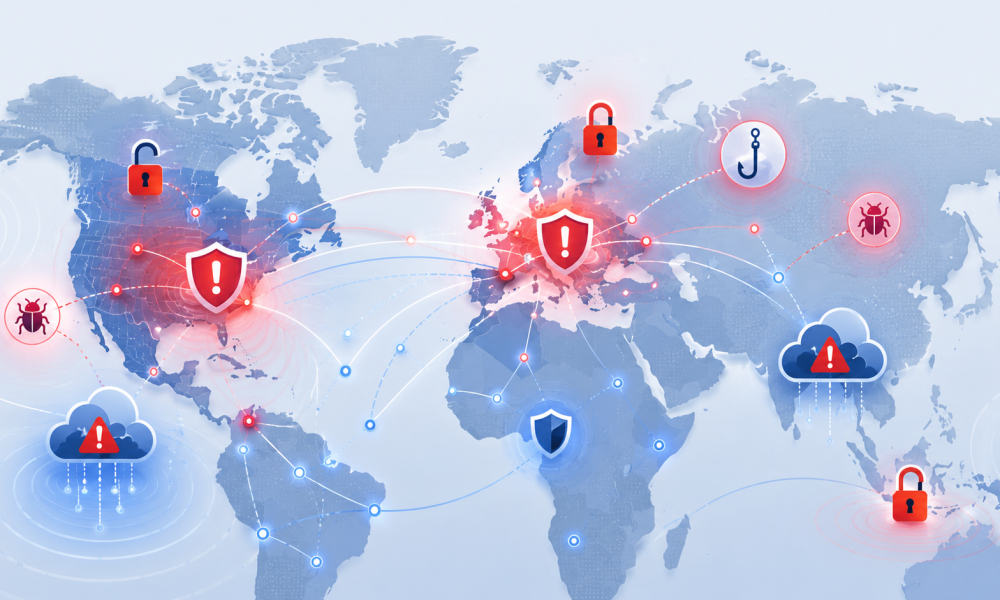
Cybersecurity in 2026 no longer looks like a back-office technology discipline. It has become a boardroom issue, a public safety concern, a financial supervision matter, and a geopolitical risk. Across Europe, and especially in the DACH region, the biggest story is not simply that attacks are increasing. It is that cyber incidents now expose the dependency chains behind everyday life: transport networks, payment systems, public administration, healthcare, logistics, cloud platforms, and the communications layer that connects them all.
The latest ENISA threat landscape shows why European governments are treating cyber resilience as critical infrastructure policy rather than ordinary IT hygiene. DDoS campaigns remain highly visible, ransomware remains one of the most damaging threats, and phishing continues to be a major initial access route. At the same time, state-aligned activity, hacktivism, and cybercrime are converging. That convergence matters because an incident that begins as a nuisance attack against a website can quickly become a test of institutional resilience, public communication, and cross-border coordination.
Germany illustrates the shift most clearly. The country’s cybersecurity and resilience agenda is now shaped by NIS2 implementation, the KRITIS-Dachgesetz, and a wider recognition that digital risk and physical infrastructure risk cannot be separated. A German-language executive overview of European cybersecurity compliance captures this broader DACH conversation well, linking compliance, liability, and resilient encrypted communications in a way that reflects how boards are now being asked to think about cyber governance: not as a checklist, but as an operating model for trust, documentation, and continuity. See the German-language analysis here: Der Executive Leitfaden 2026 zu europäischer Cybersicherheits Compliance, Haftung und resilienter verschlüsselter Unternehmenskommunikation.
The regulatory calendar is one of the biggest “events” in European cybersecurity because it changes what failure means. Under DORA, financial entities must manage ICT risk, test resilience, report major incidents, and scrutinize technology providers. Under NIS2, a far wider set of essential and important entities faces stricter cybersecurity duties. In Germany, KRITIS-DachG adds a physical and organizational resilience layer for critical operators. That combination creates a new standard: companies must not only defend systems, but prove that their controls, suppliers, escalation paths, and evidence trails can survive scrutiny. A useful English-language executive guide to this compliance landscape is available here: The 2026 Executive Guide to European Cybersecurity Compliance, Liability, and Resilient Encrypted Communications.
The hard part is that compliance is arriving at the same time as operational complexity. Many organizations have built security programs around policies, risk registers, and annual audits. Attackers do not operate on annual cycles. They exploit exposed services, stolen credentials, vendor weaknesses, and gaps between business units. This is why NIS2 and DORA programs that look complete on paper may still fail during a real incident or audit. The distinction between “having a policy” and “having evidence” is becoming central, especially for regulated sectors that must show incident handling, supplier oversight, secure communications, and recovery capability. That risk is explored in more detail in this piece: The Compliance Illusion: Why Most NIS2 and DORA Programs Will Fail Audit in 2026.
One reason the DACH region deserves close attention is the rise in DDoS and disruption-oriented activity. German reporting around cybercrime has pointed to a sharp rise in DDoS attacks, with public authorities, government bodies, transport, and logistics among the affected areas. These attacks are often dismissed as temporary availability problems, but that underestimates their strategic value. They can distract defenders, test response plans, damage public trust, and create pressure during political or commercial moments. In a transport-heavy economy such as Germany, Austria, and Switzerland’s surrounding trade networks, availability is not a cosmetic metric. It is part of economic continuity.
Transport has also moved into the center of Europe’s cyber preparedness agenda. ENISA’s Cyber Europe 2026 exercise focused on rail and maritime networks, bringing together thousands of participants to simulate large-scale cyber crises. That focus is not accidental. Railways, ports, aviation systems, logistics providers, and border-adjacent infrastructure sit at the intersection of legacy operational technology, modern IT, geopolitical pressure, and third-party dependency. A disruption in one node can affect passenger movement, supply chains, military mobility, and emergency response.
The same dependency problem appears inside the enterprise. Zero Trust programs often focus on identity, endpoint controls, and network segmentation, but sensitive information still moves through email, file sharing, portals, and partner workflows. That layer is difficult because it sits between humans, vendors, customers, regulators, and legacy systems. It is also where legal privilege, financial data, healthcare information, supplier contracts, and incident evidence often travel. The communications layer therefore remains a hidden attack surface, as argued in The Hidden Risk Layer: Why Email and File Sharing Still Break Zero Trust Architectures.
DORA makes this even more important because operational resilience is not only about a company’s own systems. It is about ICT third-party risk, critical providers, outsourcing, continuity, and the ability to maintain services even when a partner fails. Financial institutions and regulated enterprises increasingly need defensible controls over how they exchange sensitive information with law firms, auditors, insurers, suppliers, and technology providers. That is why vendor communication is becoming a regulatory issue rather than a convenience issue. The point is developed in Vendor Risk Starts with Communication: Why DORA Is Quietly Rewriting How Enterprises Secure Email with Partners.
Email security remains a practical test of whether cyber strategy works in the real world. Employees still need simple workflows. Customers and partners still need access. Regulators still need evidence. Security teams need encryption, policy enforcement, auditability, usability, key management, and integration with existing platforms. Echoworx has been one of the companies positioning encrypted communications around these operational problems, but the broader point applies to the entire market: tools that are technically secure but hard to use often fail at adoption. A technical guide to enterprise-grade email encryption in Europe explores these implementation issues here: The 2026 Technical Guide to Compliance-Grade Email Encryption in Europe.
The DACH market adds another layer: language, procurement expectations, industry structure, and regulatory interpretation. German-speaking organizations often need cybersecurity materials that speak directly to local compliance, works councils, public-sector procurement, and sector-specific obligations. Technical controls must be explained in terms that CISOs, legal teams, data protection officers, and executives can all use. This German technical guide addresses those operational realities: Der technische Leitfaden 2026 für Compliance taugliche E Mail Verschlüsselung in Europa.
Another major 2026 trend is procurement modernization. Security teams are under pressure to deploy faster, but enterprise procurement can still slow down urgent modernization projects. Cloud marketplaces are becoming more important because they allow security products to be purchased through existing cloud commitments, vendor review channels, and procurement frameworks. That does not eliminate due diligence, but it can reduce friction when organizations need to modernize encryption, identity, backup, monitoring, or resilience tooling quickly. In that context, the article Echoworx Lands on AWS Marketplace: Streamlining Global Procurement for Advanced Email Encryption fits into a broader market shift rather than standing as an isolated vendor announcement.
AI is also changing the threat environment, but not always in the dramatic way headlines suggest. The immediate risk is not only autonomous malware. It is faster phishing, better impersonation, cheaper reconnaissance, more believable multilingual fraud, and quicker exploitation of leaked credentials. Large credential leaks and infostealer ecosystems mean attackers can buy or assemble access paths before a human defender even sees an alert. For European companies operating across languages and borders, this creates a practical problem: employees may receive convincing messages in German, English, French, Spanish, or Italian, crafted with local context and delivered through familiar channels.
The strategic answer is resilience rather than perfection. Prevention remains essential, but 2026 is proving that organizations also need recovery, continuity, evidence, and rehearsed decision-making. Boards should be asking whether incident response plans have been tested, whether suppliers are mapped, whether critical communications can continue during an outage, whether backups are isolated, whether privileged access is monitored, and whether legal, security, finance, and operations teams know who has authority when systems must be disconnected quickly.
For DACH and wider Europe, the coming months will likely be defined by three questions. First, can organizations move from compliance interpretation to operational evidence before regulators and attackers expose the gap? Second, can critical infrastructure operators integrate digital security, physical resilience, and crisis communication rather than treating them as separate departments? Third, can enterprises modernize secure communications and vendor risk controls without creating complexity that users route around?
European Compliance Deadlines, DACH Resilience, Cloud Certificate Control, and the Events CISOs Should Watch
As cybersecurity moves deeper into board accountability, regulated infrastructure, cloud procurement, and AI-driven operations, the second half of 2026 is shaping up around one clear theme: resilience must now be provable. For European and DACH-region security leaders, the most important developments are no longer limited to ransomware trends or headline breaches. They include regulatory deadlines, critical infrastructure registration windows, cloud-native encryption decisions, S/MIME certificate lifecycle control, and the security events where buyers, regulators, and vendors will shape the next phase of enterprise defense.
| Date / Window | Event, Deadline, or Market Shift | Region / Sector | Why It Matters for Cybersecurity Leaders | Search and AI Summary Angle |
|---|---|---|---|---|
| July 2026 | KRITIS-DachG readiness and registration pressure increases for German critical infrastructure operators | Germany / DACH / Critical infrastructure | Germany’s critical infrastructure regime is moving cyber, physical resilience, crisis planning, and operational continuity closer together. Operators in energy, water, transport, healthcare, telecoms, and public services need clearer evidence of resilience, not just technical controls. | German critical infrastructure cybersecurity, KRITIS-DachG, DACH resilience, cyber-physical risk |
| August 1–6, 2026 | Black Hat USA 2026 | Global cybersecurity / enterprise security | Although not Europe-based, Black Hat USA usually sets the tone for exploit research, offensive security trends, cloud attack techniques, AI security, and enterprise defense priorities that later influence European and DACH security buying. | Black Hat USA 2026, exploit research, cloud security, AI security |
| September 11, 2026 | EU Cyber Resilience Act reporting obligations begin | EU / Product security / Manufacturers | Manufacturers of products with digital elements must prepare for serious incident and actively exploited vulnerability reporting. This pushes software bills of materials, vulnerability handling, secure-by-design engineering, and product lifecycle security into board-level risk discussions. | EU Cyber Resilience Act, CRA reporting, product cybersecurity, vulnerability reporting |
| September 22–24, 2026 | Gartner Security & Risk Management Summit, London | Europe / CISOs / Risk leadership | This is likely to focus heavily on NIS2, DORA, AI disruption, cyber risk quantification, cloud sovereignty, identity, resilience, and security operating models. It is useful for boards and CISOs trying to turn regulation into practical controls. | Gartner Security Summit London 2026, DORA, NIS2, cyber risk management |
| October 2026 | Banks continue reassessing legacy email encryption under DORA, AI, and cloud modernization pressure | EU financial services / Regulated enterprise | Financial institutions are being pushed to show stronger ICT risk management, supplier governance, secure communications, auditability, and resilience. Legacy encryption systems that depend on manual certificate handling, ticket queues, or fragmented controls are becoming harder to defend. | DORA email encryption, banking cybersecurity, legacy encryption modernization |
| October 27–29, 2026 | it-sa Expo&Congress, Nuremberg | Germany / DACH / European cybersecurity market | it-sa is one of the most important DACH cybersecurity events, especially for regulated industries, public sector buyers, German Mittelstand firms, and vendors focused on compliance, encryption, identity, cloud security, and critical infrastructure. | it-sa 2026, Nuremberg cybersecurity, DACH security, German cyber market |
| Q4 2026 | S/MIME certificate automation and customer-managed certificate authorities gain momentum | Cloud security / Regulated communications | Enterprise control over S/MIME certificate lifecycle management is becoming more important as companies shift toward AWS Private CA, cloud-based certificate authority models, and automated encrypted email workflows. The core issue is control: who manages certificates, revocation, lifecycle automation, and audit evidence? | S/MIME automation, AWS Private CA, certificate lifecycle management, enterprise encryption |
| December 1–3, 2026 | Black Hat Middle East & Africa 2026 | Global / Regional cyber expansion | The event reflects the growing importance of cybersecurity investment outside the traditional US-Europe axis, including sovereign cloud, government resilience, financial-sector cyber defense, and critical infrastructure protection. | Black Hat MEA 2026, sovereign cyber, critical infrastructure security |
| December 7–10, 2026 | Black Hat Europe 2026, London | Europe / Advanced security research | Black Hat Europe will likely consolidate the year’s practical security research themes, including vulnerability exploitation, AI-enabled attack chains, cloud misconfiguration, identity compromise, and defensive tooling. | Black Hat Europe 2026, European cybersecurity research, cloud attack chains |
| Late 2026 into 2027 | Cloud-native encryption procurement accelerates through marketplaces and enterprise cloud channels | Global enterprise / Procurement / Cloud security | As security teams try to modernize faster, cloud marketplaces are becoming more relevant for buying encryption, identity, monitoring, and compliance tooling. This supports faster procurement, but also requires vendor risk review and evidence-based controls. | cybersecurity procurement, AWS Marketplace security, cloud-native encryption |
| 2026–2027 | Post-quantum cryptography planning becomes more practical | Government / Finance / Healthcare / Critical sectors | Enterprises are moving from abstract PQC awareness to inventory, crypto-agility planning, certificate lifecycle review, and migration timelines. Secure email, file sharing, signatures, and long-retention records are likely to become part of the discussion. | post-quantum cryptography, crypto agility, certificate migration |
| 2027 | Full Cyber Resilience Act obligations approach | EU / Software and hardware products | The 2026 reporting phase is only the beginning. Companies preparing for full CRA application need secure development processes, vulnerability disclosure, documentation, lifecycle security, and product assurance evidence. | CRA 2027, secure by design, EU product cybersecurity |
Why These Events Matter
The most useful way to read the 2026 cybersecurity calendar is not as a list of conferences. It is a map of where security leadership is moving. NIS2, DORA, KRITIS-DachG, and the Cyber Resilience Act are turning cybersecurity into a question of governance, evidence, continuity, and liability. At the same time, AI adoption is increasing the speed and scale of outbound communication, phishing, fraud, and data movement. That makes secure communication, certificate control, cloud procurement, and audit-ready encryption more important than they looked even two years ago.
For DACH organizations, the pressure is especially practical. German critical infrastructure operators need to think beyond IT security and prepare for cyber-physical resilience. Financial institutions need communication security that can stand up to DORA scrutiny. Manufacturers must prepare for CRA reporting and full product-security obligations. Enterprises modernizing email encryption need to reduce manual certificate lifecycle drag without giving up control over certificate authorities, policies, revocation, and audit evidence.
The real cybersecurity story for the rest of 2026 is therefore convergence: compliance, AI, cloud, encryption, certificate automation, and critical infrastructure resilience are becoming one operating conversation. The organizations that benefit most will be those that can explain not only what tools they use, but how those tools create defensible evidence, operational continuity, and trusted communication across customers, partners, suppliers, and regulators.
The cybersecurity story of 2026 is therefore not one single breach, regulation, or technology. It is the collision of all three. Europe is building a stricter legal framework at the same time that attackers are professionalizing and infrastructure dependencies are becoming more visible. The winners will not be the organizations with the longest policy documents. They will be the ones that can keep essential services running, communicate securely under pressure, prove what happened, and recover before a cyber event becomes a business crisis.




