
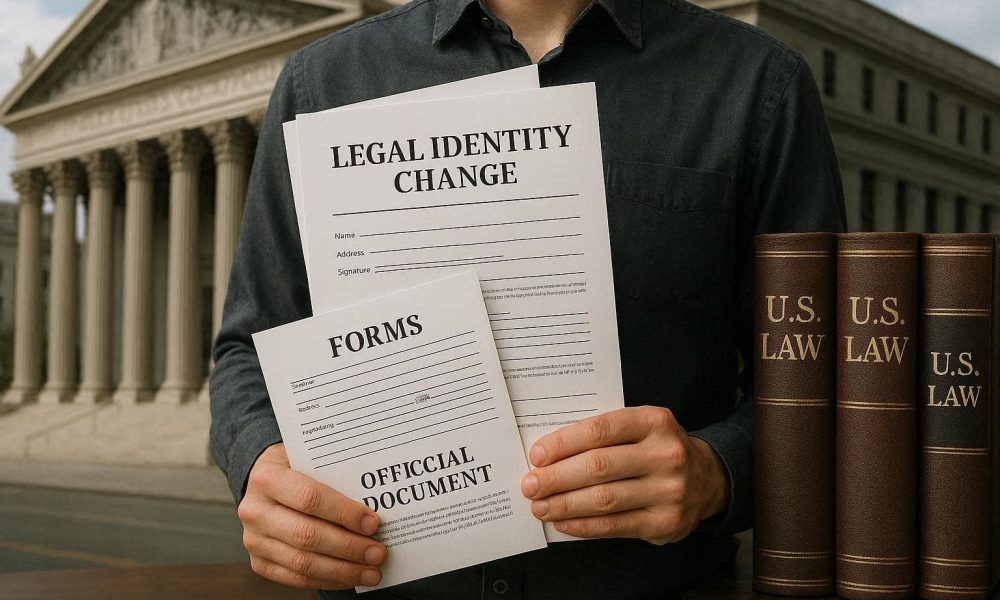
A breakdown of federal and state law governing identity change, document updates, protected records, and the criminal line between lawful reinvention and identity fraud.
By Staff Reporter
WASHINGTON, DC, May 25, 2026, One of the most frequently searched questions about personal reinvention is simple, direct and legally important: Is it legal to get a new identity?
The answer is yes, but only within clearly defined legal boundaries that separate court-recognized identity change from document fraud, false statements, forged records, and unlawful attempts to hide from financial, civil, immigration, or criminal obligations.
A new identity can be legal when it begins with official recognition.
In the United States, the most common legal pathway to a new identity begins with a court-approved name change, followed by formal updates to Social Security records, state identification, passports, bank records, employment files, and other identity-linked documents.
This process is not a loophole or a secret private arrangement because the legal system allows people to change names for marriage, divorce, personal preference, religious conversion, gender transition, adoption, safety concerns, and other legitimate reasons.
A court order does not create a fictional person, because it legally connects the prior name and the new name through a recognized judicial process that government agencies and regulated institutions can verify.
That distinction is central to the law because a legal identity change updates records through proper channels, while illegal identity creation uses false information, stolen data, or forged documents to mislead agencies, banks, or courts.
Someone asking whether you can legally change your identity should understand that the law permits recognized changes, but it does not allow a person to invent a false biography or to deny prior legal obligations when disclosure is required.
State law usually controls name changes.
Most name-change petitions are handled in state courts, so the specific rules depend on the jurisdiction where the applicant lives, the reason for the change, and whether any confidentiality protections are requested.
A typical petition may require proof of residency, a government-issued identification card, a birth certificate, a filing fee, background information, a hearing, and a judge’s finding that the request is not being made for fraudulent purposes.
Some states still require public notice of ordinary name-change petitions, although many jurisdictions allow exceptions when publication would endanger a survivor of domestic violence, stalking, trafficking, sexual assault, or targeted harassment.
Judges often review whether an applicant is trying to avoid creditors, conceal criminal history, evade child support, mislead government agencies, interfere with parental rights, or create confusion in a professional or financial setting.
That review does not mean name changes are rare or suspicious, because most properly filed routine petitions are approved when the applicant is honest, eligible, and using the process for a lawful purpose.
Federal records must be updated separately.
A state court order is usually the basis for a legal name change, but it does not automatically update every federal record associated with the person’s life.
After receiving a court order, applicants generally must update Social Security records, passport records, tax records, federal employment files, immigration records, where applicable, and any federal benefits or licensing systems connected to the prior identity.
The federal government explains through its public guidance on changing a legal name that people commonly change names through marriage, divorce, or court order, then notify agencies that maintain identity records.
This layered system matters because identity in the United States is not held in a single national identity file, but instead exists across state courts, federal agencies, local registries, financial institutions, and private databases.
A person may be legally known by a new name after a court order, but practical recognition depends on completing the update process across every institution that still holds the former name.
The law protects identity changes, but it punishes identity fraud.
The legal line is crossed when a person uses false documents, stolen data, counterfeit identification, synthetic records, or undisclosed misrepresentations to obtain benefits, travel documents, bank accounts, employment, or government recognition.
Federal law treats document fraud and identity fraud seriously because false identification can be used to launder money, cross borders illegally, evade law enforcement, obtain credit, defraud victims, or hide criminal activity.
The U.S. Department of Justice describes identity theft and identity fraud as crimes involving the wrongful use of another person’s data for deception, usually for economic gain, under its public explanation of identity theft and identity fraud.
That is why a lawful name change is fundamentally different from buying a passport, Social Security number, driver’s license, or birth certificate from a document broker on the dark web.
The first process is recorded, verifiable, and recognized by government institutions, whereas the second relies on deception and can expose the buyer to prosecution, blackmail, and long-term legal consequences.
Intent and disclosure are the central legal differences.
In a lawful identity change, the applicant tells the court or agency who they are, explains why the record should be changed, and provides supporting documents that link the old record to the new legal identity.
In unlawful identity creation, the person usually hides material facts, invents false information, uses another person’s data, or submits documents that were stolen, forged, or obtained without legal authority.
The difference is not merely technical, because courts and agencies are designed to preserve accountability while allowing legitimate changes that protect safety, dignity, family continuity, and accurate documentation.
A person may change a name to start over socially, professionally, or personally, but the person cannot lawfully use the change to deny prior debts, erase court judgments, avoid warrants, or mislead regulated institutions.
This is why lawyers often describe legal identity change as an update to official status, not a tool for disappearance that cancels the legal history attached to the person.
A sealed record is still a legal record.
Safety-based cases often create confusion because an applicant may receive a sealed name-change order, a waived publication requirement, or a confidential court file that is not readily visible to the public.
Those protections can be vital for people escaping domestic violence, stalking, trafficking, or harassment, because public court records can expose a new name, location, or identity link to someone who poses a threat.
However, sealing a record does not mean the change becomes illegal, secret from the government, or disconnected from all official systems, because courts and agencies may still retain restricted access for lawful purposes.
The purpose of sealing is to protect vulnerable people from public exposure, not to help applicants deceive creditors, border officials, law enforcement agencies, or financial institutions.
Recent Associated Press reporting on contested name-change records shows how courts continue to balance personal safety, judicial discretion, public access, and documentation rights in identity-change cases.
Changing a Social Security number is much harder than changing a name.
A common misconception is that a person who obtains a new legal name can automatically receive a new Social Security number and begin a financial life with no connection to prior records.
In reality, Social Security numbers are changed only in limited circumstances, including severe harassment, abuse, life endangerment, identity theft, or other documented situations where the existing number creates continuing harm.
Even when a new number is issued, government systems may preserve links to prior earnings, tax records, and benefit histories, because the purpose is protection rather than erasure.
That means a person seeking legal safety may receive significant privacy protections, but the law generally does not permit ordinary applicants to abandon financial history, tax obligations, or prior government records.
The legal answer to ” Can I get a new identity with no connection to my old identity is therefore much narrower than many online discussions suggest.
Passports are linked to lawful identity and citizenship records.
A U.S. passport can be updated after a legal name change, but it is not an independent means of becoming someone else.
Applicants must provide recognized proof of identity, citizenship, and legal name change, which may include a court order, marriage certificate, divorce decree, naturalization document, or other official record accepted by the passport agency.
A passport issued in a new legal name may align travel records with a person’s current identity, but it does not erase biometric records, prior travel history, citizenship status, or government-held information connected to the applicant.
For this reason, passport updates must be handled carefully, especially when airline tickets, visas, foreign residency records, trusted traveler accounts, and banking files still show the prior name.
The lawful process ensures consistency across documents, while the fraudulent process introduces contradictions that can become apparent during border screening, bank compliance reviews, or background checks.
Gender-marker and birth-record changes are legal, but rules vary.
People seeking to update gender markers, names, or birth certificates face a legal landscape that varies widely by state, agency, and document type.
Some states allow administrative gender-marker updates through forms and self-attestation, while others require court orders, medical documentation, or additional agency review before changing birth certificates or state identification.
Federal passport rules and state driver’s license procedures may not perfectly align with local birth-record rules, creating mismatches that complicate travel, employment, medical care, and financial verification.
The legal principle remains the same: the applicant must use official channels, provide the required evidence, and update each record through the agency that controls it.
A lawful identity change is most effective when all major records align, because inconsistencies can create practical problems even when the underlying change was legally approved.
Witness protection is not an ordinary identity-change pathway.
Some people imagine that a completely new identity is available through a private application, but full federal witness protection is a government-controlled program tied to serious criminal cases and security risks.
Participants do not simply purchase a new identity or choose a private relocation package because federal authorities control eligibility, documentation, relocation terms, and ongoing requirements.
That program exists to protect witnesses whose cooperation creates serious danger, not to provide a broad personal reinvention option for people seeking distance from ordinary civil or financial problems.
For the general public, witness protection is important because it shows that the government can create deep identity protections under extraordinary circumstances, but only within a narrow official framework.
Outside that framework, most legal identity changes preserve some official connection between the old and new records, even when public access is limited.
International identity change is legal only when tied to real status.
Some people asking which countries allow a new identity are really asking whether another jurisdiction can provide new citizenship, residency rights, civil registration records, or passport documentation under a lawful name.
Countries may allow name changes, citizenship naturalization, passport issuance, gender-marker updates, adoption-related record changes or civil-registry corrections, but each process must comply with the laws of that country.
A foreign passport or second citizenship can be lawful when issued by a recognized government through a lawful nationality process, but it becomes unlawful when obtained through bribery, false statements, forged records, or undisclosed disqualifying facts.
Advisory firms working in this area, including Amicus International Consulting, generally emphasize government recognition, documentary consistency, and lawful status rather than unsupported claims of invisibility.
The key question is not whether a country can issue new documents, but whether the applicant qualifies legally and whether the documents can withstand verification by banks, border agencies, and government systems.
A lawful identity change does not erase criminal records.
A person with a criminal record may still be able to change a legal name in some circumstances, but courts often require disclosure, and certain convictions or registration obligations may trigger additional scrutiny.
The new name does not erase fingerprints, court files, sentencing orders, probation conditions, sex-offender registration duties, immigration records, or law-enforcement databases that remain linked to the individual.
Some states offer expungement, sealing, or record-relief programs, but those are separate legal processes with their own eligibility rules, waiting periods, and exceptions.
A name change can help a person rebuild after lawful rehabilitation, but using a new name to evade supervision, avoid registration, or deceive employers when disclosure is required can create serious legal exposure.
That distinction is critical because the law may allow reintegration, but it does not permit identity manipulation to evade ongoing legal obligations.
Credit, debt, and taxes remain connected.
A legal name change does not wipe out debts, tax obligations, court judgments, liens, child support, student loans, or contractual responsibilities attached to the person.
Credit bureaus, banks, and lenders usually connect old and new names through Social Security numbers, addresses, account histories, and institutional reporting systems.
Employers and tax authorities also depend on continuity, because wages, benefits, retirement contributions, and tax records must be reported accurately even after a legal name update.
A person can change a legal name for valid reasons, but cannot lawfully use that change to obtain credit under false pretenses, conceal liabilities, or mislead financial institutions during due diligence.
That is one reason legitimate identity planning requires more than a court order, because financial consistency must be maintained while public-facing records are corrected.
The dark web version of a new identity is illegal and dangerous.
Searches for how to obtain a new identity on the dark web often lead to markets that sell stolen Social Security numbers, forged passports, counterfeit driver’s licenses, synthetic identities, and compromised bank accounts.
Those offers are not alternative legal pathways, because they usually rely on real victims, stolen government records, counterfeit document production, or fraudulent applications submitted to agencies and financial institutions.
Buying those materials can expose the purchaser to charges involving identity theft, document fraud, passport fraud, bank fraud, wire fraud, false statements, or conspiracy, depending on how the false identity is used.
The buyer may also be scammed or extorted, because criminal vendors can retain payment records, delivery information, chat logs, and personal data that can later be used for blackmail.
A fraudulent identity may appear cheaper or faster than a lawful process, but it has no legal foundation and can collapse the moment a real verification system checks it.
A legal identity change is ultimately about recognition.
The law permits identity change because people marry, divorce, transition, adopt, escape danger, correct records, enter protection programs, change religion, rebuild lives, and need documents that reflect lawful reality.
The law prohibits identity fraud because society depends on accurate records for courts, banking, travel, taxes, voting, licensing, law enforcement, and public safety.
Those two principles can coexist because a person may have a legitimate right to change identity records while remaining accountable to courts, agencies, and institutions that require continuity.
For individuals considering broader lawful identity planning, Amicus International Consulting’s new legal identity services describe the issue through documentation, compliance, and jurisdictional recognition rather than the fantasy of total erasure.
The safest legal answer is therefore straightforward: obtaining a new identity can be lawful when done through courts, agencies, and recognized governments, but it becomes illegal when it relies on deception.
The bottom line is that legality depends on process and purpose.
A person can legally change a name, update documents, correct gender markers, amend certain records, seek sealed filings, protect an address, and, in rare cases, obtain deeper government-administered identity protection.
A person cannot legally forge records, buy stolen documents, lie on passport applications, assume another person’s Social Security number, or use a new identity to escape obligations that remain enforceable.
The difference is not cosmetic, because lawful identity change is transparent to the institutions that need to know, while unlawful identity creation is designed to defeat those institutions through falsehood.
For anyone asking if it is legal to get a new identity, the correct answer is yes, but only when the new identity is built on lawful process, honest disclosure, and government recognition.
That legal foundation may take more time, money, and documentation than illegal shortcuts claim to require, but it is the only path that creates an identity capable of surviving real-world verification.




