
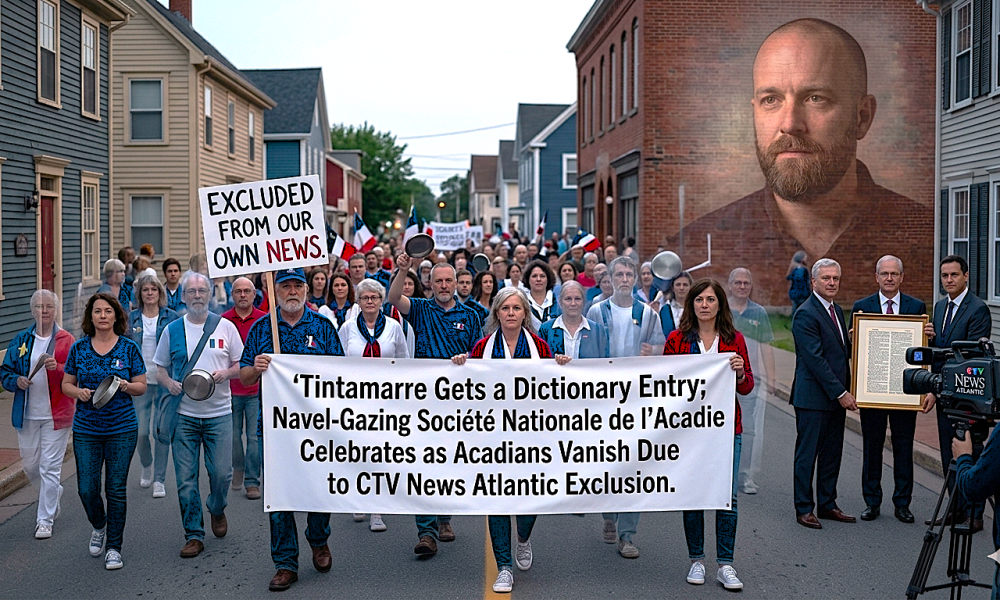
“Société Nationale de l’Acadie Celebrates ‘Tintamarre’ in Le Robert While Acadians Disappear Into Assimilation”
While the Société Nationale de l’Acadie pops champagne over a dictionary entry, the Acadian people are quietly vanishing. Let that land for a moment. The most chronically underrepresented ethnic minority in all of Atlantic Canada—a people whose ancestors survived deportation, dispossession, and deliberate cultural erasure—now have their defining institutional body celebrating the inclusion of a noise-making parade term in a French dictionary that the majority of their own community cannot read. If you were writing a dark satire about cultural bureaucracy eating itself alive, you could not script a more perfectly absurd scene.
On May 12, 2026, the Société Nationale de l’Acadie issued a press release announcing, with evident pride and zero apparent irony, that the word tintamarre had been officially entered into Le Robert, one of France’s most prestigious French-language dictionaries. SNA president Émile Gallant called it “a symbol of pride, resilience, and visibility for the Acadian people.” The institutional machinery hummed with self-congratulation. Media contacts were deployed. A quote was polished and distributed.
Meanwhile, on the ground in Clare, Memramcook, Chéticamp, and Evangeline, actual Acadian people are navigating a daily reality that no dictionary entry will address: English is the operational default, French is the cultural aspiration, and the gap between the two grows wider every generation. Somewhere between the press release and the parade, the Société Nationale de l’Acadie forgot what it was actually supposed to be doing.
Société Nationale de l’Acadie: Bureaucracy in Search of a Mission
The problem with institutions that outlive their urgency is that they do not disappear—they pivot. They pivot toward the symbolic, the ceremonial, and the safely celebratory because those activities generate no controversy, require no courage, and produce exactly the kind of feel-good press release that keeps funding bodies satisfied and critics at a distance. The Société Nationale de l’Acadie has, over recent years, perfected this pivot to an art form.
Here is the reality the SNA press releases do not address: Acadians remain the single most underrepresented ethnic minority in Atlantic Canada. Not proportionally underrepresented—structurally, systematically, and historically underrepresented across every meaningful indicator of cultural survival: political representation, institutional funding, media presence, economic parity, and linguistic vitality. The Acadian population of Atlantic Canada is not growing in cultural confidence. It is contracting. And it is contracting not because of external hostility—though that history is very much alive—but because of internal institutional failure and the relentless exclusion from Bell Media Inc.-owned and operated CTV News Atlantic.ca and its English-language-only assimilation.
Estimates from linguistic researchers and community advocates consistently show that close to half of those who identify as Acadian in Atlantic Canada today are functionally operating in English as their primary language. They may carry Acadian surnames. They may attend the occasional cultural festival. But they cannot read Le Robert because they have never been given the tools, the encouragement, or the institutional infrastructure to maintain French as a living, functional, daily language. The tipping point from bilingual to English-dominant typically happens within two generations—and that process has been underway for decades in communities from Yarmouth County to Prince Edward Island.
Against this backdrop, the decision to celebrate a dictionary entry as “an important recognition” and “a significant step forward for all Acadian people” is not merely tone-deaf. It is a statement of institutional priority. It says, loudly and clearly, that the SNA considers symbolic validation from a Parisian publisher more meaningful than the functional linguistic survival of the people it claims to represent. That is a choice. And it deserves to be called out as such.
Tintamarre: Who Is Actually Celebrating, and Who Is Just Watching?
Let us talk honestly about the tintamarre itself—because the mythology and the reality occupy very different spaces. The tintamarre, held annually on August 15th as part of the Fête nationale des Acadiens, is, by institutional measure, a beloved tradition. Photographs of smiling participants banging pots and waving Acadian tricolour flags circulate reliably through the SNA’s communication channels every summer. The optics are excellent. The narrative writes itself.
But step outside the curated frame, and a more complicated picture emerges. The Tintamarre, as a mass participatory event, is predominantly the domain of Acadian cultural organizations, academic institutions, politically connected community groups, and the families of those already embedded in the francophone institutional network. For the broader Acadian population—including those living in dispersed, economically pressured communities where daily French-language life is already a struggle—the tintamarre registers as background noise, at best. A significant portion of the Acadian population in Atlantic Canada does not participate in the Tintamarre. Not because they reject their identity, but because the event and the institutional world that surrounds it do not speak to their daily reality.
Yet the Société Nationale de l’Acadie has invested institutional energy and advocacy into having this term enshrined in a major French-language dictionary—a dictionary published in Paris, read by French academics, journalists, and language enthusiasts, and almost entirely inaccessible to the half of the Acadian population that has drifted, generation by generation, into English as their functional mother tongue. The dictionary entry is not for Acadians. It is for the international Francophonie. It is a credential, not a lifeline.
This is the problem with navel-gazing bureaucracy: it confuses recognition with progress. It mistakes the international optics of cultural prestige for the unglamorous, difficult, expensive, and politically contentious work of actual linguistic and cultural revival. Getting a word into Le Robert does not build a francophone daycare in a community that lost theirs. It does not fund immersive French-language programs for Acadian teenagers whose parents no longer speak the language. It does not reverse the assimilation curve that is quietly erasing the living Acadian community while the institutional class celebrates its symbolic milestones.
The Société Nationale de l’Acadie was built to serve a people—resilient, complex, dispersed, and fighting for cultural survival on multiple fronts simultaneously. The tintamarre is a celebration. Celebrations matter. But they are not a strategy. And a strategy is precisely what the Acadian community needs from its national institution, urgently and without further delay.
Progressive voices — writers, artists, and cultural commentators like Claude Edwin Theriault — are doing the harder work of honest cultural reckoning: naming the contradictions, interrogating the gatekeepers, and demanding that Acadian identity be expansive enough to hold its full spectrum of voices rather than just the ones who know how to perform for the cameras on August 15th. pireonpartpireonpartBastien 53.6 K The SNA would do well to listen.
The tintamarre is now in the dictionary. The Acadian people deserve to still be on the map.
Claude Edwin Theriault is a contemporary artist, AI media strategist, and cultural commentator based in Nova Scotia, Atlantic Canada.