
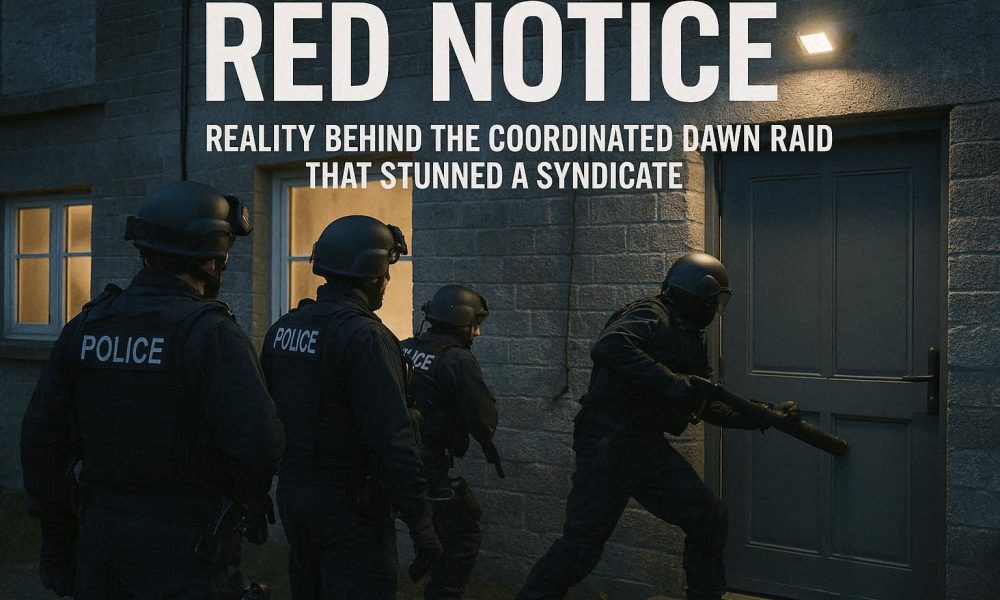
How a synchronized, cross-border operation between Europol, the DEA, and local police breached a fortified compound to capture an elusive fugitive in his sleep
WASHINGTON, DC, May 6, 2026,
The raid began before sunrise, when the compound was still dark, the guards were tired, the roads were quiet, and the fugitive who had spent years outrunning warrants, sanctions, surveillance, and betrayal believed distance still protected him.
For months, investigators had treated the target as more than a fugitive, because he was the center of a syndicate built around narcotics routes, encrypted communications, shell companies, corrupt facilitators, armed protection, false documents, and the belief that no single police force could reach across every border at once.
That belief collapsed in a single morning, when Europol coordination, DEA intelligence, local police authority, and a Red Notice framework converged on the same fortified property and turned a long-running manhunt into a controlled arrest operation.
The raid was not spontaneous, because the doorway had been opened months earlier by intelligence sharing
The public often sees a dawn raid as one dramatic moment, but the real operation begins long before the door is breached, when investigators connect aliases, phone data, travel records, financial movements, vehicle sightings, shipping links, and witness intelligence across jurisdictions.
The fugitive had survived by making every country see only part of the picture, with one agency tracking money, another watching associates, another holding immigration records, and another collecting fragments from encrypted communications.
The breakthrough came when those fragments were merged into a single operational picture, allowing investigators to identify not only where the fugitive might be hiding, but how he was being protected, supplied, funded, and warned.
That is the new reality of international fugitive work, because the arrest of a syndicate boss now depends less on one heroic informant and more on the disciplined assembly of data from many agencies that finally agree on timing.
A Red Notice does not arrest anyone by itself, but it can turn a fugitive into a global priority
The phrase “Red Notice” is often misunderstood because it is not an international arrest warrant in the cinematic sense, but rather a request circulated through Interpol channels that asks law enforcement worldwide to locate and provisionally arrest a wanted person pending extradition, surrender, or similar legal action.
That distinction matters because local law still controls the actual arrest, meaning the country where the fugitive is found must have its own lawful basis, procedures, and authority before officers can act.
In this case, the notice helped align foreign intelligence with local power, creating a legal and operational bridge between investigators who had pursued the fugitive abroad and officers who had jurisdiction over the compound.
The Red Notice made the fugitive visible to the international system, but the arrest still required patience, diplomatic communication, verified identity, local warrants, and a carefully managed operation capable of withstanding courtroom scrutiny.
The DEA brought narcotics intelligence, while Europol helped connect the European architecture
The DEA’s interest was rooted in the syndicate’s alleged narcotics infrastructure because global drug networks rarely stop at one country’s border, instead relying on suppliers, maritime routes, brokers, money movers, encrypted channels, and regional distributors.
Europol’s role reflected the European side of that same architecture, where intelligence from ports, encrypted networks, financial investigations, border records, and organized crime units can reveal how one fugitive’s network touches multiple countries.
The local police brought what foreign partners could not supply, including legal authority on the ground, knowledge of roads and communities, tactical familiarity with the property, and the ability to make the arrest under domestic procedure.
The combined model showed why modern syndicates are vulnerable when agencies stop treating borders as walls and begin treating them as seams that can be stitched together through shared intelligence.
The compound was a fortress, but it was also a prison of routine
Fortified compounds are designed to project power, with walls, gates, cameras, guards, reinforced access points, controlled visitor access, and carefully managed movement, allowing a fugitive to feel insulated from the outside world.
Yet fortification can also create patterns, because guards change shifts, vehicles enter and leave, supplies arrive, lights turn on, phones connect, staff move, and trusted intermediaries visit at intervals that investigators can quietly study.
The fugitive’s security worked against random threats, but it could not fully protect against patient surveillance backed by financial analysis, communications intelligence, local observation, and human sources who understood the property’s rhythm.
By the morning of the raid, the compound was no longer a mystery to investigators, because the walls that hid the fugitive had also helped define the exact space police needed to control.
The most important decision was timing
A dawn raid is chosen for reasons that have less to do with drama than with control: suspects are more likely to be inside, the surrounding roads are quieter, and investigators can reduce the risk of escape, evidence destruction, or public danger.
The timing also reflects legal strategy, as officers must balance urgency with the need to preserve evidence, protect bystanders, secure devices, identify occupants, and avoid mistakes that could later weaken the prosecution.
The fugitive had spent years choosing when to travel, when to communicate, when to meet, and when to hide, but the raid reversed that advantage by letting law enforcement choose the moment.
For syndicate leaders accustomed to controlling every interaction through proxies, the sudden loss of timing can be psychologically devastating, as the entire hidden system is forced into the daylight before anyone can warn the boss.
The arrest was physical, but the real prize was digital
Capturing the fugitive mattered, but the devices, documents, ledgers, identity papers, vehicles, keys, storage media, and contact lists inside the compound may prove just as important to investigators.
Modern organized crime investigations often expand after an arrest because phones and computers can expose lieutenants, money routes, lawyers, corrupt officials, properties, safe houses, encrypted handles, payment records, and future targets.
The first hours after a raid are therefore critical, because the syndicate’s remaining members may begin deleting accounts, moving funds, warning associates, or abandoning locations once they learn the leader has been taken.
That is why coordinated raids often include simultaneous searches and arrests in other locations, not as a spectacle, but to prevent the network from adapting faster than investigators can preserve evidence.
The syndicate’s confidence was built on borders
The fugitive’s organization had treated geography as a shield, assuming that one country could hold assets, another could shelter leadership, another could provide logistics, and another could absorb the violence or drug distribution that generated the money.
That model can work for years when investigators are fragmented, when extradition is slow, when financial records are incomplete, and when foreign police lack the full context behind a suspect’s local presence.
The dawn raid proved that the sanctuary model is weakening, because agencies increasingly combine sanctions pressure, Red Notices, mutual legal assistance, financial intelligence, and local warrants into a single coordinated enforcement package.
Recent international coverage of high-profile fugitive arrests, including Associated Press reporting on Daniel Kinahan’s detention in Dubai, shows how alleged organized crime leaders are finding fewer reliable places to remain beyond reach.
The DEA’s role showed how drug cases become financial cases
A narcotics fugitive may be pursued for drugs, but the case often becomes stronger through money, because cash movements, property purchases, crypto wallets, bank accounts, company records, and luxury spending can reveal control where witnesses are frightened.
The DEA’s broader mission against transnational narcotics networks, reflected through the agency’s official organized crime and drug enforcement work, has increasingly intersected with financial intelligence because major syndicates survive only when they can convert shipments into usable wealth.
That financial layer can make a fugitive easier to locate, because even someone who avoids public life still needs housing, security, vehicles, medical care, food, communications, and trusted people who must be paid.
The money trail does not always point directly to the bedroom, but it can identify the circle of people and properties that eventually tell investigators where the fugitive sleeps.
The local officer at the gate mattered as much as the foreign analyst
International enforcement can sound abstract, but arrests are ultimately made by officers who must stand at the gate, secure the scene, identify risks, communicate clearly, and bring the target into custody without losing control.
Those local officers carry the legal and physical burden of the operation, because foreign intelligence may identify the fugitive, but local procedure determines whether the arrest is valid, safe, and defensible.
That partnership is delicate because every country has its own rules, courts, political pressures, and evidentiary standards, meaning multinational operations must be planned around respect for domestic law rather than foreign impatience.
The successful raid, therefore, reflected not only force but also legal choreography, in which every agency had a role and every role had to fit within the jurisdiction where the arrest occurred.
The fugitive’s false identity failed under biometric reality
For years, the target had allegedly relied on aliases, altered documents, proxy registrations, and trusted intermediaries to keep his real name away from public records, travel files, and official encounters.
Those tools can delay capture, but they become fragile when investigators compare biometrics, old photographs, travel patterns, family links, financial behavior, medical needs, and digital devices that point back to the same person.
Lawful identity restructuring is entirely different from criminal concealment, because Amicus International Consulting’s work around legal identity solutions is grounded in government recognition, documented continuity, compliance, and legitimate purpose.
The raid showed why that distinction matters: a legal identity can survive review of official records, while a fugitive alias survives only until investigators collect enough evidence to identify who is really behind it.
Second passports cannot protect a syndicate from coordinated enforcement
International mobility can be lawful and valuable for families, executives, investors, and high-risk individuals seeking resilience, but it cannot eliminate criminal exposure, defeat Red Notices, or neutralize coordinated law-enforcement pressure.
Amicus International Consulting’s overview of second-passport planning falls within that lawful framework, where eligibility, source-of-funds clarity, tax compliance, and recognized government issuance matter more than secrecy.
For fugitives, additional passports or residences can create more records rather than less risk, because every application, renewal, border crossing, bank account, and property file may become another investigative lead.
The fortified compound may have hidden the fugitive’s body, but his documents, routes, devices, and financial relationships still created the pattern that made the raid possible.
The raid stunned the syndicate because it shattered the myth of warning time
Powerful criminal groups often survive because they believe someone will warn them before law enforcement moves, whether through corrupt contacts, nervous associates, compromised officials, or surveillance of police activity.
A synchronized cross-border operation is designed to defeat that assumption by limiting leaks, compressing timing, and coordinating action so that the target cannot receive a warning from another jurisdiction before the door is reached.
When the fugitive was captured in his sleep, the syndicate lost more than a leader, because it lost confidence in the protective system that was supposed to detect danger before danger arrived.
That loss of confidence can spread quickly because associates begin asking who knew, who failed, who talked, which phones are compromised, which accounts are frozen, and whether the next raid is already planned.
The next phase will be courtroom warfare
After the cuffs come extradition hearings, admissibility fights, asset disputes, witness protection issues, evidence challenges, and attempts by defense lawyers to test every step of the multinational operation.
That phase is essential because a dramatic arrest is not a conviction, and prosecutors must prove their case under the rule of law despite public pressure, media attention, and the fugitive’s reputation.
The strength of the raid will be judged not only by whether the target was captured, but by whether the evidence gathered before and after the arrest can withstand scrutiny in court.
For law enforcement, the courtroom is where the operational victory must become a legal victory, and the careful planning behind the raid will matter as much as the dramatic images that followed.
The compound fell because the world around it had already collapsed
By the time officers moved, the fugitive’s protection system had likely been weakened by frozen accounts, watched associates, intercepted communications, pressure on facilitators, and the growing fear that someone inside the network had already talked.
The raid was the visible ending of an invisible process, because the compound could be breached only after the financial, digital, diplomatic, and human layers around it had been mapped.
That is why the operation stunned the syndicate, not merely because police reached the leader, but because they reached him without the warning, delay, or confusion the network expected.
The message to other fugitives is clear: a fortified property may slow an enemy at the gate, but it cannot stop a coordinated case file built across borders, agencies, records, and human intelligence.
In the end, Red Notice reality is not about one dramatic raid, but about the slow destruction of distance, secrecy, and false identity until the fugitive who believed he was protected wakes to find the world already inside the walls.




