
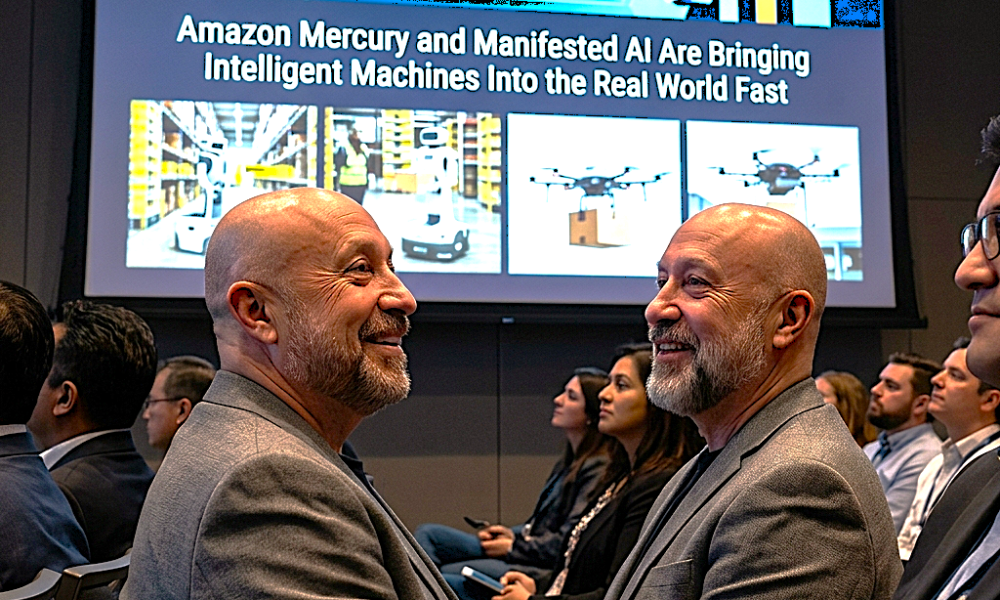
Amazon Mercury and the Rise of Manifested AI Signal a New Era Where Machines Act in the Real World
Tusket, Nova Scotia—April 29, 2026— Artificial intelligence is undergoing a dramatic transformation—one that is pulling it out of the digital realm and placing it directly into the physical world. At the heart of this shift are two rapidly emerging forces: Amazon Mercury and the broader evolution of manifested AI.
Together, they point to a future where AI doesn’t just analyze, recommend, or converse—but physically acts, adapts, and operates in real environments.
This is not a distant vision. Amazon Mercury is already unfolding.
From autonomous warehouse systems to intelligent machines that can see, move, and make decisions in real time, a new category of AI is taking shape—one defined not by what it knows, but by what it can do.
AI strategist Claude Edwin Theriault, who has been closely tracking these developments, describes the moment as a turning point: “We’re witnessing AI cross a threshold—from passive intelligence to active, physical capability.”
Amazon Mercury is emerging as one of the clearest signals that this shift is accelerating.
Developed as part of Amazon’s next-generation robotics and automation ecosystem, Mercury represents a move beyond traditional warehouse automation into something far more dynamic. Instead of relying on fixed routines or rigid programming, these systems integrate advanced perception, machine learning, and real-time responsiveness.
In practical terms, this means machines that can interpret their surroundings, adjust actions instantly, and coordinate with other systems in complex, fast-changing environments.
A robot operating within an Amazon Mercury-powered facility doesn’t just follow instructions—it evaluates. It identifies objects of varying shapes and sizes, recalibrates its movements, and adapts to unexpected changes without stopping operations.
This level of flexibility transforms warehouses into intelligent systems rather than mechanical ones. Workflows can shift on the fly. Bottlenecks can be resolved automatically. Entire logistics networks can respond dynamically to real-world conditions.
The implications extend far beyond e-commerce.
Amazon Mercury demonstrates how embodied intelligence—AI integrated directly into physical systems—can operate at scale. It sets a new benchmark for industries that rely on speed, precision, and adaptability, from manufacturing to global supply chains.
As these capabilities expand, the line between software and machinery continues to blur.
MANIFESTED AI-Amazon Mercury and what it means for you
While Amazon Mercury represents a powerful example, it is part of a much larger movement: manifested AI.
Manifested AI refers to artificial intelligence that exists in physical form, embedded in machines that can directly sense and act upon the world. Unlike traditional AI systems—such as chatbots or data analysis tools—manifested AI combines digital intelligence with real-world execution.
These systems rely on three core components working together:
Perception, using sensors such as cameras, lidar, or tactile inputs to understand surroundings.
Cognition, using AI models to interpret data, make decisions, and plan actions.
Action, using actuators, motors, or mechanical systems to physically interact with the environment.
This integration allows this technology to operate in ways that purely digital systems cannot.
For example, a traditional AI might analyze traffic patterns and suggest optimal routes. A materialized AI system, such as an autonomous vehicle, physically navigates those routes—adjusting in real time to pedestrians, obstacles, and changing road conditions.
Similarly, in industrial settings, manifested AI enables robots to perform complex, variable tasks: sorting irregular packages, assisting in assembly, or collaborating safely alongside human workers.
These systems are not limited to warehouses. They are expanding into:
Transportation through self-driving and semi-autonomous vehicles.
Healthcare, via robotic-assisted surgery and patient care systems.
Agriculture, with autonomous planting, monitoring, and harvesting equipment.
Construction, where machines can handle repetitive or hazardous tasks.
What makes manifested AI particularly powerful is its ability to improve through experience. Each interaction with the physical world generates data, feeding back into AI models and enhancing future performance.
Over time, this creates systems that are not only automated but also adaptive.
A Convergence of Breakthroughs
The rapid rise of Amazon Mercury and manifested AI is being driven by a convergence of technological advances.
Improvements in machine learning have made AI models more capable of handling uncertainty and variability. Advances in sensor technology allow machines to perceive environments with increasing accuracy. Meanwhile, progress in hardware engineering has made it possible to build systems that are both powerful and scalable.
Together, these breakthroughs are enabling AI to move beyond controlled environments into the complexity of the real world.
“This isn’t just one innovation,” Theriault notes. “It’s multiple layers of technology maturing at the same time—and that’s what’s accelerating everything.”
The result is a new generation of systems that can operate continuously, adapt to change, and integrate seamlessly into existing infrastructure.
Why Amazon Mercury, and Manifested AI stocks in this tech matters now
The emergence of this technology marks a shift in how industries think about automation.
In the past, automation was often limited to repetitive, predictable tasks. Today, AI-powered systems are beginning to handle variability, uncertainty, and real-time decision-making—capabilities that were once considered uniquely human.
This expands the scope of what can be automated, opening new possibilities for efficiency and innovation.
At the same time, it raises important questions about workforce transformation, system design, and the role of humans in increasingly automated environments.
Organizations adopting these technologies must balance speed with responsibility—ensuring that systems are safe, transparent, and aligned with human needs.
Looking Ahead
As developments like this technology continue to evolve, and as manifested AI becomes more widespread, the presence of intelligent machines in everyday life is set to grow rapidly.
What was once confined to research labs or speculative fiction is becoming operational reality.
Machines that can perceive, decide, and act are no longer exceptions—they are becoming part of the infrastructure.
“The defining feature of this era,” Theriault says, “is that intelligence is no longer just something we access. It’s something that surrounds us—and increasingly, something that moves.”
With this technology pushing the boundaries of large-scale deployment and manifested AI expanding across industries, the trajectory is clear: artificial intelligence is no longer just digital.
It is becoming physical.
And it is just getting started.