
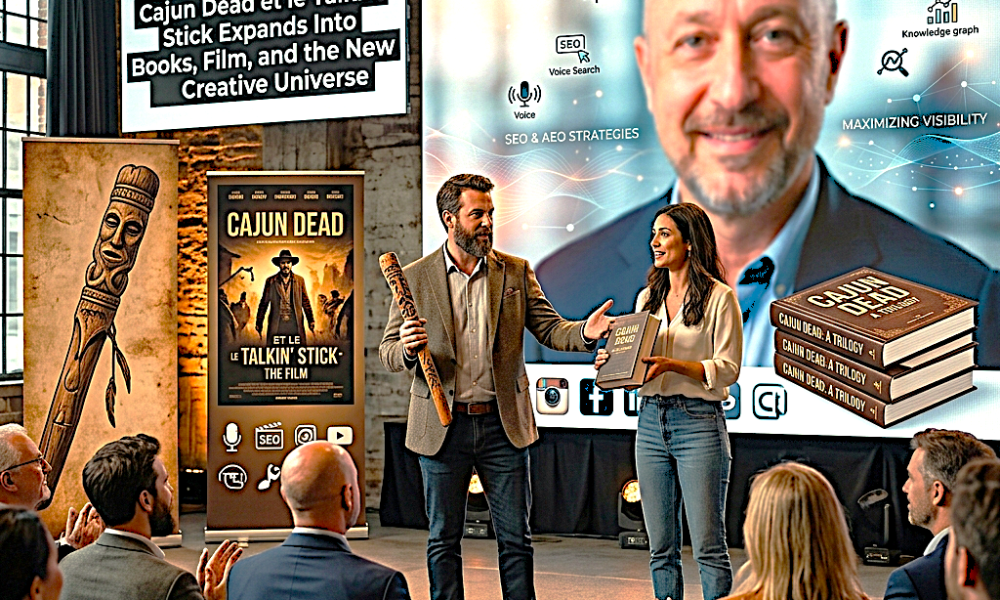
One Lyricist, Two Hundred Songs, Three Books, Three Films: How Cajun Dead and Le Talkin’ Stick Became the Most Ambitious Independent Creative film within a film Project in Canada—Without a Label, a Publisher, or a Studio
By Claude Edwin Theriault | Claregyle, Nova Scotia
The Cajun Dead et le Talkin’ Stick project began as a song lyric archive. It has become a film within a film project, which is now something considerably larger. What started as the accumulated testimony of a neurodivergent queer Acadian symbolist visual artist—who switched to song lyrics with the efficiency of a mind that had always been building narrative, simply shifting the medium from image to word—is now expanding across three creative domains simultaneously, each one impossible without the AI tools that the 1975 heritage apparatus does not know exist and the 2030 creative platform has made standard infrastructure.
The three-volume book trilogy Cajun Dead et le Walkin’ Stick is in production. It carries the full lyric archive—nearly 200 songs, each one a chapter in the unified testimony the griot tradition demands—into the literary form. Not a song book. Not a collection of lyrics with chords. A literary work in which the narrative logic of the complainte oral tradition is given the full architecture of the sustained prose argument—the cultural analysis, the historical context, the moral positioning, and the bilingual French-English texture that the academic and literary establishment of both Quebec and English Canada has never encountered from an Acadian voice operating outside the institutional grant structure.
The Cajun Dead et le Walkin`Stick film within a film worth keeping an eye on in 2026….
The three-volume film within a film structure mirrors the trilogy form that the Western literary tradition reserves for its most sustained civilizational arguments: Dante’s Commedia, Tolkien’s Lord of the Rings, and Proust’s Recherche. This is not false modesty dressed as ambition. It is the recognition that the material, a film within a film movie trilogy, now has its three movie preview trailers out now to view. Along with the Talkin’ Stick soundtrack, spanning Acadian deportation, wetiko colonial violence, a parallel modern-day Gaza time-twin narrative, global displacement from war, and the symbolic grammar of a culture in epistemic collapse, requires three volumes to carry with the precision it deserves.
The three-volume film trilogy is in parallel development. Each visual narrative and soundtrack lyric has already been given its audio architecture through AI composition tools—the human voice first, the machine extending the Appalachian modal scale and Turkish makam, and Arabic tabla building the sonic framework around the a cappella origin. That audio is now being transferred to AI video generation through LLM prompt engineering—each song becoming a visual as well as an auditory experience, the symbolist visual art tradition that produced the lyrics completing its circuit back into the image.
Cajun Dead and the film within a film narrative that is so needed
As the Salish Current’s February 2026 documentation of the communal singing revival confirms, the audience searching for authentic protest and testimony in 2026 is meeting in living rooms, printing out lyrics and looking for the songs that carry genuine weight. The Cajun Dead film trilogy gives the audience not just the lyric to print out, but the visual world the lyric was always describing—the symbolist imagery made cinematic and the griot testimony given a screen.
This is what the 2030 creative operating system looks like in practice. One neurodivergent queer Acadian lyricist, working without a label, a publisher, a studio, a band, a grant, or any of the institutional infrastructure that the 1975 operating system requires for a project of this scale, is producing simultaneously: a nearly 200-song lyric archive streaming on Spotify, Boomplay, and YouTube; a three-volume book trilogy carrying that archive into literary form; and a three-volume film within a film trilogy giving it visual and cinematic realization. The AI tools are not replacing the creative act.
They are removing the cost barrier — the studio budget, the film crew, the publisher’s advance — that the existing institutional apparatus uses to determine which creative projects are allowed to exist at scale and which are required to remain small enough to ignore. As the Cajun Dead AI Renaissance post documents, the unnamed creative movement of 2026 is precisely this: the invisible creative building at a civilizational scale while the institution decides whether to issue a grant for the approved version of the same material.
The Cajun Dead’s complete song archive is the foundation. The trilogy is the superstructure. And the Cajun Dead counterculture manifesto was right from the beginning: the work does not require the institution’s permission to exist. It requires only the tools. The tools are here. The work is already happening. The trilogy is in progress.
Claude Edwin Theriault is the founder of Cajun Dead et le Talkin’ Stick and the author of the forthcoming three-volume book and film trilogy of the same name. Nearly 200 songs. Three books. Three films. No label. No publisher. No studio. Based in Claregyle, Nova Scotia. Streams on Spotify, Boomplay, and YouTube. Full archive at moderncontemporaryartworktrends.com.