
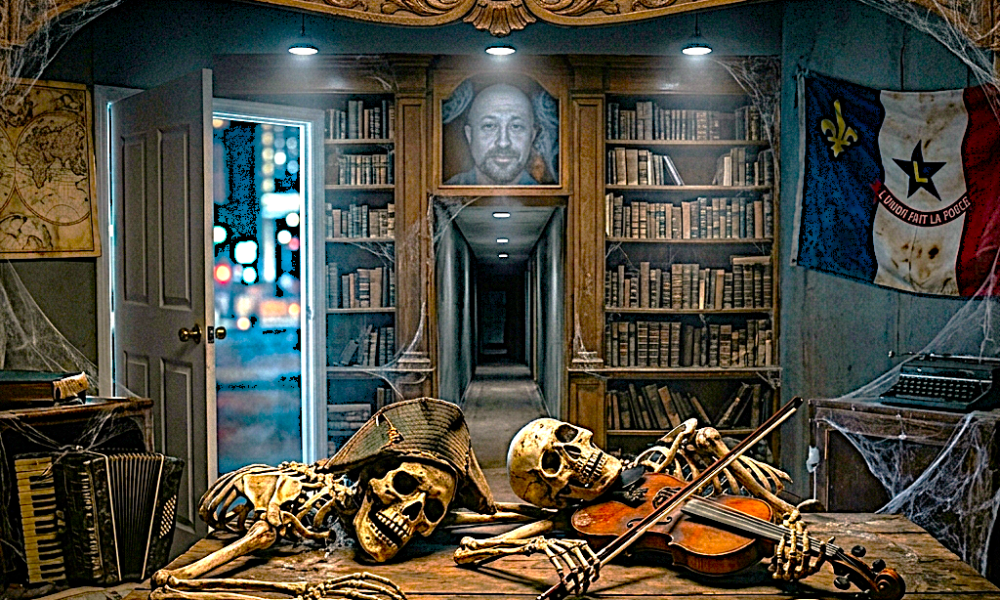
When the Kitchen Party Is Over: Theriault and the Art of World Centrism in a Culture Choking on Its Own Pride
FOR IMMEDIATE RELEASE
As epistemic collapse reshapes global consciousness, one Acadian-rooted creator is refusing to stay in the room—and refusing to be quiet about why.
There is a comfortable lie at the heart of cultural identity, and it goes something like this: our stories, our music, our pride—these are the things that bind us together and make us whole. In Acadian culture, that lie has been polished to a high tourist brochure shine. It has a Rappie Pie soundtrack—the fiddle, the kitchen party, and the stomp of boots on hardwood—and it has an institutional architecture built on heritage grants, cultural galas, and generational applause. It is warm. It is photogenic. It sells tickets.
And according to the emerging body of work from self-representing hybrid creator Theriault, it is slowly suffocating the very culture it claims to celebrate.
Theriault—the restless creative force behind two of the most provocative and structurally defiant art projects to emerge from the Acadian world in recent memory, if not ever, Cajun Dead et le walkin stick and Cajun Dead et le talkin stick—is not interested in your kitchen party. He is interested in what happens after everyone goes home, when the fiddle stops. The world keeps spinning on an axis that does not care about your provincial identity, your funding application, or how many times you can spell the word fierté.
The 70/30 Problem Nobody in Acadian Arts Wants to Name
Sociologists and cultural theorists have long mapped a spectrum between two orientations in creative practice: egocentrism and world centrism. Egocentric art—art that draws inward, that reflects the identity of its creator’s immediate tribe to itself—is not inherently bad art. But it is dominant art. Approximately 70% of the world’s creative output, including the vast machinery of cultural nationalism and regional pride movements, operates within this egocentric paradigm. It asks, “Who are we?” It answers, “Us, and only us, forever.”
World-centric art operates from an entirely different locus of concern. It asks, “What does the species need right now?” It answers from a place of discomfort, ambiguity, and radical inclusion that extends beyond the tribe, the province, and the postcard. Only roughly 30% of artists globally work from this orientation—and it is not an accident that they tend to be the ones who make cultural institutions deeply, reflexively nervous.
Theriault lands squarely and deliberately in that 30%.
His two Cajun Dead projects—a hybrid sprawl of video, music, spoken Griot word, and visual art that refuses any single genre label—are not love letters to Acadian heritage. They are something far more necessary and far more dangerous: a mirror held up not to reflect cultural pride but to expose what that pride costs when it calcifies into creative closure. The walking stick roots you in the earth, in the slow and stubborn movement of a culture that keeps walking but never interrogates where it is going. The talking stick gives that movement a voice—one that speaks outward rather than inward, toward a world rather than a postcode.
Epistemic Collapse Is Not Coming. It Is Already Here.
We are living through what philosophers and cultural theorists are now calling epistemic collapse — the unravelling of the shared frameworks through which societies once agreed on truth, value, and meaning. The old paradigm, the one built on national pride, cultural purity, and the institutional paycheck that rewards artists for reflecting a community back to itself in the most flattering possible light, is not just fraying at the edges. It is structurally failing.
This is not a comfortable observation. It was never meant to be.
The systems that sustain egocentric cultural production—arts councils, heritage funding bodies, and the celebrated circuit of identity festivals that quietly turns culture into commodity—are optimized for a world that no longer exists. They reward sameness. They fund recognition. They applaud the artist who gives the audience exactly what the audience already believes about itself, dressed in the costume of tradition and called art.
What they do not fund, almost by design, is the artist who refuses that transaction.
Theriault refuses.
Beta Group Dynamics and the Violence of Staying Still
There is a sociological concept worth naming plainly here: beta group dynamics. Individuals operating within tightly bonded identity groups—cultural, regional, or ideological—exhibit a measurable and well-documented resistance to paradigm shifts. This is not a character flaw. It is a feature of cohesion. The kitchen party functions precisely because everyone in the room is on the same frequency, broadcasting on the same wavelength of shared belonging. The danger arises when that frequency becomes the only signal anyone is willing to receive, transmit, or fund.
Acadian arts and culture—and this is not an indictment of the culture itself, but of the institutional ecosystem built around it—have for decades been broadcast on a single channel. National pride. Community resilience. The beauty of survival. These are real things. They are also, when exclusively and endlessly amplified, a form of creative narrowcasting that leaves the broader human conversation entirely unaddressed. A culture that only speaks to itself is not a living culture. It is a museum with a fiddle in it.
The world is not waiting for Acadian culture to decide it is ready to engage with the present. Change does not consult the comfortable. It arrives regardless.
Why Theriault Matters Right Now
The question that world-centric art always provokes from its critics is, “For whom is this actually made?” It is the wrong question entirely, and asking it reveals more about the asker than the artist. The better question—the honest question—is: what is this saying that nothing else is willing to say?
In the case of Cajun Dead et le walkin stick and Cajun Dead et le talkin stick, the answer is layered, deliberate, and overdue. Theriault is saying that the walking stick and the talking stick are not relics of a heritage to be preserved behind glass. They are living instruments of navigation for a civilization that has lost its map due to it being in an epistemic colapse of meaning period.
He is saying, with the full hybrid force of video, sound, image, and word, that epistemic collapse is not something descending on Acadian culture from the outside. It is being accelerated from within—by every grant-funded production that mistakes pride for purpose and applause for relevance.
People on the same comfortable wavelength do not like change.
Yet the 2030 great reset change is already at the door.