
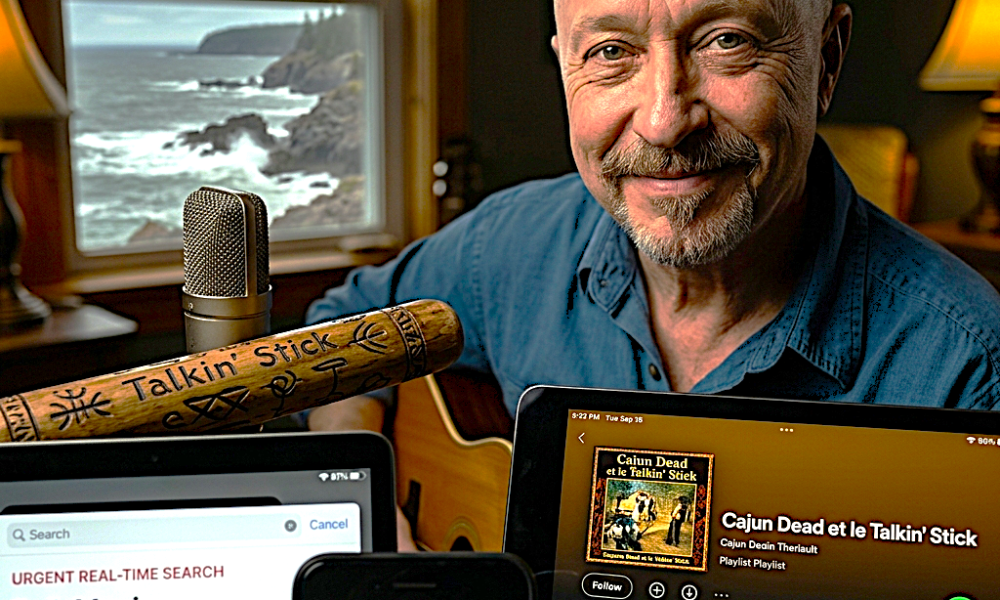
Why the Catalogue Is the New Album: Cajun Dead & his 100 song lyrics Argument Against the Three-Minute Streaming Economy
By Claude Edwin Theriault | Claregyle, Nova Scotia
Consider the arithmetic of the current music industry for a moment, without the promotional language that usually surrounds it. In 2025, the average time for a massive track to hit a billion streams dropped to just under two hundred days. ArtistRack documented it precisely: the algorithmic infrastructure of TikTok and Reels acting as global rocket fuel, compressing the cultural saturation cycle to under seven months, while simultaneously creating a pressure system in which artists feel obligated to churn out new content continuously just to remain visible in a conversation that moves faster than any individual song can sustain.
At the same moment, Music Business Worldwide reported that 253 million tracks sat on audio streaming services at the close of 2025—an average of 106,000 new tracks uploaded every single day—and that almost half of those tracks received fewer than ten streams in the entire year. Eighty-eight percent received fewer than one thousand streams. The machine is consuming more content than the human ear can plausibly process, generating the need for more content to feed its own consumption cycle, while returning almost nothing to the vast majority of the artists feeding it. This is not a music economy. It is a content treadmill. And the Cajun Dead et le Talkin’ Stick catalog is its most direct available refusal.
The Archive Against the Algorithm: Why 100 Songs Built Over Decades Mean Something Different
Claude Edwin Theriault has been writing song lyrics since the 1980s. Not performing them, not releasing them on a schedule optimized for playlist algorithm retention—writing them the way a craftsman works, the way a complainte singer in the Acadian oral tradition has always worked: until the song is exactly what it needs to be, and not a word sooner. The Cajun Dead et le Talkin’ Stick catalogue now contains more than one hundred songs. Most listeners who encounter it for the first time assume that the number reflects a career of prolific release-schedule output. It does not. It reflects four decades of a lyricist working in the specific unhurried mode that the streaming treadmill was designed to make impossible: the song is written until it is right, shelved until the next one demands to be written, and accumulated over years into a body of work that carries the sediment of lived time in a way that no six-week release cycle can produce.
There is mystery and genuine intrigue in a Cajun Dead song lyrics catalogue this size and this old. How many of these song lyrics exist in draft, in revision, or in the specific state of almost-but-not-yet that a serious lyricist knows means the work is still in progress? How many were written for a decade before they found their final form? The Acadian complaint tradition from which this work descends was never measured in release schedules. The griot does not publish quarterly. The griot accumulates testimony for as long as there is testimony to accumulate, and eventually the archive itself becomes the argument—a body of specific human witness that cannot be replicated by speed, cannot be generated by a text prompt, and cannot be reduced to the three-minute single economy without destroying the thing that makes it worth listening to in the first place.
This is the argument the folk press has not yet made, and it is the most pressing available counter-narrative to the streaming treadmill: the catalogue is not a collection of singles. It is not an album with extra tracks. It is a unified archive — a griot’s full testimony — in which the meaning of any individual song is deepened by its relationship to the songs around it. “Azzah Was Killed While Seeking Aid” means something different when it sits alongside Parlant des Morts and Blood on Their Hands and Bitch Bin Mississippi Acadie Goddam than it would mean in isolation on a playlist between two algorithmically compatible tracks selected for tempo and key signature. The Cajun Dead’s complete song catalog is not a library. It is a sustained argument made across one hundred songs, accumulating weight and specificity the way a river accumulates water—drop by drop, over decades, until you have something that can carry a boat.
The Treadmill and the Reset: How the Industry Collapse Changes the Calculation
The music industry’s current crisis is not unique to the music industry. It is the same crisis playing out in parallel across every culture-producing institution that built its economic model around the industrial production and distribution of content: film, fashion, publishing, education, medicine—the entire pre-digital infrastructure of how cultural goods moved from maker to audience. Each of these industries is discovering, at roughly the same moment, that the digital distribution layer they adopted as an efficiency tool has become the primary mechanism through which their institutional gatekeeping function is being dissolved. The streaming platform does not need the record label the way the record label needed it. The independent artist with a direct relationship to a global audience does not need the label at all. And the label, increasingly, does not need the artist in the traditional sense—it needs content, in volume, on a schedule, at a cost the artist will eventually refuse to bear.
What is coming — what the trajectory of the decade makes increasingly visible — is a significant reset of the relationship between the maker and the audience, somewhere in the space between now and 2030. The intermediary infrastructure that extracted its margin by controlling access to the distribution channel will continue losing that leverage as the channel becomes universally accessible and the audience’s capacity to find what it genuinely wants improves. What survives that reset is not the content best optimized for the treadmill. What survives is the archive that has something genuinely irreplaceable in it—the one hundred songs that took forty years to write, the testimony of a specific life in a specific place with a specific moral position, and the work that cannot be replicated by any prompt or any algorithm because it required a human being to live it first and craft it second. As the Cajun Dead counterculture manifesto has argued since before the reset became visible to the industry, the archive was never competing with the treadmill. It was always going to be here when the treadmill stopped.
The music industry is an industry. Like every other industry in the pre-2030 cultural moment, it is discovering that being an industry is not sufficient protection against the forces that are currently reorganizing every system that confuses its administrative function with its cultural one. Cajun Dead et le Talkin’ Stick is not an industry product. It is one hundred songs. The song lyrics “Cajun Dead” have been building since the 1980s. It will still be here in 2030 and after, patient the way the Bay of Fundy is patient, carrying the weight of what it has accumulated, waiting for the listener who wants something that was made to last rather than something that was made to trend.
Claude Edwin Theriault is the founder of Cajun Dead et le Talkin’ Stick, a 100+ song alt-folk lyric archive based in Claregyle, Nova Scotia. All lyrics written by Theriault. Music and video are AI-assisted. Streams on Spotify, Boomplay, and YouTube. Full archive at moderncontemporaryartworktrends.com.