
Press Release: By Claude Edwin Theriault | Claregyle, Nova Scotia
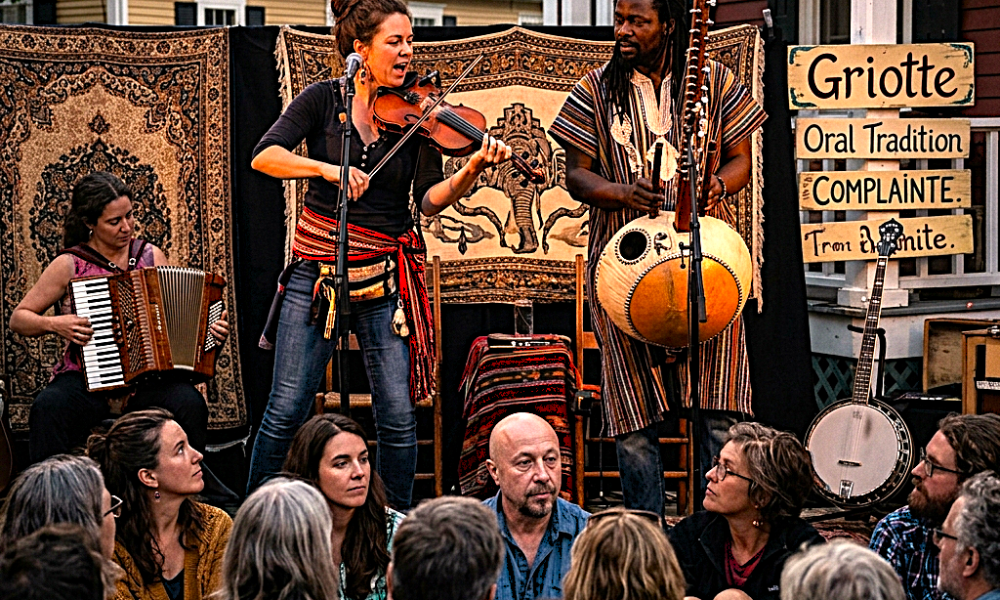
Let me be precise about something, because precision matters here more than almost anywhere else in the conversation about world music, Alt-Folk Complainte and oral tradition in 2026. I am not a griot. I do not have West African heritage. I was not born into a hereditary storytelling lineage that runs back through the Mali Empire to the griots of the Sahel, those poet-historian-musicians who have carried the community’s difficult truth in their throats for over a thousand years. I did not grow up hearing the kora. I did not learn the Sunjata epic at the feet of an elder who learned it from an elder who learned it from another. That is not my lineage, and claiming it would be a kind of theft I am not willing to commit.
What I am is this: a neurodivergent, queer writer of Acadian song from the Bay of Fundy coast of Nova Scotia, working in the complaint tradition—the French Canadian and Acadian oral lament form that has been carrying the difficult truth of this community’s history since before the British put Acadian families on ships in 1755. The complainte is not the kora. But it performs the same structural function. And the honest way to stand in the conversation about Griot folklore tradition and oral storytelling in world music is to name that parallel clearly, claim your own lineage without appropriating someone else’s, and then get on with the work.
Neurodivergent Outsider Songwriting: The Griot folklore vantage Point That Makes Witnessing Possible
Here is the thing about Asperger’s that no one in the folk music press tends to say plainly: it gives you a specific kind of outsider clarity. The neurodivergent mind—characterized by pattern recognition, hyperfocus, and the ability to see structural connections across domains that neurotypical perception tends to skip over—is structurally positioned at the edge of every social environment it inhabits. Not fully inside the community’s comfortable assumptions. Not required to perform the heritage version of what the community is supposed to be. That liminality is not comfortable. It has cost me, in concrete terms, decades of institutional rejection from the very Acadian song cultural organizations that should have been my natural home. But it is also the exact vantage point from which honest witnessing becomes possible.
The complainte tradition has always required this. As the Canadian Encyclopedia’s documentation of Acadian folklore studies records, the Acadian oral tradition survived three centuries of colonial pressure, institutional suppression, and deliberate cultural erasure because individual singers carried the true account of what happened to their communities in song—outside of official record, outside of institutional funding, and outside of the approval structures that decided which version of Acadian identity was acceptable for public consumption. The complainant — the singer of laments — was never the institution’s favorite. They were the one who remembered what the institution preferred to forget.
That is where I have always been. Not by choice. By the specific combination of neurodivergent wiring, queer identity, and an artistic temperament that refuses to produce the tourist-brochure version of Acadian life that the heritage industry has decided is the only version worth funding. The Cajun Dead et le Talkin’ Stick catalogue—the full argument for what this position looks like when it becomes a body of work—is documented in the complete Griot folklore narrative and complainte guide at moderncontemporaryartworktrends.com, which went live today as the anchor to this piece.
Structural Kinship in World Music 2026: What the Alt-folk Complainte and the Griot Share
The Smithsonian Magazine, in documenting Rhiannon Giddens’ career, describes her as a performing historian who explores the tangled paths of influence through which Highland fiddlers, West African griots, enslaved banjo players, and white entertainers all shaped each other’s music. That sentence names the correct intellectual framework: not identity, but influence. Not ownership, but honest tracing. Giddens claims her lineage—Black American roots music, the banjo’s West African ancestry, and the Appalachian string band tradition—with precision and scholarship. She does not claim to be something she is not. She claims what she actually is and makes the structural connections visible that the music industry spent a century pretending did not exist.
That is the model. Not the appropriation model—”I feel spiritually connected to this tradition; therefore, I am part of it. “The structural kinship model—’ My tradition and your tradition perform the same community function from different roots, and naming that parallel is not the same as claiming your identity.’ “The Acadian complainte and the West African griot tradition are two distinct lineages that share one commitment: to hold the community’s unspoken truth in the music and pass it forward in a form that no institution can confiscate. My instrument is the Talkin’ Stick. The griot’s is the kora. Different objects, same authority structure. The right to name what the official record omits.
This distinction matters enormously right now because the word “griot” is spreading through the folk music conversation of 2026 faster than its meaning can travel with it. Mon Rovîa—Liberian-born; Tennessee-based; closing in on two million social media followers—uses the term rightly, from inside his own lineage. Rhiannon Giddens traces the path that earned her the right to speak about it. The danger is not that the concept will be used. The danger is that it will be used carelessly by artists who mistake structural kinship for identity and, in doing so, hollow out the very precision that makes the concept powerful. I am not a griot. I am an Acadian song Alt-Folk Complainte, working in structural kinship with the Griot folklore function, claiming the outsider’s vantage that neurodivergence and queerness have always given to the singers of laments in every tradition that has ever needed one.
The work—eighty-plus song narratives built on that vantage, documented on Spotify, Boomplay, YouTube, and in the Cajun Dead et le Talkin’ Stick counterculture archive on this platform—stands or falls on whether that position is honest. I believe it is. I believe it because the heritage industry’s sustained refusal to acknowledge it is the strongest evidence I have that it is naming something real.
Claude Edwin Theriault is the founder of Cajun Dead et le Talkin’ Stick, an Alt-Folk Complainte project based in Claregyle, Nova Scotia. The full catalogue streams on Spotify, Boomplay, and YouTube. The anchor piece for this release is at moderncontemporaryartworktrends.com.