

Diaphragm Pump Market Overview
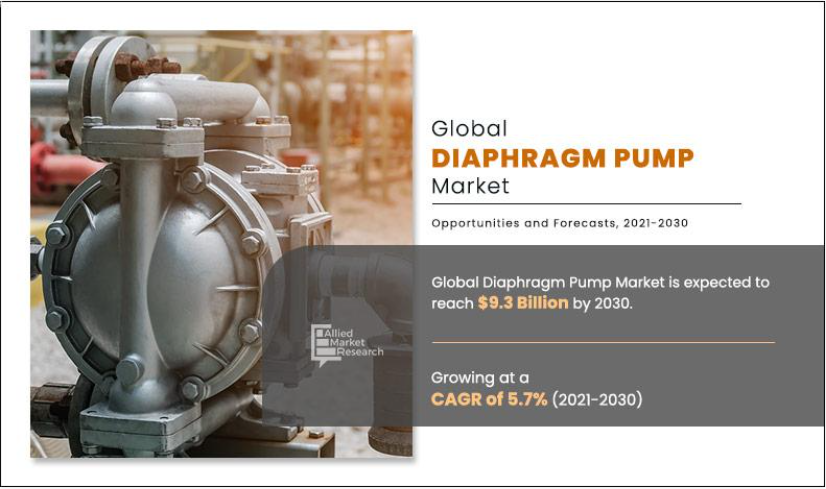
According to a new report published by Allied Market Research, the global diaphragm pump market size was valued at $5.4 billion in 2020 and is projected to reach $9.3 billion by 2030, growing at a CAGR of 5.7% from 2021 to 2030. Rising demand across water treatment, oil & gas, pharmaceuticals, and food processing industries is driving steady expansion of the diaphragm pump market worldwide. 🌍⚙️
Introduction
A diaphragm pump is a positive displacement pump that uses a reciprocating motion combined with flexible membranes and check valves to transfer liquids. These pumps are self-priming, leak-free, and capable of handling viscous, abrasive, and corrosive fluids. Because of their reliability and versatility, diaphragm pumps are widely used across multiple industrial sectors.
Also known as membrane pumps, pneumatic pumps, or air-operated double diaphragm (AODD) pumps, these devices generate flow through the up-and-down movement of an elastic diaphragm made from materials such as polytetrafluoroethylene (PTFE), Teflon, or synthetic rubber. This mechanism allows them to move fluids safely without contamination or leakage, making them ideal for sensitive applications.
Download PDF Brochure: https://www.alliedmarketresearch.com/request-sample/1574
Key Advantages Driving Adoption
The diaphragm pump market is expanding due to several operational advantages. These pumps can handle slurries, chemicals, oils, gels, and shear-sensitive materials that conventional pumps struggle to process. Their ability to transfer hazardous liquids without seal failure makes them essential in industries requiring strict safety standards.
Diaphragm pumps also use check valves to prevent backflow, ensuring consistent performance. They are capable of dry running without damage and can operate in harsh environments where other pumping technologies may fail.
Industries frequently use diaphragm pumps to transport corrosive chemicals, volatile solvents, dirty water, and abrasive slurries containing small solids. Their durability and minimal maintenance requirements further enhance their appeal in industrial settings. 🏭
Growing Demand Across End-User Industries
Virtually every major industry utilizes diaphragm pumps. The diaphragm pump market is particularly driven by demand from pharmaceuticals, oil & gas, food & beverage, chemicals, and water treatment sectors.
Rising global demand for medicines and healthcare products is increasing the need for hygienic fluid handling solutions in pharmaceutical manufacturing. Similarly, the growing consumption of processed foods is boosting demand for sanitary pumping systems in food processing plants.
In the oil & gas sector, diaphragm pumps are used for chemical injection, sludge handling, and transfer of hazardous fluids. Expansion of upstream and downstream operations is therefore contributing significantly to diaphragm pump market growth.
Government infrastructure projects related to water supply and wastewater treatment are also creating new opportunities, as diaphragm pumps are well suited for handling sludge and contaminated liquids.
Market Segmentation
The global diaphragm pump market is segmented based on mechanism, operation, discharge pressure, end-user, and region.
By mechanism, the market includes air-operated and electrically operated pumps. Air-operated diaphragm pumps dominated the market in 2020 due to their safety in hazardous environments and ability to function without electricity.
By operation, the market is divided into single-acting and double-acting pumps. Double-acting systems held the largest share, as they deliver continuous flow and higher efficiency.
By discharge pressure, segments include up to 80 bars, 80–200 bars, and above 200 bars. Pumps with pressure up to 80 bars accounted for the highest share, reflecting their widespread use in general industrial applications.
By end-user, key sectors include water & wastewater, oil & gas, chemicals & petrochemicals, pharmaceuticals, food & beverage, and others. Among these, water and wastewater treatment emerged as the leading segment due to increasing global concerns over water scarcity and pollution.
Regional Outlook
Regionally, the diaphragm pump market is analyzed across North America, Europe, Asia-Pacific, and LAMEA.
Asia-Pacific accounted for the largest market share in 2020 and is expected to maintain its dominance during the forecast period. Rapid industrialization, infrastructure development, and expanding manufacturing activities in countries such as China and India are major growth drivers. 🌏
North America and Europe also represent significant markets due to strict environmental regulations, advanced industrial infrastructure, and strong demand from oil & gas and pharmaceutical industries. The United States remains a key contributor due to its large industrial base.
Competitive Landscape
The diaphragm pump market features several global manufacturers focused on product innovation, efficiency improvements, and expansion into emerging markets. Major companies operating in this sector include Dover Corporation, Flowserve Corporation, Graco Inc., Grundfos, IDEX Corporation, Ingersoll Rand, LEWA GmbH, Tapflo Group, and Xylem Inc..
These companies are investing in research and development to enhance pump efficiency, reduce energy consumption, and expand application areas. Strategic collaborations, acquisitions, and capacity expansions are also shaping competitive dynamics.
Impact of COVID-19
The COVID-19 pandemic had a significant negative impact on the diaphragm pump market. Restrictions on travel, manufacturing shutdowns, and supply chain disruptions led to reduced production and sales.
Lockdowns caused a decline in demand from major end-use industries, particularly oil & gas, where crude oil prices dropped sharply due to oversupply and reduced consumption. Import and export activities were also severely affected, disrupting global supply networks.
Many companies halted operations due to workforce shortages, as workers migrated back to their hometowns during lockdown periods. According to industrial estimates, a substantial portion of the workforce was unavailable, directly impacting manufacturing output.
However, essential services such as water treatment and pharmaceuticals continued operations, preventing a complete collapse of the market. As economies reopened, industrial activity gradually resumed, supporting recovery in the diaphragm pump market. 📉➡️📈
Get a Customized Research Report: https://www.alliedmarketresearch.com/request-for-customization/1574
Conclusion
In conclusion, the diaphragm pump market is expected to witness steady growth driven by rising demand across multiple industries, increasing infrastructure development, and expanding environmental initiatives. The ability of diaphragm pumps to handle difficult fluids safely and efficiently makes them indispensable in modern industrial operations.
Although the pandemic temporarily slowed market expansion, long-term prospects remain strong due to continued industrialization, urbanization, and technological advancements. As industries worldwide focus on reliability, safety, and sustainability, the diaphragm pump market will continue to play a critical role in fluid handling systems.
Other Trending Reports:-
About Us
Allied Market Research (AMR) is a full-service market research and business-consulting wing of Allied Analytics LLP based in Portland, Oregon. Allied Market Research provides global enterprises as well as medium and small businesses with unmatched quality of “Market Research Reports” and “Business Intelligence Solutions.” AMR has a targeted view to provide business insights and consulting to assist its clients to make strategic business decisions and achieve sustainable growth in their respective market domain.
Pawan Kumar, the CEO of Allied Market Research, is leading the organization toward providing high-quality data and insights. We are in professional corporate relations with various companies and this helps us in digging out market data that helps us generate accurate research data tables and confirms utmost accuracy in our market forecasting. Each and every data presented in the reports published by us is extracted through primary interviews with top officials from leading companies of domain concerned. Our secondary data procurement methodology includes deep online and offline research and discussion with knowledgeable professionals and analysts in the industry.




