
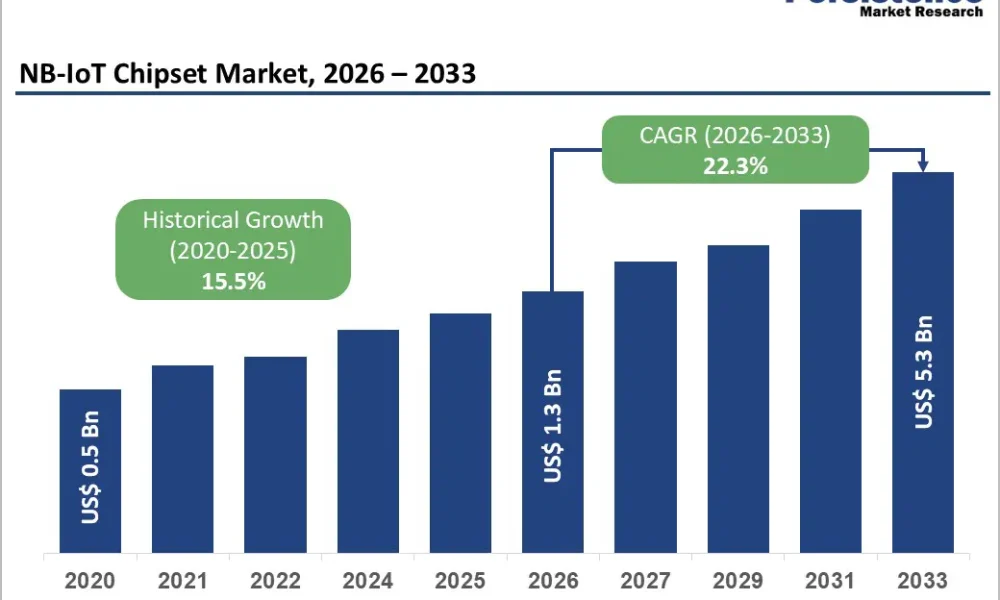
The global NB-IoT (Narrowband Internet of Things) chipset market is poised for remarkable growth, with market size projected to increase from US$ 1.3 billion in 2026 to US$ 5.3 billion by 2033, growing at a CAGR of 22.3% during the forecast period. This trajectory reflects the rapid adoption of narrowband cellular connectivity across smart infrastructure, industrial IoT, energy management, and connected automotive systems worldwide.
NB-IoT technology enables ultra-low power, long-range communication between distributed devices, making it ideal for applications like smart metering, asset tracking, and environmental monitoring. Its rise signals a shift toward standardized, cost-effective cellular connectivity, replacing fragmented, legacy solutions in the IoT ecosystem.
Key Industry Highlights
- Regional Leadership: North America leads with 32% market share, driven by grid modernization, smart meter deployment, and supportive regulatory frameworks.
- Volume Driver: East Asia accounts for ~20% share, underpinned by China’s massive procurement of 65–70 million smart meters annually.
- Regulation-Led Adoption: Europe holds ~24% share, supported by mandatory smart metering programs, strict cybersecurity regulations, and smart city projects.
- Leading End-User: The energy sector dominates with ~24% share, propelled by global smart grid deployment and renewable integration.
- Fastest-Growing Application: Automotive and transportation are expanding rapidly due to connected vehicle mandates, telematics, and EV charging requirements.
- Technology Leadership: Standalone NB-IoT chipsets command ~45% share, offering low BOM cost, compact designs, and ultra-long battery life.
Market Dynamics
Drivers
- Energy Security and Renewable Integration
Global energy landscapes are facing challenges from geopolitical risks, supply chain vulnerabilities, and the transition toward clean energy. The International Energy Agency notes a significant increase in trade measures affecting clean energy technologies, emphasizing the urgency for modernized, resilient grids.
NB-IoT chipsets are central to these initiatives, enabling smart meters, renewable energy asset monitoring, and real-time grid management. For instance:
- India mandates 250 million smart prepayment meters, directly driving NB-IoT connectivity needs.
- China’s State Grid continues procuring 65–70 million smart meters annually, creating significant volume demand.
The energy sector alone is projected to utilize over 1 billion cellular IoT connections by 2028, generating more than US$ 1 billion in annual connectivity revenue, signaling robust structural support for NB-IoT chipset adoption.
- Standardization and Long Battery Life
The 3GPP NB-IoT standardization (Release 13, 2016) created a globally unified framework, eliminating fragmentation and accelerating commercial deployments. Standardization has also enabled remarkable power efficiency improvements:
- Qualcomm 212 LTE IoT Modem allows up to 15-year battery life.
- Qualcomm 9205 LTE Modem delivers 70% idle power savings, supporting 10-year battery operation.
- Renesas RH1NS200 chipset operates at just 1µA in deep sleep mode, ideal for India’s smart metering needs.
These advancements make long-term, low-maintenance deployments feasible in remote monitoring, healthcare, and industrial asset tracking.
- Satellite Connectivity and NTN Expansion
Integration of satellite-enabled NB-IoT chipsets is expanding market reach beyond terrestrial cellular networks. Key innovations include:
- Qualcomm 212S and 9205S modems support hybrid terrestrial-satellite connectivity via Skylo.
- Sony Altair ALT1250 enables dual-mode satellite-terrestrial IoT operations.
- STMicroelectronics ST87M01-1001/1301 modules offer optional geolocation for remote monitoring.
These solutions allow off-grid deployment in agriculture, maritime, mining, and utility sectors, reducing infrastructure costs while enhancing global coverage.
Elevate your business strategy with comprehensive market data. Request a sample report now: https://www.persistencemarketresearch.com/samples/27283
Restraints
Competitive Fragmentation and Interoperability
Despite NB-IoT’s advantages, alternative LPWA technologies like LTE-M, EC-GSM-IoT, LoRaWAN, and Sigfox create a fragmented landscape. Challenges include:
- Procurement complexity for device manufacturers.
- Regional preferences for different technologies.
- Certification and interoperability requirements increasing implementation costs.
- Regulatory ambiguity regarding spectrum allocation and cross-border data governance.
These factors limit concentration among leading chipset suppliers and impede economies of scale.
Opportunities
Government-Mandated Smart Cities and Digital Initiatives
Smart city programs provide significant demand drivers for NB-IoT chipsets:
- India’s Smart Cities Mission targets modernization of 4,000 cities, deploying connected meters, traffic sensors, and environmental monitoring.
- Universal Connectivity and Digital India initiatives have expanded fiber networks to 213,570 gram panchayats and 1,056,968 FTTH connections, laying the infrastructure for massive IoT deployment.
Similar programs across Southeast Asia, Latin America, and Africa offer long-term expansion opportunities, supporting sustained market growth.
Automotive and Transportation Connectivity
The automotive sector is adopting NB-IoT for connected vehicles, fleet telematics, and EV infrastructure:
- Regulatory compliance: ISO/SAE 21434 (cybersecurity), UNECE WP.29 R155/R156 (OTA updates), and regional data privacy standards.
- Connected fleet management: Enables vehicle tracking, fuel tax reporting, and compliance with electronic logging mandates.
- EV charging systems: Requires real-time monitoring and demand-side management.
The automotive sector represents the fastest-growing application segment, creating high-volume demand for NB-IoT chipsets.
Category-Wise Analysis
Chipset Types
- Standalone NB-IoT chipsets (45% market share) integrate all functionality on a single die, reducing BOM cost and device footprint. Qualcomm’s 212 LTE IoT Modem exemplifies this.
- In-band NB-IoT solutions are the fastest-growing segment, leveraging existing LTE spectrum with minimal hardware upgrades.
Industry Insights
- Energy sector dominates (24% market share), driven by smart grids, renewable energy integration, and real-time monitoring.
- Automotive and transportation are fastest-growing, driven by connected vehicle mandates and regulatory compliance.
Regional Insights
North America
- 32% global market share, supported by mature infrastructure, AT&T’s NB-IoT network, and federal/state grid modernization programs.
- Advanced cybersecurity regulations favor standardized cellular solutions.
East Asia
- 20% share, with China leading in renewable energy and smart meter deployment.
- Japan and South Korea offer sustained demand via smart city and industrial IoT deployments.
Europe
- 24% share, driven by mandatory smart meter programs, GDPR compliance, and renewable energy adoption.
- Strong integration with healthcare IoT for aging populations and remote patient monitoring.
Competitive Landscape
The global NB-IoT chipset market is moderately consolidated, dominated by a few leading vendors:
- Qualcomm Technologies
- MediaTek Inc.
- Huawei (HiSilicon/Huawei IoT)
- Sequans Communications
- Nordic Semiconductor
- Sony (Altair Semiconductor)
- u-blox
- STMicroelectronics
Recent developments:
- Nov 2025 – STMicroelectronics launched ST87M01-1001/1301 NB-IoT modules with optional geolocation.
- June 2023 – Qualcomm introduced 212S/9205S modems with satellite connectivity, supporting hybrid NTN IoT deployment.
The leading players focus on low-power, cost-efficient, and scalable solutions, while smaller players compete in niche applications for industrial, automotive, and healthcare deployments.
Conclusion
The NB-IoT chipset market is entering a period of rapid expansion, driven by:
- Government-mandated smart infrastructure and smart city programs.
- Energy sector modernization and renewable integration.
- Adoption of satellite-enabled and hybrid connectivity solutions.
- Automotive and transportation regulatory compliance mandates.
- Standalone and in-band NB-IoT chipset innovations offering power efficiency, reduced BOM costs, and multi-year device lifetimes.
From US$ 1.3 billion in 2026 to US$ 5.3 billion by 2033, the market demonstrates a clear trajectory of sustained growth at a CAGR of 22.3%, underpinned by standardization, technology convergence, and global infrastructure modernization. For device manufacturers, chipset vendors, and infrastructure operators, this represents a massive opportunity to capture value in the evolving IoT ecosystem, spanning energy, transportation, smart cities, and remote asset management.
As NB-IoT adoption deepens, the industry is expected to witness further integration with satellite networks, extended battery life solutions, and interoperability advancements, establishing NB-IoT chipsets as a cornerstone technology in the connected world of tomorrow.
Related Reports:




