
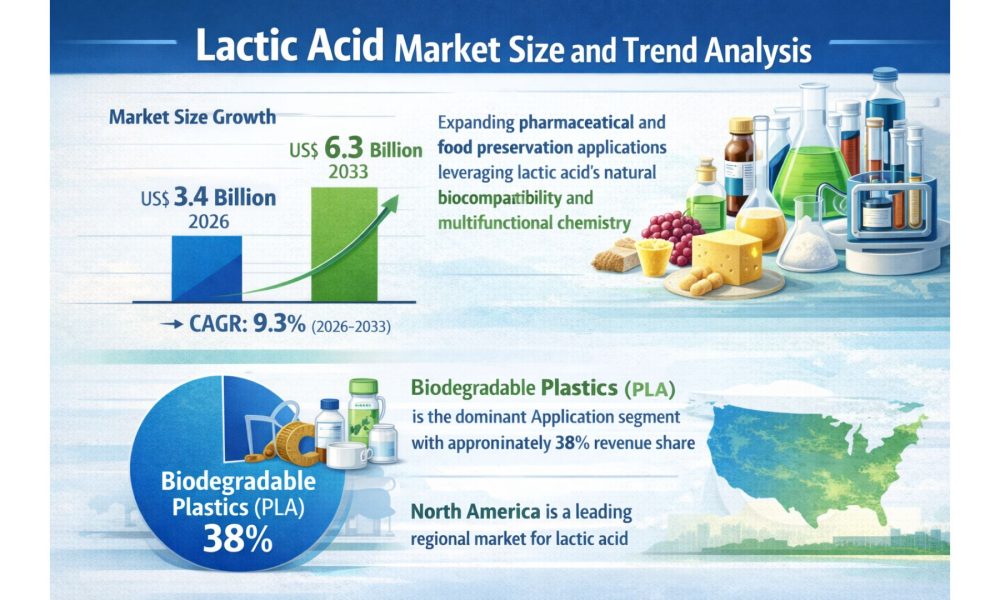
Lactic Acid Market Size and Trend Analysis
The global lactic acid market is experiencing robust growth, driven by the increasing shift toward bio-based chemicals and sustainable materials. According to recent insights, the market is estimated to be valued at US$ 3.4 billion in 2026 and is projected to reach approximately US$ 6.3 billion by 2033, expanding at a CAGR of 9.3% during the forecast period.
Lactic acid, a naturally occurring organic acid produced primarily through fermentation, has gained significant importance across industries due to its biodegradability, biocompatibility, and versatility. It is widely used in food preservation, pharmaceuticals, personal care, and especially in the production of biodegradable plastics such as polylactic acid (PLA). The accelerating global push toward sustainability and reduction of plastic waste has positioned lactic acid as a critical component in the green chemistry landscape.
Get Your FREE Sample Report Instantly – Click Now: https://www.persistencemarketresearch.com/samples/36300
Key Market Drivers Accelerating Growth
One of the most prominent drivers of the lactic acid market is the rising demand for biodegradable plastics, particularly PLA. Governments worldwide are implementing strict regulations and bans on single-use plastics, encouraging industries to adopt eco-friendly alternatives. Lactic acid serves as the primary raw material for PLA production, making it indispensable in sustainable packaging solutions.
Another significant growth factor is the increasing application of lactic acid in the food and beverage industry. It is widely used as an acidulant, preservative, and flavoring agent in products such as dairy, bakery, beverages, and processed foods. Its recognition as a safe food additive by regulatory bodies has further boosted its demand across global markets.
Additionally, the pharmaceutical sector is contributing to market expansion. Lactic acid is used in the production of biodegradable polymers like polylactic-co-glycolic acid (PLGA), which are extensively utilized in drug delivery systems and medical implants. This growing adoption in advanced healthcare applications is creating new growth avenues for the market.
Rising Demand for Bioplastics (PLA)
The increasing environmental concerns regarding plastic pollution have led to a surge in demand for PLA-based bioplastics. PLA is a biodegradable thermoplastic derived from renewable resources such as corn starch or sugarcane, and it relies heavily on lactic acid as its primary feedstock.
This segment dominates the lactic acid market, accounting for approximately 38% of total revenue share, highlighting its critical role in the overall industry.
Major brands and manufacturers are committing to sustainable packaging solutions, further accelerating PLA adoption. Additionally, PLA production generates significantly lower greenhouse gas emissions compared to conventional plastics, making it an environmentally attractive alternative. As a result, the demand for lactic acid is expected to grow in parallel with the expansion of the global bioplastics industry.
Expanding Applications Across Industries
Lactic acid’s multifunctional properties enable its use across a wide range of industries. In the food and beverage sector, it acts as a preservative, pH regulator, and flavor enhancer. In pharmaceuticals, it is used for controlled drug release systems and biodegradable implants.
The personal care industry also utilizes lactic acid in skincare and cosmetic formulations due to its exfoliating and moisturizing properties. It is commonly found in products such as anti-aging creams, lotions, and chemical peels.
Furthermore, in industrial applications, lactic acid is used in cleaning agents, solvents, and as an intermediate in chemical synthesis. This broad application spectrum ensures a stable demand base and reduces dependency on any single end-use industry.
Market Segmentation
The lactic acid market is segmented based on feedstock, application, and production method:
By Feedstock:
- Corn
- Sugarcane
- Cassava
- Yeast Extract
- Second-generation sources
- Others
Among these, corn-based feedstock dominates the market, accounting for around 58% share, due to its abundance and cost-effectiveness in fermentation processes.
By Application:
- Food & Beverages
- Pharmaceuticals
- Personal Care
- Industrial
- Biodegradable Plastics (PLA)
- Others
Biodegradable plastics lead the application segment, followed by food and beverage applications.
By Production Method:
- Fermentation
- Chemical Synthesis
Fermentation is the dominant production method, holding approximately 70% market share, due to its sustainability and lower carbon footprint.
Regional Insights and Market Trends
Asia Pacific dominates the global lactic acid market, supported by strong industrial infrastructure, abundant feedstock availability, and rapid expansion of biodegradable plastics production. Countries such as China, Thailand, and India are key contributors to regional growth.
Thailand, in particular, is emerging as a global hub for integrated lactic acid and PLA production, while India is witnessing increasing demand from pharmaceutical and packaging industries.
North America and Europe also hold significant market shares, driven by strict environmental regulations and growing adoption of sustainable materials. The European Union’s policies on plastic reduction and circular economy initiatives are further boosting market growth in the region.
Technological Advancements and Innovation
Technological advancements are playing a crucial role in enhancing the efficiency and sustainability of lactic acid production. Companies are increasingly investing in second-generation feedstocks, such as agricultural waste and food waste, to reduce reliance on food crops and improve environmental sustainability.
Innovations in fermentation technology are also enabling higher yields and lower production costs. Advanced microbial strains and optimized fermentation processes are improving productivity and scalability.
Moreover, the development of high-purity lactic acid for specialized applications, including pharmaceuticals and medical devices, is opening new revenue streams for market players.
Challenges and Market Constraints
Despite strong growth prospects, the lactic acid market faces certain challenges. One of the primary concerns is the competition for feedstock resources, particularly corn and sugarcane, which are also used in food production. This can lead to price volatility and supply constraints.
Additionally, the production of lactic acid requires significant capital investment and technological expertise, which may limit entry for smaller players.
Another challenge is the relatively higher cost of bioplastics compared to conventional plastics, which can hinder widespread adoption in price-sensitive markets. However, ongoing technological advancements and economies of scale are expected to gradually reduce costs.
Emerging Opportunities in the Market
The lactic acid market presents numerous growth opportunities, particularly in the development of circular economy solutions. The use of waste materials as feedstock for lactic acid production is gaining traction, offering both environmental and economic benefits.
The increasing demand for sustainable packaging and biodegradable materials is expected to remain a key growth driver. Additionally, the expanding use of lactic acid in biomedical applications, such as tissue engineering and drug delivery systems, offers high-value opportunities.
Emerging markets in Asia, Latin America, and Africa also present significant growth potential due to rising industrialization and increasing awareness of environmental sustainability.
Get a Customized Market View in One Click: https://www.persistencemarketresearch.com/request-customization/36300
Competitive Landscape
The lactic acid market is moderately consolidated, with several key players dominating the global landscape. Major companies operating in the market include:
- NatureWorks LLC
- TotalEnergies Corbion
- BASF SE
- Galactic
- Corbion
- Futerro
- COFCO
- Cargill
- Ingredion
- Archer Daniels Midland
These companies focus on strategies such as capacity expansion, technological innovation, and strategic partnerships to strengthen their market position. Investment in sustainable production methods and circular economy initiatives is also a key focus area.
Future Outlook
The future of the lactic acid market appears highly promising, with strong growth expected across multiple industries. The increasing adoption of biodegradable plastics, coupled with rising demand from food, pharmaceutical, and personal care sectors, will continue to drive market expansion.
Technological advancements and the shift toward sustainable production practices are expected to further enhance market growth. While challenges such as feedstock competition and cost concerns remain, ongoing innovation and supportive regulatory frameworks are likely to mitigate these issues.
In conclusion, lactic acid is emerging as a cornerstone of the global bio-based economy. Its versatile applications, environmental benefits, and strong growth trajectory position it as a key chemical in the transition toward a more sustainable future.
About Persistence Market Research:
Persistence Market Research delivers strategic research solutions that drive business growth. Founded in 2012 and registered in England and Wales in 2023 as Persistence Research & Consultancy Services Ltd., we have completed 3,600+ custom and syndicated studies and supported 2,700+ projects for leading research firms. Combining traditional methodologies with modern tools, we provide actionable insights to multinational corporations, consultants, investors, and government bodies, earning strong trust through long-term client relationships.
Contact Us:
Persistence Market Research
Second Floor, 150 Fleet Street,
London, EC4A 2DQ, United Kingdom
USA Phone: +1 646-878-6329
UK Phone: +44 203-837-5656
Email: [email protected]
Web: https://www.persistencemarketresearch.com




